
Propagation of Thanh Chuong black olive
(Baonghean) - In recent years, black olives have been considered a valuable specialty fruit. However, the lack of quality seedlings has affected yield and fruit quality. Therefore, propagating black olives is a necessary undertaking.
In Nghe An province, the black olive tree is distributed in several districts such as Thanh Chuong, Do Luong, Anh Son, and Tan Ky. Among these, the black olives from Thanh Chuong are considered the highest quality. Many people in communes such as Phong Thinh, Cat Van, Thanh Nho, Hanh Lam, Thanh Duc, Thanh Thuy, Thanh Tien, and Thanh Lien consider this crop a way to alleviate poverty. Annual monitoring shows that each mature tree yields over 100 kg of fruit, currently priced at 45,000 - 50,000 VND/kg. If each household has 5-6 trees in their garden, they can earn 20-25 million VND per year, even with trees aged 10-15 years. Black olive trees grown in Thanh Chuong district have good growth and development potential. Many trees have very high yields and good quality fruit, bringing significant income to farmers.
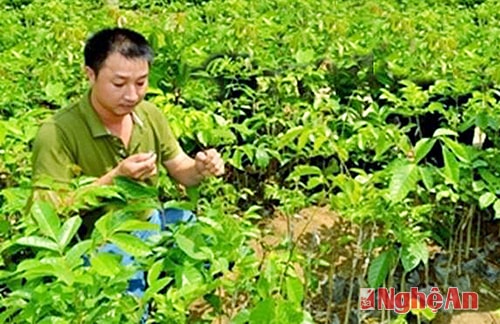 |
| Grafting is being carried out to propagate black ebony trees in Thanh Chuong. |
However, the black olive trees currently found in the districts are mostly naturally growing or grown from seeds by local people. These trees are not selectively bred or properly cared for, resulting in unstable yields – some years good, some years bad – and inconsistent fruit quality. Most trees produce low-quality fruit, with astringent or sour tastes; some even have fruit that doesn't ripen or only partially ripens. Trees grown from seeds take a long time to bear fruit (7-8 years), and their tall canopy makes harvesting, care, and pest control difficult. However, the biggest challenge currently facing the development of black olive trees is the lack of high-quality seedlings, including in Thanh Chuong district. Therefore, applying scientific and technological advancements to propagate black olive trees through grafting to create high-quality seedlings, shortening the time to fruiting, and subsequently establishing demonstration models to promote the widespread cultivation of black olive trees in Thanh Chuong district is essential. The project "Applying scientific and technological advancements to breed and develop black olive trees in Thanh Chuong district" is being implemented by the Gia Lam Vegetable and Fruit Experimental Research Center under the Central Institute of Vegetable and Fruit Research. The goal is to protect and promote the local black olive seed source, and to establish nurseries for producing black olive seedlings among the local population.
Propagation by grafting shortens the time to fruiting and revives the cultivation of black olive trees in Thanh Chuong district. This method has the advantage of grafted trees bearing fruit quickly (fruiting begins in the third year after planting), seedlings inheriting good characteristics from the mother tree, a high propagation rate, and trees with a low canopy frame, making them convenient for care, harvesting, and pest and disease control. Specifically, a nursery model for producing black olive seedlings has been established in Thanh Lien commune.
In 2013, the Provincial Agricultural Extension Center, in coordination with the Gia Lam Vegetable and Fruit Experimental Research Center, transferred and supplied grafted seedlings, planting 1.5 hectares in Bac Thanh commune (Yen Thanh district). After nearly a year of planting, the trees are growing and developing well. According to the plan, in September 2014, 2 hectares will be planted in Khai Son commune (Anh Son district) using an agroforestry model. This model involves planting non-timber forest products with both economic goals and environmental protection, contributing to mitigating climate change.
Text and photos:Nguyen Huu Duc


