
Scaling up effective fisheries extension models.
Over the years, aquaculture throughout the country has faced numerous challenges stemming from both objective and subjective factors. Despite these challenges, many successful models have emerged and deserve to be replicated.
The Tay Son Dynasty in Binh Dinh Province is a typical example.
In 2012, the Department of Labor, War Invalids and Social Affairs of Binh Dinh province invested in expanding effective production models for poor households in Tay Son, Phu Cat, Hoai An districts, and other areas.
Tay Son is one of the exemplary models of poverty reduction, with its bio-secure free-range chicken and duck farming model and improved extensive freshwater fish farming. The model was implemented in Dong Sim village, Tay Xuan commune. According to the Tay Son Agricultural Extension Station: Dong Sim is a poor village, located near the mountains, more than 5km from the commune center. It has large pond areas, and each household has a spacious garden suitable for aquaculture and livestock farming. The station selected two models: bio-secure free-range chicken farming and improved extensive freshwater fish farming, which both utilize natural conditions and ensure stable output. With 100% government support for purchasing breeding stock, feed, and disease prevention and treatment for livestock, poor households in Dong Sim enthusiastically participated. In August 2012, on an area of 5,000m2, the households released 10,000 fish fry, earning a profit of nearly 35 million VND.
In 2013, the improved extensive freshwater fish farming model continued to be expanded in Phu Lam village, Tay Phu commune. Mr. Nguyen Van Canh (Phu Lam village) said that his family has been raising fish in this pond for 9-10 years and has never seen the fish grow so quickly and healthily; in less than two months, the fish reached the size of those raised normally for 5-6 months. Mr. Lam Van Lanh, Head of the Labor, War Invalids and Social Affairs Department of Tay Son district, said that the poverty reduction models in Tay Son district have equipped the poor with new production knowledge, helping them see the effectiveness so that they can apply the new methods on a scale suitable for each family. These models have also been replicated in many other households, helping to change lives and escape poverty.
Positive signs in Dak Lak
In recent years, the model of raising red-tailed catfish in floating cages in large lakes and hydroelectric reservoirs in Dak Lak has proven the economic value of this specialty fish, considered one of the best in the Mekong catfish family. With a selling price of 150,000 - 200,000 VND/kg, many red-tailed catfish farming models have generated billions of VND in income annually. Notable examples include the models of Mr. Tran Van Kiem (Hamlet 2) and Mr. Hoang Quoc Bai (Hamlet 5), Hoa Phu commune, Buon Ma Thuot city. In 2005, their families started raising catfish experimentally. With only 300 fish, they earned over 200 million VND in the first year. Based on this success, the Hoa Phu Catfish Club was established in July 2009 with 16 members, and now has 22 members, with some members harvesting approximately 1 ton of catfish annually.
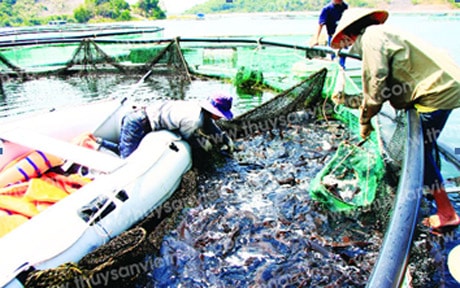
Fish farming in hydroelectric reservoirs opens up new opportunities for many localities.
Photo: Huy Hung
Many other households raise more than 1,000 fish individually, such as the model of Mr. Nguyen Ninh Tuan (Ea Kao commune, Buon Ma Thuot city). Since 2007, he has rented the surface of Ea Kao lake and built cages to raise red-tailed catfish. Initially, with 3 cages, each containing about 1,500 fish, he earned a profit of over 100 million VND. Expanding the scale, he now has 40 cages of red-tailed catfish, each cage yielding about 1.5 tons of fish per year. Mr. Tuan said that raising red-tailed catfish has low disease risks; with a selling price of 150,000 VND/kg, he earns more than 4 billion VND per year.
For the past three years, in addition to the Vietnam Salmon Farming Group, more than 40 households have been raising fish at the Buôn Tua Sah hydroelectric reservoir. Initially, they only raised catfish, carp, and snakehead. For over a year now, many households have been raising red-tailed catfish; some have already harvested their first batches, earning hundreds of millions of dong in profit. At its peak, the Buôn Tua Sah reservoir covers 4,200 hectares, and even during the dry season, over 1,000 hectares are utilized. Mr. Y Krang Ndu, Chairman of the Krông Nô Commune People's Committee, said that the effectiveness of the red-tailed catfish farming models by households in the floating villages of the Buôn Tua Sah hydroelectric reservoir is opening a new direction for the local fisheries industry. The commune will support farmers in maximizing the potential not only of the hydroelectric reservoir but also of hundreds of other irrigation ponds and lakes.
Making a fortune from salt fields and fish ponds.
This is the salt-making and grouper farming model of Mr. Nguyen Van Gia (An Thanh, An Ngai, Long Dien, Ba Ria - Vung Tau). With 10 hectares of salt fields, he leases out 7 hectares, earning over 160 million VND in profit annually. On the remaining 1 hectare, he applies a clean salt production model using tarpaulin sheets. The average yield is over 100 tons/ha. With an average selling price of 1 million VND/ton, after deducting expenses, he earns a profit of 80 million VND.
Because salt production is only possible during the dry season, Long Dien district has implemented crop rotation models such as raising tiger prawns and fish during the rainy season. Mr. Nguyen Van Gia, one of the first salt farmers to adopt this model, said: After the salt season, he switches to raising grouper, starting in May. Each season, he buys and releases 1,000 fingerlings, spending 40 million VND on feed and other expenses, and earns a profit of over 35 million VND. Thus, with the salt field-fish pond rotation, his family's income reaches 225 million VND per year. He is currently providing regular employment for 5 workers with an income of 2.5 - 3 million VND per month. In addition, he shares his experience and techniques in producing clean salt and expands the crop rotation model.
According to Vietnam Fisheries - LC


