
"First Cờn, second Quả..."
(Baonghean) - Over two days (February 18th and 19th, corresponding to the 19th and 20th of the first lunar month of the Year of the Horse), two regional festivals, the Quả Sơn Temple Festival and the Cờn Temple Festival, took place in the districts of Đô Lương and Quỳnh Lưu. Each festival had its own unique characteristics, attracting a large number of people and tourists from all over, creating a lively and bustling atmosphere while still maintaining a solemn and respectful atmosphere.
(Baonghean) - Over two days (February 18th and 19th, corresponding to the 19th and 20th of the first lunar month of the Year of the Horse), two regional festivals, the Quả Sơn Temple Festival and the Cờn Temple Festival, took place in the districts of Đô Lương and Quỳnh Lưu. Each festival had its own unique characteristics, attracting a large number of people and tourists from all over, creating a lively and bustling atmosphere while still maintaining a solemn and respectful atmosphere.
In Boi Son commune (Do Luong district), although the opening ceremony of the Qua Son Temple Festival officially began at 8 am, a large number of local people had already gathered at the temple by 6 am to light incense and wait to participate in the activities of the ceremony. Despite being over 80 years old and having witnessed the ups and downs of the temple in his hometown as well as many festivals, Mr. Le Ngoc Trung from Hamlet 6, Boi Son commune, was still present very early at Qua Son Temple to join the crowds from all over. Mr. Trung happily said: “I am proud to be born in Bach Ngoc, where the famous and sacred Qua Son Temple, dedicated to Uy Minh Vuong Ly Nhat Quang, is located. Every year, after Tet (Lunar New Year) and the full moon of the first lunar month, we eagerly await the Qua Son Temple Festival. My family and many other families in the hamlet and commune are very willing to contribute funds and labor to renovate the temple to make it more beautiful, so that the festival becomes more solemn and joyful.”
Traveling nearly 30km to attend the ceremony, Ms. Tran Thi Van from Hamlet 10, Cao Son Commune (Anh Son District) shared: “Although I live far away, every year, during the Quả Sơn Temple Festival, I always come here to participate in the procession. Quả Sơn Temple is a famous and sacred temple for the people of Do Luong and Anh Son, and I find the activities at the festival to be serious, solemn, joyful, and exciting.” Prior to this, over two days (January 18th and 19th of the lunar calendar), locals and tourists were immersed in the vibrant atmosphere of sporting activities such as women's volleyball, wrestling, and traditional boat races upstream on the Lam River. In addition, this year's festival featured a new activity: stalls displaying specialties of the Do Luong region such as rice crackers and peanut candy from Do Luong town, My Son sweet potatoes, Giang Son Dong sugarcane syrup, Hong Son fermented bamboo shoots, etc., attracting many visitors to view and purchase goods. These products not only promote the specialties of the people of Do Luong, but also serve as meaningful gifts for tourists from all over to give to friends and relatives.
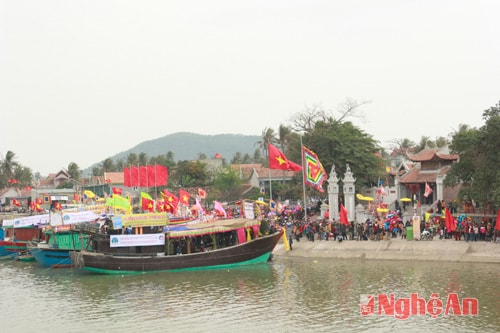 |
| Scenes from the Cờn Temple Festival in 2014. Photo: Triều Dương |
At exactly 8:00 AM, the sound of drums and gongs echoed from the temple grounds, guiding locals and tourists to the opening ceremony of the festival. In his opening speech, Mr. Nguyen Minh Hanh – Vice Chairman of the People's Committee of Do Luong District – spoke of the contributions of Uy Minh Vuong Ly Nhat Quang – the revered figure worshipped at Qua Son Temple: “For 21 years, including 16 years as the Prefect of Nghe An, with his benevolent and people-oriented policies, Ly Nhat Quang made a great contribution to consolidating and building Nghe An from a border region into a major stronghold, a solid fortress in terms of military, economic, and cultural aspects, not only for the Ly Dynasty but also for subsequent dynasties…”
In Do Luong district, Ly Nhat Quang made significant contributions to encouraging people to cultivate rice, raise silkworms, weave silk, and raise many buffaloes, cows, and horses. He also encouraged people in riverside and coastal areas to build boats and develop fishing and seafood harvesting, facilitating trade between regions. He also paid attention to the people's cultural and spiritual lives by repairing and building many temples and pagodas. Today, Nghe An province has over 30 temples dedicated to Ly Nhat Quang, honoring him as the tutelary deity, including Qua Son Temple. "First Corn, second Qua, third Bach Ma, fourth Chieu Trung" - Qua Son Temple has been considered one of the four largest temples in Nghe An province and is revered as the "foremost sacred temple." At the beginning of the 20th century, Qua Son Temple became a large complex of seven buildings and 40 rooms in the Ly-Tran architectural style and was classified as a National Historical and Cultural Monument by the Ministry of Culture and Information.
Following the ceremonial part of the Quả Sơn Temple Festival are unique activities. First, there is a parade of both naval and land forces – recreating the heroic training spirit of the soldiers under King Uy Minh in ancient times. Then comes the most spectacular part: the procession of King Uy Minh's ancestral tablet from Quả Sơn Temple to give thanks at Bà Bụt Pagoda (also known as Tiên Tích Temple), located 4km west of the temple in Lam Sơn commune. Legend says that Bà Bụt frequently provided divine assistance to Lý Nhật Quang in his governance and guided him to the place of enlightenment and sainthood at the foot of Quả Sơn mountain. The procession travels upstream along the Lam River and by land through five villages in three communes of Bạch Ngọc (Bồi Sơn, Ngọc Sơn, and Lam Sơn). In each village, the people organize solemn ceremonies to pay their respects to the King.
Despite the long walk and the slippery dirt roads caused by the previous night's rain, a large number of people joined the procession from the very beginning. Along the route, more and more people joined, creating a procession stretching over a kilometer. Those unable to participate crowded the alleys and streets, searching for a suitable spot to observe the entire procession. Ms. Thai Thi Hong from Ngoc Son commune said: "From early morning, my sisters and I prepared chairs on the second floor of our house so we could observe the procession from afar and record images without our view being obstructed." Nguyen Thi Hong Vinh, a lecturer in the History Department of Vinh University and a visitor to the festival, commented: "I have participated in many festivals in the province, and I find that the beauty of the Qua Son Temple Festival lies in the fact that the ceremonial part is not overshadowed by the festive part, attracting a large number of people to participate. The activities of the festive part are orderly, joyful, and exciting."
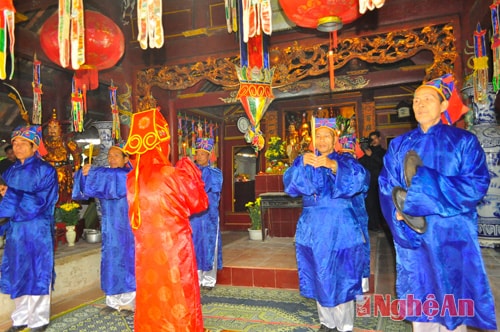 |
| A thanksgiving ceremony at Ba But Pagoda during the Quả Sơn Temple festival. Photo: Minh Quân |
In Quynh Phuong ward, Hoang Mai town, blending in with the crowds gathering from all over, we carried with us feelings of both excitement and curiosity, as it was our first time attending a festival of the riverine region, deeply rooted in the culture of the fishermen – the Corn Temple Festival.
Historical records state that the temple was built in the 13th century to worship the Four Holy Mothers. Despite wars and the ravages of time, the two temple areas, the Inner and Outer Temples, although not retaining much of their original architecture, still retain their ancient, imposing, and unique character. During their lifetimes, the two kings, Tran Anh Tong and Le Thanh Tong, would visit the temple to offer prayers before embarking on their campaigns. Later kings such as Le Loi and Quang Trung also sent their close advisors to offer sacrifices before going into battle. With 35 royal decrees bestowed upon it by various dynasties, the value of the Corn Temple truly lives up to its folk name, "the most magnificent in Corn."
Cờn Ngoài Temple, where the main activities take place, is located near the Lạch Cờn estuary. For generations, hundreds of fishing boats from the Quỳnh Lưu coastal region have docked here daily. The people of Quỳnh Lưu (formerly) and Hoàng Mai town (now) still believe that, thanks to the protection of the temple's deity, the higher powers, and the blessings of their ancestors, their sea voyages are safe, with favorable weather and calm seas. And true to the traditional customs of the coastal people, the Fishing Prayer Ceremony, a ritual praying for a new year of favorable weather, national peace and prosperity, calm seas, and abundant catches, has become one of the most important ceremonies of the festival.
To prepare for this ceremony, the procession will combine land and water activities, following the coastal path of Cua Lach from the Ngoai Coen Temple to the Trong Coen Temple. With the boat bearing the registration number NA – 90143, 250 HP, belonging to the Hoang Van Viet family, although this is the 10th year the boat has been in operation, it is the first year his boat has been honored to participate in the procession. Standing on the deck of the boat, formerly used for storing fish but now decorated like a tourist boat, cutting through the waves, Mr. Viet, neatly dressed in a suit, proudly said: “Because the procession limits the number of boats participating, the selection procession and ward must be very careful. Not only must the boat achieve great success and the crew live in harmony and unity, but the family itself must also be a culturally exemplary family… Being trusted to participate in the procession, coupled with the success of this first long sea voyage of the new year, I believe that the coming days will bring even more good fortune…”
This year's Cờn Temple Festival was also vibrant with many other rich and beneficial activities, including competitions in folk games such as boat racing, tug-of-war, stick pushing, volleyball, and a competition for the best singing of the crested myna bird. The tradition of elephant and horse processions, which had been forgotten for 40-50 years, was also restored. Notably, the festival also served as the main event to inaugurate the 2014 Hoàng Mai tourism season.
Reporters' Team


