
General Le Duc Anh's top secret mission
The Politburo once again placed a heavy responsibility on the General's shoulders – he, along with the Ministry of Foreign Affairs, would seek to explore and "break through" the normalization of relations with the United States.
Following the great victory of Spring 1975, which unified the country, Vietnam entered a new phase of healing the wounds of war while simultaneously restoring the economy and developing the nation. This historical context placed a great responsibility on the shoulders of a general: to carry out a diplomatic mission – a crucial and confidential task. And with his qualities, intellect, and courage, he accomplished it brilliantly. That general was General Le Duc Anh – the man who quietly pioneered Vietnam-US relations.
Golden opportunity
Vietnam began its reform process at the 6th National Congress of the Communist Party of Vietnam in 1986 with basic outlines. However, the comprehensive implementation of reforms was largely due to the 7th and 8th National Congresses. These congresses implemented drastic and effective reforms: they lifted the country out of a severe socio-economic crisis, with inflation reaching 774%, and resolved fundamental economic issues to promote development. As a result, the Vietnamese people have honored the leaders of these two congresses as the "golden" leadership.
During this period, a slogan considered a strategic guiding principle of our Party was: "Vietnam wants to be friends with all countries and peoples in the world." The Politburo clearly recognized that to open up the economy, it was first necessary to cooperate with powerful countries such as South Korea, Japan, the EU, and the United States... and the "breakthrough" was to normalize relations with the US. Because until then, these countries had always taken the US as their benchmark – "following the US and acting according to its example" had become an unwritten rule.
This raised the issue of normalizing relations with the US as soon as possible. At this time, within the Politburo, Comrade Do Muoi, Comrade Vo Van Kiet, and Comrade Le Duc Anh all shared this idea. On the side of the Central Committee's advisors, Comrade Nguyen Van Linh and Comrade Pham Van Dong also strongly agreed. This was a great advantage, as the high-level leadership of the Party had a high level of consensus and determination.
A deeper analysis of historical developments reveals that this was a golden opportunity for Vietnam to break the blockade and embargo, and to normalize relations with the United States. This was after the US, using China and the Pol Pot regime in Cambodia, failed in its attacks on Vietnam's southwestern border; and while the US had yet to formulate a new policy towards Vietnam.
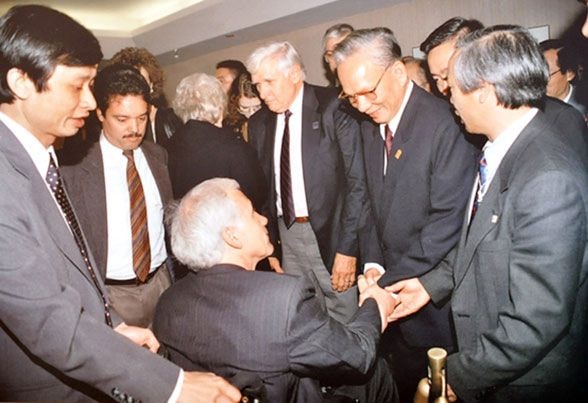 |
| The photograph, titled "President Le Duc Anh visiting Boby Muller, a former American soldier in the Vietnam War," was taken by Pham Cao Phong in 1995 in New York. |
Specifically, after Vietnam liberated the South and unified the country on April 30, 1975, on October 15, 1975, the US President sent Special National Security Advisor Henry Kissinger to Beijing to meet with Deng Xiaoping (China). The US realized that Deng Xiaoping, who had begun launching economic reforms and opening up to "build socialism like China," was in dire need of foreign currency.
Therefore, the US made an agreement: China was surrounded on all sides, with only one way out being the South. The US would "give" China one billion USD, in exchange for China preparing for 17 months, and by the 18th month using Pol Pot's army to attack Vietnam from the Southwest, and China directly instigating conflict on the northern border of Vietnam. At the same time, the US and China would jointly train large commando units, sending them to Vietnam to carry out acts of violence and disrupt Vietnam's healing from the wounds of war.
Because the US realized that allowing Vietnam to heal its war wounds and join ASEAN too soon would be very disadvantageous for both the US and China – ASEAN countries would rise to independence and self-reliance, escaping dependence on a "great power"...
Following General Le Duc Anh's previous successful mission of "exploring and opening a channel" to normalize relations with China, the Politburo once again placed a significant responsibility on his shoulders. Accordingly, the General, along with the Ministry of Foreign Affairs, would seek to explore and "open a breakthrough" to normalize relations with the United States.
It should also be added that normalizing relations with China was difficult, given the recent border war between the two countries, but it was easier than with the US. The biggest obstacle was that Vietnam and the US had just gone through a 21-year war, so both sides harbored resentment, animosity, and suspicion, and neither was willing to initiate the conversation.
Previously, China and the US experienced a 16-year period of "frozen" relations following World War II. To "open the floodgates" for reconciliation, China employed a tactic of "ping-pong diplomacy," sending its ping-pong teams to the US for competitions, both to foster interaction and to gauge the other's reaction. Now, how will Vietnam and the US pave the way for reconciliation? This is a major question posed to General Le Duc Anh.
The General concluded that opening a trade route through economic exchange was not feasible because the US was a superpower, while Vietnam was one of the poorest countries in the world.
Exploration using scientific and technical methods
Through research and exploration, General Le Duc Anh came up with the idea of "opening the door to exploration through science and technology." At that time, there was an event, though not major, that was very significant: Major General, Professor, Doctor Nguyen Huy Phan, working at Hospital 108 (Ministry of National Defense), a highly skilled orthopedic surgeon, had just attended an international orthopedic surgery conference and was greatly admired and praised by international doctors, including a group of American doctors.
A few days later, the Americans invited Mr. Phan to attend another international medical conference held in the United States. Therefore, General Le Duc Anh summoned Mr. Phan and assigned him a task: When you go there, focus solely on reporting your achievements in orthopedic medicine; don't mention politics. This is absolutely confidential; only the Politburo and the person assigned the task will know. General Le Duc Anh also instructed that if any American doctors intend to help the Vietnamese people in any way, they should be invited over.
Upon arriving in America, Vietnamese expatriates, many of whom were doctors, were greatly impressed and warmly welcomed a world-renowned Vietnamese orthopedic surgeon who had come to visit. Taking advantage of this support, Mr. Nguyen Huy Phan followed the General's instructions and approached the American medical team to arrange for them to send "Smile Surgery" teams to Vietnam.
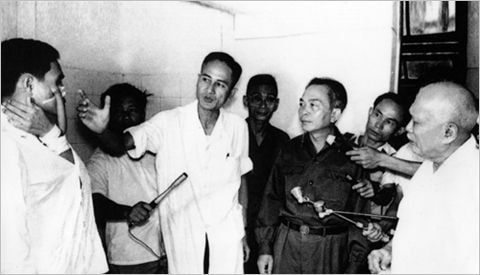 |
| Professor Nguyen Huy Phan reported on the method of creating a human prosthetic model of a severely wounded soldier to General Vo Nguyen Giap and President Ton Duc Thang on July 27, 1974. |
Professor Nguyen Huy Phan performed his assigned task very well. And, as General Le Duc Anh had predicted, within a short time, the US sent a team of doctors to perform free surgeries for children with cleft lip and palate in Vietnam. This was a very important initial step, confirming that medical exchanges had helped Vietnam gauge the goodwill of the US.
After one or two rounds of exchanges and mutual support between American and Vietnamese doctors in an open and friendly spirit, at the suggestion of General Le Duc Anh, the Central Committee appointed Mr. Nguyen Huy Phan as Chairman of the Vietnam-America Friendship Association, serving as a liaison between the two sides. However, a very difficult situation arose because Mr. Phan was assigned a top-secret mission, and the General Department of Logistics (which managed the entire medical sector of the Army) disciplined him, believing him to be a spy for the United States.
It was this misunderstanding that led to a man's fate being pushed in a different direction, and only much later, after the normalization process was successful and everything could be made public, was Mr. Nguyen Huy Phan exonerated, his merits recognized, and awarded the Labor Medal. The person who "cleared" Mr. Phan's name was none other than General and President Le Duc Anh.
Colonel Khuat Bien Hoa - Former assistant to General Le Duc Anh
(According to Vietnamnet)


