
The rhythm of life on a street corner
(Baonghean) - It was just a tiny plot of land, less than 10 meters wide.2Yet, it is the livelihood of five families with dozens of people. I rarely see that narrow plot of land at rest; it seems to be constantly caught up in the struggle for survival of its inhabitants...
"Father Nguyen Dinh Thuc incites parishioners."
The place I'm talking about is located on a street corner off Nguyen Thi Minh Khai Street (Vinh City). When I worked at an office nearby, I often came here for breakfast. It wasn't fancy food; we usually chose sticky rice for breakfast. As my colleagues said, sticky rice was still the most "fashionable" item on the street food menu because it gave diners peace of mind regarding food safety and hygiene, and it was also filling and kept them full for a long time.
The sticky rice stall we usually frequent is set up right on a small plot of land less than 10 square meters.2As I mentioned above, there are actually two sticky rice stalls here, separated by a thin tarpaulin. And I only chose one of them for my simple breakfast. That was the stall run by Mrs. Nguyen and her husband. The sticky rice made by this woman, nearly 70 years old, is chewy but not sticky, and has a rich, fragrant aroma of glutinous rice. That's why, compared to the stall next door, Mrs. Nguyen's is always crowded and sells very quickly; she sets up her stall at 6 am and is usually packing up to go home before 8 am.
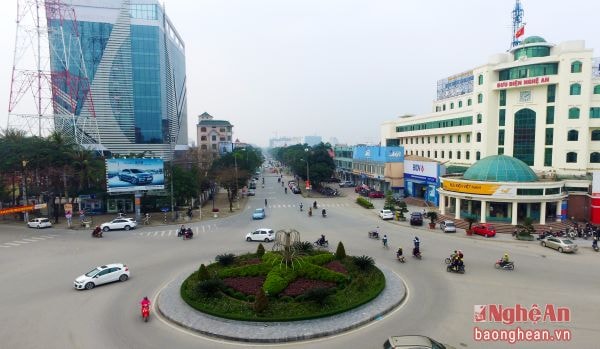 |
| The five-way intersection where Nguyen Thi Minh Khai Street is located (Vinh City). Photo: Duc Anh |
To elaborate on this woman, she's from Dien Phong commune (Dien Chau district) and used to be a catering staff member for a state agency during the subsidy period. After retiring from her job and receiving a pension, she struggled to make a living, eventually remarrying her husband when she was quite old. They had a daughter together. When she was just over 10 years old, they decided to find a small plot of land on a street corner to sell sticky rice to earn a living. Fortunately, their daughter was a good student and has now graduated from university. I also had the chance to meet their beloved daughter; she has a kind face, a gentle and calm demeanor, and a very charming smile.
Previously, the girl occasionally came to help her parents set up their stall and carry things, but usually Mrs. Nguyen didn't want her daughter there. As she would say, "Why go out there? Society is so complicated; it's enough for us to handle things ourselves. She should focus on her work at home and her studies..." Then, from selling sticky rice in the mornings, Mrs. Nguyen's family's finances improved. On the 15th and 1st days of the lunar month, she would even take the opportunity to go to the temple and donate a little to charity for those less fortunate than herself.
But it wasn't just Mrs. Nguyen's family and the sticky rice stall next door making a living on that plot of land. After 8 a.m., a woman selling drinks would push her cart there. All her goods—sweets, cigarettes, and all sorts of other odds and ends—were neatly arranged on the cart. The owner was difficult to guess her age; she looked haggard and seemed rather meticulous. Her customers were usually the rickshaw drivers and tricycle drivers working around the area. Besides them, there were also young people, employees of nearby companies and businesses, who would stop by to smoke a cigarette, drink some sour tea, and eat some peanut candy.
And what's special is that it's not just the old woman's stall here; right next to the plot of land, there's another drinks stall run by a veteran, Mr. Man. Actually, his family didn't need money to open a drinks stall. He and his wife both have pensions, their three children—one son and two daughters—are all settled down, and the two daughters work for the government. "It's just to find joy, to come here every day to watch people, to observe life, to keep myself from feeling bored and restless," he said. Few people know that Mr. Man fought at the Quang Tri Citadel in 1972, during the most intense period of the Quang Tri Campaign against the American imperialists.
Mr. Man once told me: When swimming across the Thach Han River to enter the ancient citadel at night, the commander would only call out names and numbers, then shine a flashlight on their faces to identify them. Many people were killed before they even had a chance to recognize each other's faces. It was incredibly fierce; sometimes, out of 10 people who went in, all 10 would be killed. Therefore, he didn't want to waste his life returning to civilian life from the battlefield. That's how he explained opening the tea shop – to connect with the world, to be more useful to his family and everyone else.
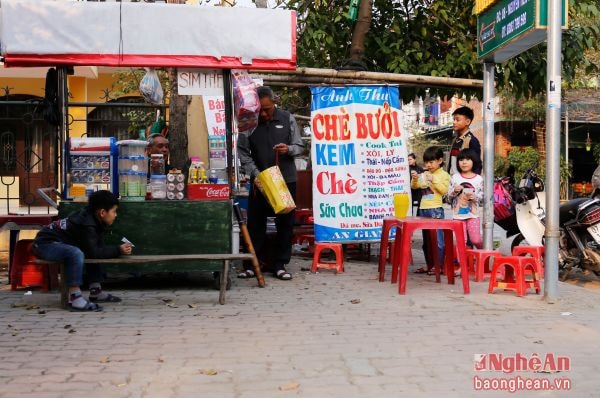 |
| A small plot of land, yet it's the gathering place and livelihood of many people. Photo: Duc Anh |
Late in the afternoon, as Mr. Man packed up his tables and chairs and moved his stall back home to the alley on the other side of the street, the tea vendors would set up their large and small pots, cups, and saucers to begin their day's work. Their customers were mostly children, so the tea stalls were arranged and decorated in a more eye-catching and "modern" way.
The signboard is illuminated with flamboyant light bulbs. The words printed on it read: mixed sweet soup, mung bean sweet soup, black bean sweet soup, pomelo sweet soup… This sweet soup stall offers many snacks to cater to young people's tastes, but it seems to be most famous for its pomelo sweet soup. At night, many couples and teenagers flock to eat pomelo sweet soup. The stall is even considered by young people to be the best in Vinh! After eating the sweet soup, customers can also drink water infused with pandan leaves.
The small shop always has 3-4 servers. They are young people who are always quick and efficient. However, they are just employees of a woman in Le Mao ward. The tea shop has been there for about 15 years and will probably continue to exist for a long time. I heard that thanks to that small tea shop on that narrow plot of land, the owner has been able to build a multi-story house and buy a car. If that's true, then this is truly a money-making piece of land.
There was a man who had no profession or business to set up a stall on his plot of land, yet he still earned a steady income every month. He was a motorbike taxi driver who lived nearby. He had previously paved the land with cement for his wife to sell goods, but later abandoned the project. Claiming he had invested in the foundation, the driver continued to collect money from the vendors and businesses there every month. Knowing it wasn't right, but wanting to share the burden, people like Mrs. Nguyen happily contributed a few tens of thousands of dong to the old man as a token of their respect…
Having moved to a new office, far from my usual route, I rarely have the chance to return to Mrs. Nguyen's sticky rice shop for breakfast. Only occasionally, on my days off, do I ride my motorbike there to buy a few portions for my family to eat for breakfast. As always, Mrs. Nguyen's sticky rice is very soft and fragrant. Lately, she's also added steamed rice cakes to her menu. She's gotten older, but she's still very agile, and her open personality makes everyone feel happy. Whenever I buy sticky rice and don't get any change back, Mrs. Nguyen still firmly grasps my hand and says, "Oh Buddha! Thank you, my child. I'll donate this money to charity for the poor."
Quoc Son
| RELATED NEWS |
|---|


