
Lessons learned and requirements
(Baonghean)For nearly two months, public opinion nationwide has been stirred by the fact that some residents of Quang Lang village (Thuy Hai commune, Thai Thuy district, Thai Binh province) built a wall in front of the Thuy Hai Fish Meal Factory gate due to environmental pollution. The factory was forced to close, incurring daily economic losses of nearly 1 billion VND. Initial investigations revealed: "There is environmental pollution, but it is not yet serious," and "The factory has a wastewater treatment system, but it is not integrated, outdated, and does not meet requirements."
From this costly lesson, we must re-examine similar environmental violations in Nghe An province to resolutely implement comprehensive planning and adopt clean technology – something that businesses are still indifferent to, causing public outrage.
The most striking example is from 2006, when 200 residents of Nghia Quang commune (Nghia Dan district) protested against the Viet Trung Wood Factory, demanding that production be stopped and environmental pollution be rectified. The tension escalated to the point where the factory had to relocate, costing billions of dong. Following this, the Yen Thanh and Thanh Chuong cassava starch factories, due to polluting entire residential areas and causing fish deaths in the Lam River, had to temporarily cease production and build wastewater treatment systems. The two factories suffered billions of dong in losses, with thousands of tons of harvested cassava rotting. One would have thought that after these incidents, industrial production and business establishments would have learned their lesson. However, the situation has recently become even more serious.
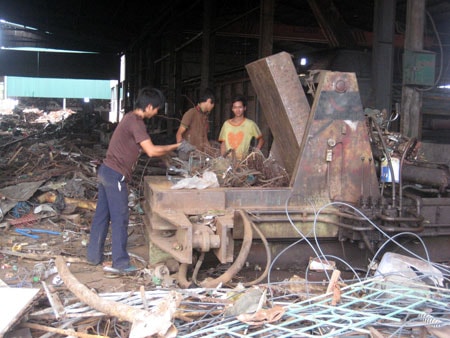
A scrap metal processing facility is causing environmental pollution in Dien Hong (Dien Chau).
Photo: Chau Lan
In January 2010, some residents of Nghia Dan district dug up the road to prevent vehicles from entering the Hai Hoa mini cassava processing plant, forcing the plant to close. Following this, residents of Dai Son commune (Do Luong district) angrily stormed the Thai Duong livestock farm, destroying machinery and workshops due to environmental pollution.
Furthermore, the province's two largest factories, the Saigon - Song Lam Brewery and the Sabeco Packaging Factory, also faced public protests and had to pay compensation for environmental pollution. The brewery was fined 72.5 million VND and ordered to pay over 1 billion VND in environmental protection fees, but residents of Truong Thi and Hung Dung wards are still submitting petitions. The situation with the Sabeco factory is somewhat calmer, as the factory admitted that its wastewater was not being treated.
Most recently (April 2011), Hoang Linh Plastic Joint Stock Company (located in Hung Loc Industrial Park, Vinh City) was attacked by local officials and dozens of residents who filmed and photographed the factory, demanding that production be suspended and environmental pollution be rectified. Furthermore, during a recent Vinh City People's Council meeting, residents reported that the river water (in the Hung Tay and Hung Dong sections) was polluted due to wastewater discharge from Phuc Thinh Co., Ltd. and Viet Nhat Roofing Company.
In 2010, 14 entities were fined for various levels of environmental protection violations, including those previously considered "undisturbed" and rarely complained about by the public, such as: Song Lam Sugar Company, Mineral Development Company No. 4, Nghe An Food Company, Concentrated Pineapple Juice Processing Plant, Seafood Import-Export Company, Cua Hoi Frozen Seafood Processing Plant, Song Lam Paper Company, Export Meat Processing Plant, Hoang Mai Brick Factory, Intimex Company, Industrial Shrimp Environmental Project, Nghe An Aquatic Products Company... The violations committed by these entities included: failure to build wastewater treatment systems as registered; failure to collect domestic wastewater; lack of wastewater discharge permits; and improper management of hazardous waste.
A common cause of environmental pollution from manufacturing businesses is their disregard for pollution issues and their unwillingness to invest in building waste treatment systems.
Another reason is the lack of coordination in the overall planning. Even the Bac Vinh Industrial Park, which has been operating for over 10 years and attracted 29 projects filling all 60 hectares of land, still lacks a centralized wastewater treatment facility; similarly, the Nam Cam Industrial Park, after 5 years of operation, has yet to complete the planning for a solid waste collection area and a centralized wastewater treatment plant. Smaller industrial parks are even more lacking in these mandatory planning requirements.
On the other hand, most production facilities in our province, due to limited capital and lack of access to new information and technology, generally still have outdated production lines, equipment, raw materials, and chemical usage methods. For example, while the whole country has long abandoned the dusty vertical kiln cement production technology and switched to rotary kiln technology and modern dust treatment machines, we still apply vertical kiln technology. This is a burden that the 12/9 Anh Son Cement Plant and the Cau Duoc Cement Plant will have to overcome at considerable expense and over the long term.
Today, alongside comprehensive planning and investment in modern waste and wastewater treatment systems, the application of advanced clean technologies is also being implemented. For our province, given the widespread and serious environmental pollution, both approaches must be prioritized.
Hoang Chinh


