
The pre-revolution cadres from my hometown
While working in Hanoi, I had the opportunity to visit my uncle, Le Van Ngoi, who was then an officer in the Ministry of Public Security, at apartment C4 on the 4th floor of the Kim Lien apartment complex. In a warm family atmosphere, he recounted memorable moments from his life and activities in preparing for the seizure of power in 1945 in his hometown…
(Baonghean)While working in Hanoi, I had the opportunity to visit my uncle, Le Van Ngoi, who was then an officer in the Ministry of Public Security, at apartment C4 on the 4th floor of the Kim Lien apartment complex. In a warm family atmosphere, he recounted memorable moments from his life and activities in preparing for the seizure of power in 1945 in his hometown…
In 1948, he held the position of Party Secretary of Thanh Duong commune (comprising Ma Thanh and Lang Thanh communes) in Yen Thanh district. He gradually rose through the ranks during the two wars of resistance against French colonialism and American imperialism, becoming an officer of the Ministry of Public Security. Throughout his years of revolutionary service until his retirement, he remained in apartment C4 on the 4th floor of the Kim Lien apartment complex, which the State had allocated to his family while he was still working.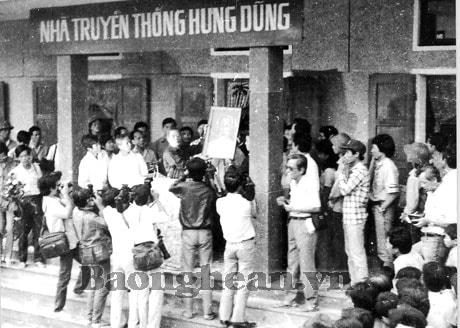
Comrade Nguyen Van Linh - former General Secretary of the Central Committee of the Communist Party of Vietnam - visited, spoke at, and presented gifts to the Hung Dung Traditional House (formerly part of Lang Do Village, now Hung Dung Ward, Vinh City) - 1990. (Photo courtesy of KH)
As for Mr. Phan Quang Di, he both taught and participated in revolutionary activities. In 1945, he led the uprising committee to seize power in the commune, and in 1949, he became the Party Secretary of Thanh Duong commune before leaving to join the revolutionary movement. Over 40 years as a teacher, he served as principal of many schools: Nguyen Hue High School (Ha Dong district – Hanoi), the Southern Students' School, the Social Sciences Teacher Training College, Dan Phuong High School (Hanoi)... He lived a very simple life, was sociable with teachers and students, and possessed the ability to mobilize and unite the masses. He also did a good job advising the local Party committee and government, so every school he taught became an outstanding and advanced school. Many of his students have achieved success. Some individuals became leaders of our Party and State, such as Mr. Truong Quang Duoc (former Vice Chairman of the National Assembly), Mr. Nguyen Canh Dinh (former Minister of Agriculture, Head of the Office of the President)... The teacher's entire life was a long series of sacrifices. When he started teaching, he rode a brand-new bicycle, and even after retiring to his hometown, he still rode that same bicycle.
Born and raised in the Soviet-era homeland of Nghe An and Ha Tinh, Le Van Luan, along with his older brother Le Van Nam, secretly sheltered revolutionary cadres in their hometown and joined the local National Salvation Army, eventually becoming a key official in the village and commune. In 1950, he served as the Party Secretary of Thanh Duong commune, before leaving to participate in the resistance against the French colonial invasion. In 1954, he was the Secretary of the civilian labor battalion serving Central Laos, then became the Head of the Production Steering Committee of Nghe An province, and later the Deputy Manager of Viet Lam State Farm (Nghe An).
During his years dedicated to the cause of national defense, his two eldest daughters passed away one after another, and his family faced extreme hardship, so he requested to return to work in his hometown. In key positions at the commune and cooperative levels, he constantly pondered how to advance the cooperative movement and transform arid lands, where only one crop could be grown annually relying on rain, into areas with two rice crops per year and lush green villages. Thus, he and the Party Committee of Ma Thanh commune decided to build an irrigation dam to bring water to the parched fields. With the district's approval, the Bon Vang dam project was completed, and he was entrusted by the commune's Party Committee with the important responsibility of overseeing the construction. Working tirelessly amidst the mountains and forests, he and the people of Ma Thanh commune successfully built the Bon Vang irrigation dam, bringing water to the Tan Yen area and transforming this arid land into a region with two rice crops per year and verdant villages.
Uncle Tran Dinh Duc was a local revolutionary activist, joining the people in seizing power during the August 1945 Revolution in his hometown. In 1951, he served as the Party Secretary of Thanh Duong commune, then as the District Party Secretary of Yen Thanh district, and Deputy Head of the Provincial Party Organization Department of Nghe An province. Later, he became a Central Committee official and was appointed by the Party and State as an advisor to Laos. Upon retirement, he returned to his hometown to enjoy time with his children and grandchildren…
How many more pre-revolutionary activists from the Soviet-era homeland of Nghe An and Ha Tinh have dedicated their entire lives to their country, leaving us with a philosophy of life and humanity!
Le Anh Choi


