
July Stories
The search for fallen soldiers continues. I witnessed how the search teams, codenamed K, operated along the Central Highlands provinces bordering Cambodia. They worked alone, following maps, venturing into dense forests, searching for and carefully collecting fragments of remains, bringing them back to the martyrs' cemeteries—many of whom were unnamed or whose names were unknown...
1.Five years ago, my friend, the writer Pham Duc Long, from Quynh Luu, a friend of mine for decades living in Pleiku, called and said: "Please come over to my place for lunch; we're entertaining guests from our hometown with my wife and me."
Usually, gatherings like these are warm, joyful, heartwarming, and delicious, because they feature only local dishes and stories from the countryside.
It turned out that Long's guest was also named Long, Nguyen Hong Long, from Quynh Hau commune, a former deputy police chief of a district in Nghe An province, and a high school classmate of Pham Duc Long. And it turned out that this man wasn't out for leisure, but was looking for his father.
The search was quite arduous, and hearing about it broke my heart. I'm sure there are many children who love and respect their fathers and long to see them like Long, but hearing Long's story filled me with immense respect. I felt both anxious and heartbroken, yet information about his father remained elusive.
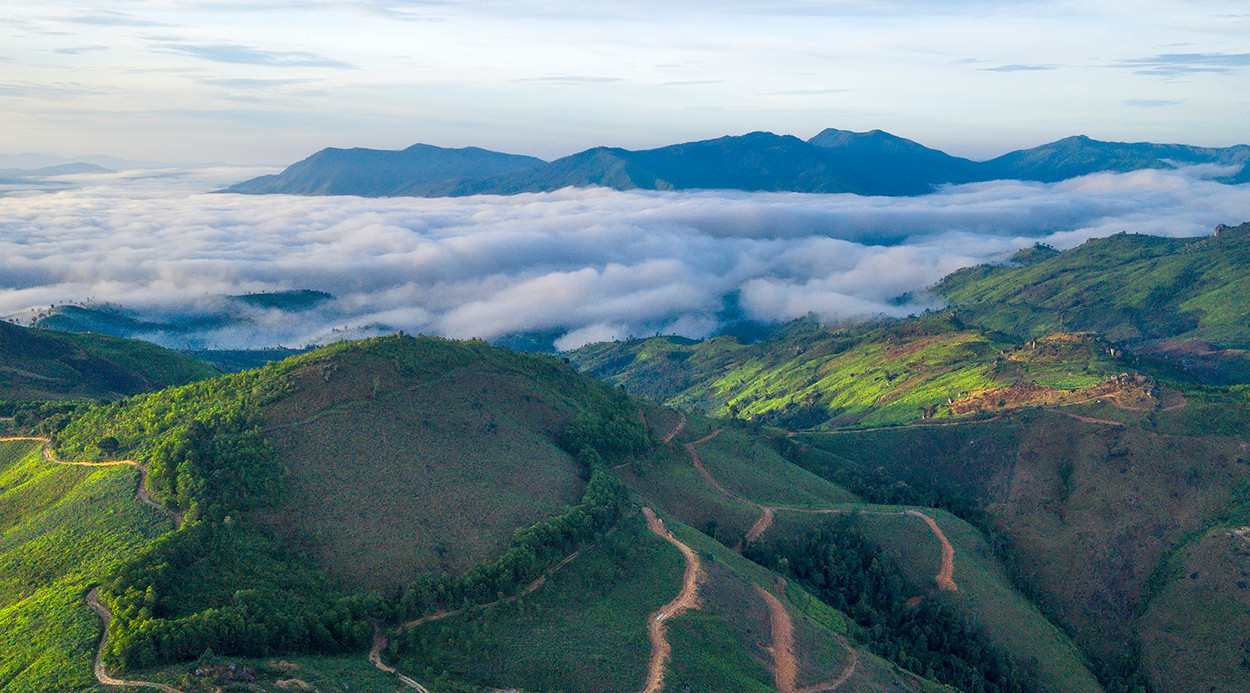
Talking to him really impressed me; Long knows the Central Highlands better than I do, even though I've lived there for forty years. He knows everything about it, from what he's seen in the field, on maps, and through letters, phone calls, and all sorts of other communication.
His father died on the Central Highlands front sometime between 1962 and 1964. He contacted many places, many people, and many agencies... and vaguely knew that his father died at H40, and upon searching, that address corresponds to Dak Glei district, Kon Tum province today. At that time, his father was the squad leader of the reconnaissance squad of the 300th Anti-Aircraft Artillery Regiment.
He scoured the Central Highlands provinces searching, and whenever he heard of veterans who were his father's comrades or served in the same unit, he would arrange to go and find them. The police had the advantage of being able to find clues and addresses easily, but time was limited. Whenever he was on leave, he would go to Kon Tum, Gia Lai, Dak Lak... and even to Thanh Hoa when he heard that an elderly colonel from his father's unit was living there, and even to Hanoi and Hai Duong to seek help from psychics... He recounted that he went to these places based on recommendations from friends, clinging to hope, but with his professional skills, he knew immediately what they were saying... that they were scams, so he left, not wasting money or time.
It's all hopeless.
This trip was also part of that search. He's retired, so he has more time. It's safe to say he's scoured the vast Central Highlands in his search for his father, but hasn't found him yet. He heard that in Chu Prong district (20 km from Pleiku), there were several graves of martyrs from Quynh Luu who died during the war against the US, so he immediately packed his bags and set off. He hasn't found his father's grave yet, but he discovered many graves of martyrs from the same district in the cemetery. He's been writing down the information so he can find a way to inform the families of the fallen soldiers.
He told me about his mother: She gave birth to two children, Long and his younger sister. His father joined the army, and after training in Son Tay, went straight to the battlefield. He sent two letters to his wife in Quang Nam before all contact was lost. His mother single-handedly shouldered the family responsibilities and raised the children, enduring a long wait for over half a century. That's why he's determined to find his father and bring him back so his mother can have peace of mind.
One major difficulty for cases like Nguyen Hong Long's, and for many others in general, is that the terrain of the Central Highlands is now vastly different from the past, if not completely new; relying solely on memory is insufficient. Secondly, the witnesses are now very old, and most, if still alive, suffer from dementia. And thirdly, the units have changed significantly. For example, Nguyen Hong Long's father heard that in October 1964, the 300th Anti-Aircraft Artillery Regiment of Military Region 5 was disbanded. One company was transferred to Binh Dinh province, another to Dak Lak...
While writing this article, I called writer Pham Duc Long to ask about the progress of Nguyen Hong Long's search for his father. He sadly replied that it was still a mystery, but they hadn't given up.
2.I have a younger cousin, my maternal aunt. When my father was relocated to the North, she got married and had a bunch of children, including this girl. My cousin grew up and married a local soldier stationed in the village. One night, he was shot dead. My cousin became a widow, built a thatched hut behind my parents' house, and raised her two children. Then, after the reunification of the country, the whole nation faced hardship, with rice mixed with other grains. A widowed mother raising two children, especially with connections to the "other side," suffered even more.
My father had a friend, a soldier who had also returned to his hometown after the war. For some reason, he never had a wife or children in the North. Many people tried to set him up with my sister, and they ended up getting married. I call him "uncle" because he's my father's friend, and now I have the honor of being his older brother. But a single pension at that time was too much to support four people. The whole family moved to Gia Nghia, which at that time hadn't been divided into Dak Nong yet but was still part of Dak Lak, and... they had five more children.
He passed away too. Last year, I went to Dak Nong, and all seven of my nephews and nieces are doing well, mainly in trading, and now they all have shops and cars. I went to light incense at their altars; my sister's two husbands were sitting there together. I lit three incense sticks, and they both shared them. I prayed, "Well, it's been decades, and I'm happy that you're all united." I saw the incense sticks curl up.

3.Since I live in Gia Lai, many friends often ask me to search for information about fallen soldiers who died in the Central Highlands. The Central Highlands is vast (of course, even though it's vast, it can't compare to Quang Tri), and most of the time I... fail despite my enthusiasm, and the places I ask are also very enthusiastic. They search through their files, and if they can't find it, they have to inform me that it's not there, what else can they do?
But when I witnessed journalist Pham Tam Hieu in Hanoi and his family unexpectedly and unofficially find his brother, a fallen soldier, in a martyrs' cemetery just a few dozen kilometers from my house—after contacting and asking the authorities for help without success—I thought, maybe we're not working scientifically enough?
Currently, there are many programs to find relatives of fallen soldiers, from mainstream newspapers to personal websites like the one of Mr. Nguyen Si Ho, a person who tirelessly searches for information about fallen soldiers and their relatives. However, perhaps we are missing one more thing: the cemeteries themselves need to compile information and put it online. Before searching, families can go there to research and compare the information. If they find a match, or a close match, or if there are relevant details, then they should proceed with their search, avoiding the arduous and hopeless efforts we currently face.
For example, the family of Ms. Pham Tam Hieu was searching for her brother, the fallen soldier Pham Hoai. The death certificate stated: Died on June 13, 1979, on the Southwestern front, buried in Thang Duc, Chu Krong, Gia Lai, Kon Tum, grave number 63, row 7. This information was missing (and there was no Chu Krong district). However, they had information that a grave in the Ia Grai district martyrs' cemetery had been relocated with the information: Martyr Pham Hoa, from Hanoi, unit C3E1F2, born in 1956, died on June 3, 1979. Upon inquiring with the relevant authority, they learned that the Ia Grai cemetery did not contain any Cambodian martyrs. A friend informed them that the search system was incomplete. Finally, the family conducted their own search and found the grave. It turned out that Mr. Hoai was indeed buried in the Ia Grai district cemetery, a place the family had visited many times.
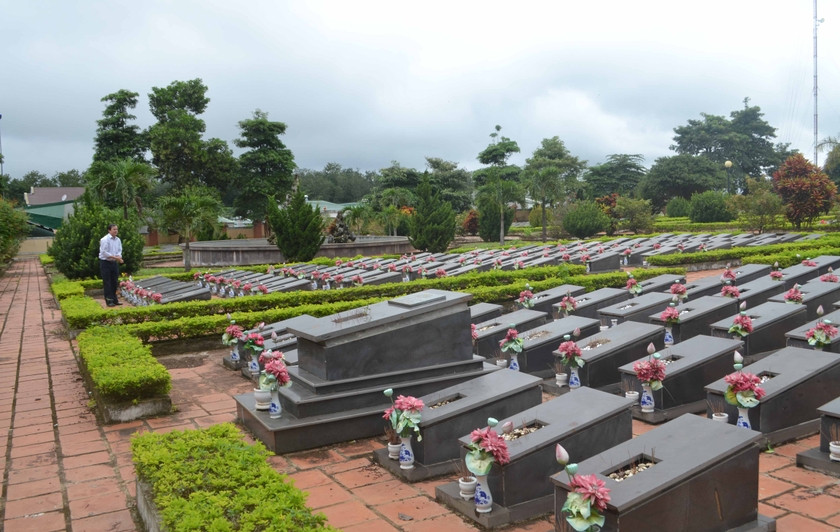
4.The search for fallen soldiers continues. I witnessed how the search teams, codenamed K, operated along the Central Highlands provinces bordering Cambodia. They worked alone, following maps, venturing into dense forests (where most of the fallen soldiers died, now largely uninhabited), searching for and carefully collecting fragments of remains, bringing them back to the martyrs' cemetery. Many of these soldiers were nameless or unnamed. The Duc Co Martyrs' Cemetery in Gia Lai province is one such place. Every year, there are grand ceremonies to welcome the fallen soldiers back home, organized with great solemnity and emotion...


