
Forbidden memories
(Baonghean.vn) - June 4, 2015 marks 26 years since China's crackdown in Tiananmen Square, but visitors to the square will find it difficult to find signs or monuments commemorating the large-scale popular uprising that once took place there.
According to experts and various media outlets, the Chinese government has relentlessly attempted for over a quarter of a century to ban commemorative activities and marches by the public to remember this historical event. On this day, Tiananmen Square still appears to be just an ordinary tourist or meeting place.
However, large-scale marches demanding democratic reforms were initiated by Chinese students in this square starting in April 1989, following the death of a liberal member of the Communist Party, Hu Yaobang, who strongly supported reforms. These students gathered in the square and remained there for three days after Hu Yaobang's death. The crowd grew larger, reaching 100,000 people who attended the state funeral of the leader.
In the following month, the crowds in Tiananmen Square reached 1.2 million. Unable to force the protesters to obey orders to disperse, the Chinese government, led by Premier Li Peng, declared martial law on May 19, 1989. Li Peng also prevented foreign media from reporting on the protests, which began on June 1 of that year.
The massacre of protesters by army soldiers and tanks is believed to have taken place on June 3rd and 4th, hence the common name for the June 4th incident. No reliable reports of casualties have ever been released. To this day, the Chinese government only acknowledges the crackdown as an attempt to suppress "anti-revolutionary rebel forces."
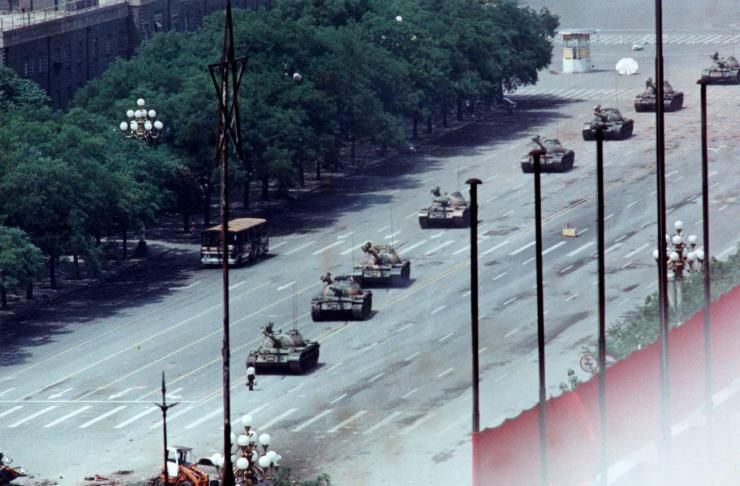 |
| A Beijing resident stands in front of a column of tanks on Chang'an Avenue on June 5, 1989. This photograph has become a symbol of the Tiananmen Square protests. Photo: Reuters. |
A day after the aforementioned event, on June 5, 1989, a protester defiantly blocked a column of Chinese tanks. The photograph capturing this moment has become the iconic image of the Tiananmen Square uprising.
Now, the only remaining signs of the June 4th events are groups of police officers patrolling the squares in central Beijing, the Washington Post reports. Last year, the government's counter-tactics ahead of the Tiananmen Square anniversary were even broader and more comprehensive—evidence that perhaps the event is still fresh in the memories of the Chinese people and the Beijing authorities.
Thu Giang
(According to International Business Times)


