
Efforts to save tea
(Baonghean.vn) - According to the Department of Agriculture and Rural Development, the recent severe drought has caused leaf burn on over 2,260 hectares of tea plants, resulting in losses of 30-70%; nearly 850 hectares of tea plants have been completely wiped out. In tea-growing areas throughout the province, people and local authorities are implementing various measures to "save the tea."
With a total tea-growing area of over 4,500 hectares, tea cultivation has been considered a strength of Thanh Chuong district for many years. However, the recent prolonged heatwave has damaged more than 1,200 hectares of tea, with Thanh Mai, Thanh Tung, Thanh An, Thanh Thinh, and other communes experiencing significant damage, with over 70% of their tea plants dying due to scorching. This brings the total area requiring replanting to 585 hectares. Mr. Le Dinh Thanh, Head of the District's Agriculture Department, stated: "Currently, the district is encouraging farmers to utilize water resources from 7 large reservoirs and over 200 smaller reservoirs in the district to irrigate their tea plants. Simultaneously, we are limiting tea harvesting during the drought. In the next season, we will encourage people to intercrop with legumes to regenerate the soil and provide shade for the tea plants."
In Thanh Huong commune, farmers are using a highly effective drip irrigation system to combat drought for tea plants. Because water is channeled directly to the sprinklers via pipes, water loss is minimized, maintaining consistent moisture levels for tea plant growth. Currently, each hamlet in the commune has between 4 and 6 households using this system.
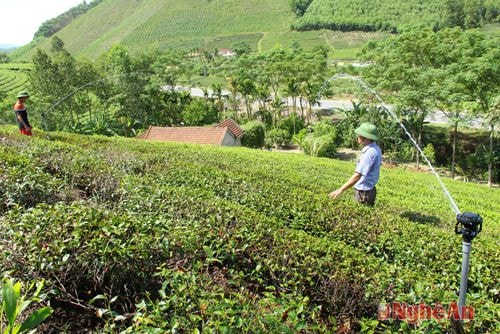 |
| The automatic Bep irrigation system is used in Thanh Huong, Thanh Chuong. |
Lacking the resources to install automatic irrigation systems like some families in Thanh Huong commune, many people in Thanh Thuy have come up with other creative ways to help their tea plants overcome drought. Le Van Chien's family has installed a high-capacity pump system to supply water to three tea plantations covering a total area of 1 hectare. He shared: "If the tea dies and we have to replant, it would cost more than 70 million VND per hectare, so proactively dealing with the situation is better than trying to mitigate the severe consequences later."
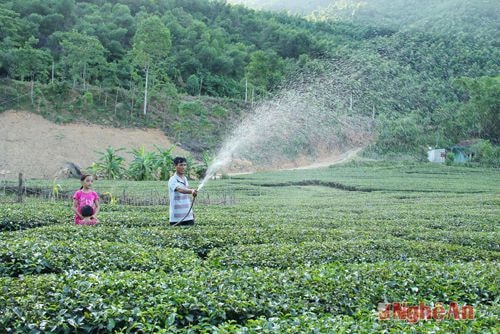 |
| Mr. Tran Trong Hao (Hamlet 3, Thanh Thuy) dammed the stream to bring water to irrigate his family's tea plantation. |
Thanh Thuy commune has 485 hectares of tea plantations, of which over 100 hectares are young tea plants. Mr. Ha Van Thai, Vice Chairman of the commune, shared: “Currently, 82 hectares of tea plantations in the commune are affected by the heatwave. The commune has encouraged farmers to invest in water pumping systems to utilize water from the two large dams, Song Ro and Lai Lo, and four other smaller dams. In particular, at the end of this year, the Vietnam Tea Growers Association has agreed to support the cultivation of the *Cot Khi* plant (also known as *Cot Khi*) to be intercropped in the tea plantations to combat drought.”
 |
| People in Thanh Thuy have purchased high-capacity water pumps to irrigate their tea plantations. |
In Anh Son district, over 300 hectares of tea plantations have been affected by drought. In Hung Son commune, many tea fields have suffered severe drought and scorching. It is estimated that these areas will be replanted and supplemented in September (lunar calendar), when the weather will be milder and more suitable for seedling growth.
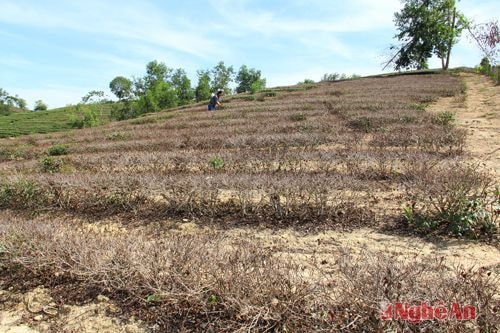 |
| Tea plants withered and died in Khe Long area, Hung Son commune, Anh Son district. |
Mr. Nguyen Dinh Huong (Deputy Head of the Crop Production Department - Department of Agriculture and Rural Development) said: Currently, the province has directed localities: For tea plantations with leaf burn and damage ranging from 30-70%, care will be provided, and seedlings will be prepared for replanting when the rain comes to ensure the density matches the newly planted tea area; for commercial tea plantations, weeding and fertilizing will be done after the rain to help the tea recover and develop. As for nearly 850 hectares of tea plantations with over 70% burn, they will have to be destroyed and replanted. The province is proposing that the Government provide support in the form of disaster relief./.
Thanh Quynh


