
Non-performing loans decrease and their correlation with the rise of the VN-Index.
Historical data shows that cycles of declining non-performing loans often coincide with strong stock market growth, opening up positive prospects for the VN-Index.
The correlation between bad debt and the stock market
According to analysis from VPBankS, developments in non-performing loans within the banking system can provide early and important signals for the stock market. Data shows a strong correlation between improved bank asset quality and the growth of the VN-Index.
Between 2015 and 2019, non-performing loans (NPLs) recorded a continuous four-year improvement trend, coinciding with a stock market growth of approximately 70%. Similarly, in the last 18 months, a new cycle of declining NPLs has also accompanied a 45.7% increase in the market.
Even during the 2020-2021 period, when non-performing loans fell to record lows due to restructuring and debt relief measures in the context of COVID-19, the stock market still recorded impressive growth of approximately 56%.
Non-performing loans are an effective standalone indicator.
VPBankS believes that the non-performing loan (NPL) indicator (NPL ratio plus write-offs) is most effective when used to identify market cycles and conditions. In Vietnam, this is considered a fairly effective independent indicator. Statistics show that if investors buy into the VN-Index at the beginning of years when this indicator decreased in the previous year, the success rate is very high, with an average return of 19.0%.
Market outlook for 2026
Based on its analysis, VPBankS assesses that the most recent bottom of the stock market cycle occurred in November 2022, while non-performing loans peaked in 2023, marking the bottom of the current economic cycle. Since 2023, asset quality has improved significantly.
If the non-performing loan ratio at the end of 2025 is recorded at or below the 4.3% level of the first nine months of 2025 (annualized), the outlook for 2026 will become quite positive. This reinforces the view that the stock market is still in the middle stage of its growth cycle.
VPBankS also forecasts that credit growth will remain at 18-20% during the 2025-2026 period, despite the scenario of interest rates potentially increasing by another 50 basis points in 2026. The main driving force comes from the shift in business borrowing demand from supplementing working capital to financing expansion and investment.
Supporting factors and indicators to watch
The current economic landscape in Vietnam is considered to be significantly different from that of 2016, creating a more solid foundation. Key factors include Resolution 68, which places the private sector on equal footing with the state sector, administrative reforms, and the growing role of infrastructure investment.
Investors should continue to closely monitor the composite indicator, which includes:Non-performing loan ratio (NPL) + Subordinate loan ratio (SML) + loan write-offsTo identify early signs of reversals, the increasing adoption of IFRS 9 by banks will be a crucial line of defense against undisciplined lending practices.
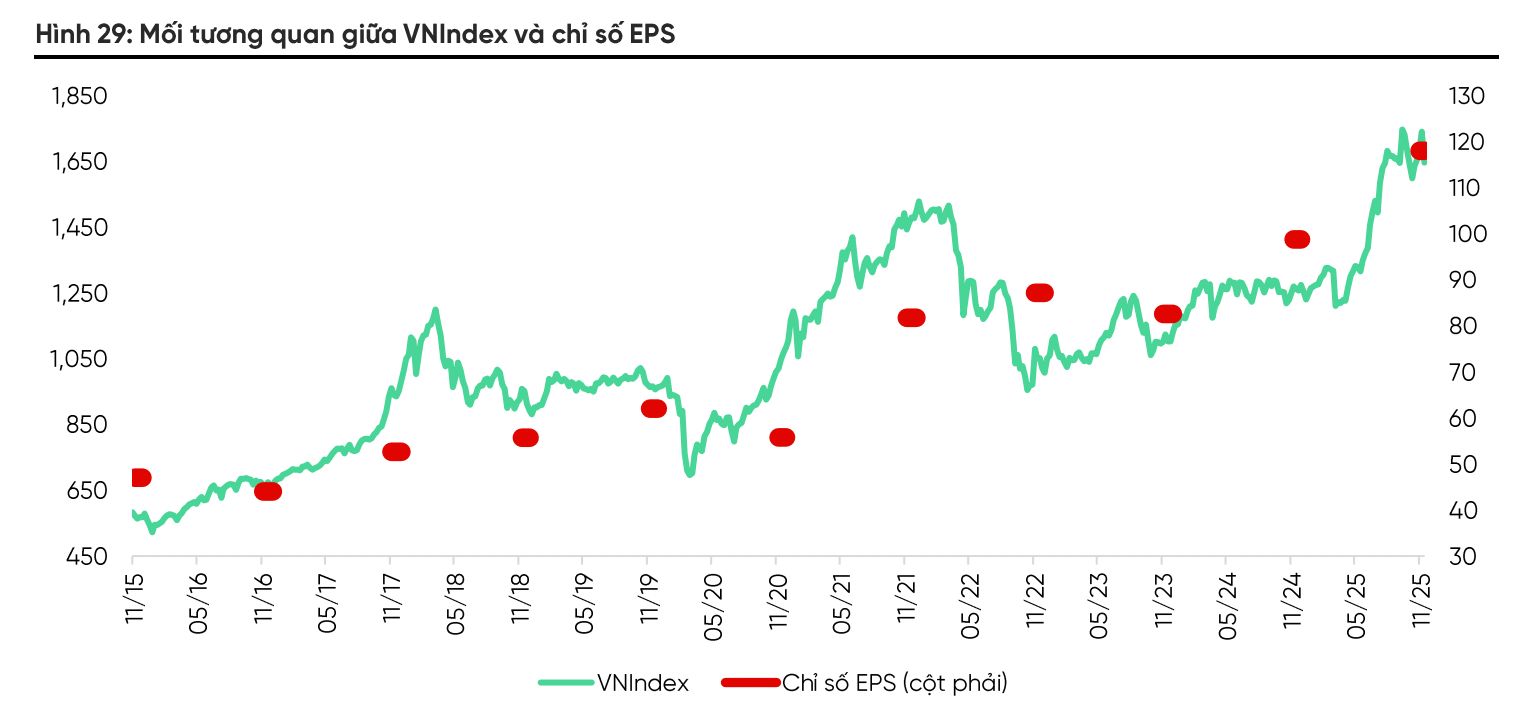
Based on these factors, VPBankS estimates that the market-wide EPS in 2026 will increase by approximately 14.4% year-on-year.


