
The Sadness of the South
(Baonghean.vn) -Once one of the most prosperous villages of the Khmu ethnic group in Bac Ly commune, Ky Son district, Keo Nam has now become a "dead" village, with only houses resembling huts, and poverty clinging to its inhabitants. Even worse, the "storm" of drugs is gradually withering this village away.
>>> Reassessment: Why is a prosperous, model village being relocated for resettlement?
Before 2012, Keo Nam was almost the most remote village in Bac Ly commune, Ky Son district. Despite its remoteness, Keo Nam was considered a model village for the Khmu ethnic group in the area. At that time, many villages in Bac Ly lived in makeshift thatched houses and suffered from frequent food shortages, but Keo Nam was one of the few villages surrounded by sturdy wooden stilt houses built close together. The village was always clean, and every family owned many buffaloes, cows, pigs, and chickens. Food was abundant year-round, so food shortages were rare. Each family owned a motorbike, with some families having three or four expensive motorbikes.
“From the 1990s, when I worked in finance in Keo Nam village, it was full of stilt houses and dense forests. There were also many motorbikes and buffaloes; some households even had dozens of buffaloes and cows,” recalled Mr. Cut Van Long, Chairman of Bac Ly commune.
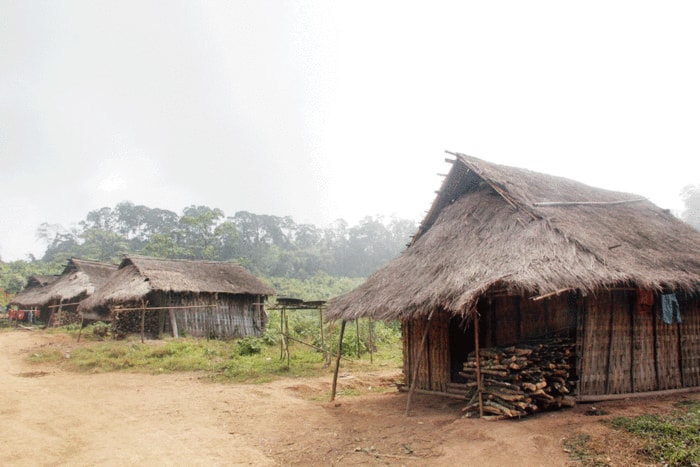 |
| The present-day Kẻo Nam village. Photo: Xuân Hòa |
But now, anyone who once visited Keo Nam and returns would hardly recognize the "model" village of the Khmu people of the past. The new Keo Nam village has been moved closer to the commune center, about 30 minutes by motorbike from the old village. Currently, the entire Keo Nam village has 60 households, but only two wooden stilt houses remain: one belonging to the Party Secretary and the other to the village head. The rest are just makeshift thatched houses, like shacks. Some houses are built to a size of less than 10 square meters.2 It's so low that you have to sit down to enter the house through the doorway.
Walking through the entire village, we could only see a couple of men; the rest were women, children, and the elderly. The children wore tattered, dirty clothes, some without pants at all. The women, seeing strangers, hid inside their houses, their dark, thin faces peeking out, their skin clinging to their bones.
The buffaloes and cows that once symbolized the wealth of Keo Nam are now nowhere to be seen. Around the village, only a couple of pigs and chickens are left, foraging for food. Right at the foot of the houses, livestock and poultry waste is scattered everywhere.
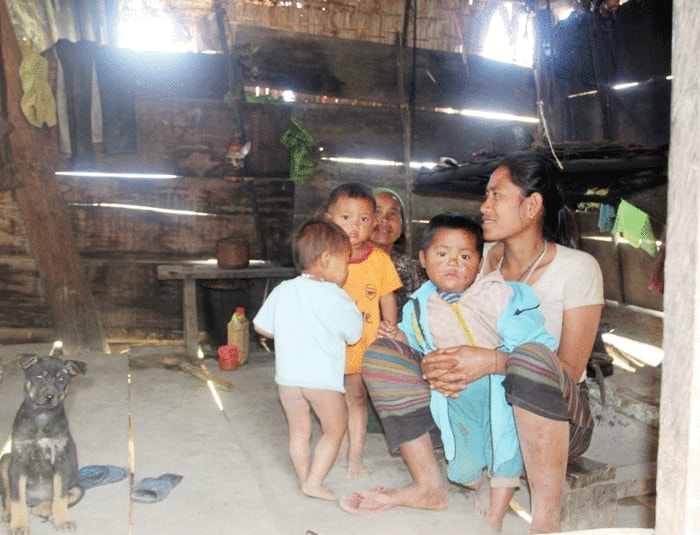 |
| Most of the men and young people in the village have gone to work at alluvial gold mining companies in Quang Nam province, so mostly women and children are left at home. Photo: Xuan Hoa |
Shaking our hands with a haggard face, Mr. Luong Pho Bich, Secretary of the Party Branch of Keo Nam village, said: “Now only our house and the village head's house are left with thatched roofs. The rest of the houses have all been sold, so now they have temporary houses made of bamboo and thatch. The buffaloes, cows, and motorbikes have also been almost all sold; now the whole village only has about 10 buffaloes and cows, and four or five motorbikes left. Now, the villagers are mainly women, children, and the elderly. The young men and girls have gone to work in factories in Quang Nam and haven't returned yet.”
Further investigation revealed that the locals go to work at "companies," but in reality, they work in alluvial gold mining in Quang Nam. Each time they return, they bring back a significant number of drug addicts. It is largely due to drugs that many once-sturdy stilt houses, motorbikes, and valuable household items have been lost, leaving behind abject poverty in Keo Nam. The decline of Keo Nam doesn't stop there. Previously, Keo Nam was considered a drug-free village, with only a few elderly people using opium naturally for generations, and almost no addicts in the rest of the village. However, according to preliminary data from village officials, there are currently 13 addicts. But that number is likely to increase, as revealed by Mr. Luong Pho Bich, the village Party Secretary: "There are 13 addicts currently at home, and many more who work at 'companies' are also addicted; we haven't been able to count them all."
Meeting Mrs. Luong Me Xan Tay (60 years old) living in a damp, makeshift hut made of bamboo and thatch, I learned that she also has children, but due to hunger and drug addiction, they couldn't support their mother. Therefore, she had to ask the villagers to build her this rickety hut to live in temporarily, with her possessions consisting of a plastic water container, a pot, and a few bowls. Not only Mrs. Xan Tay, but it's not difficult to find similar houses throughout Keo Nam village.
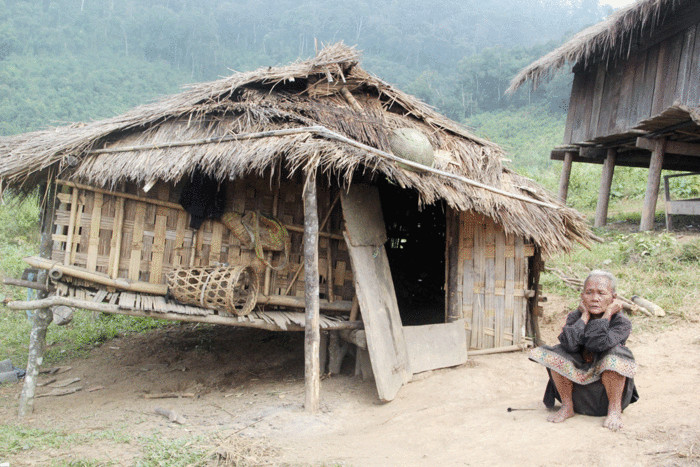 |
| Because of hunger and drug abuse, Mrs. Luong Me Xan Tay's children were unable to support their mother and had to leave her in this tiny hut made of bamboo and thatch, less than 10 square meters. Photo: Xuan Hoa |
In search of the reasons for this alarming decline of a once-wealthy village like Keo Nam, Mr. Cut Van Long, Chairman of the People's Committee of Bac Ly Commune, explained that in 2012, the old village's remote location from the commune center made it difficult for villagers and students to travel to the commune office and school. Furthermore, the old village's high elevation and scarcity of water led the District People's Committee to implement a policy of relocating Keo Nam to a more convenient location.
After the district People's Committee implemented a policy, but due to a misunderstanding that they would receive full support for building new houses, the people sold all their old homes. Therefore, upon moving to the new location, the people had to build makeshift houses of thatch and bamboo to live in. From then on, Keo Nam took a long step backward into poverty and social ills; today, 100% of the households in the village are classified as poor.
"I don't know when Kẻo Nam will escape poverty, because in the whole village, even the most valuable livestock like buffaloes and cows are down to less than 10, and the few motorbikes are just frames, barely resembling vehicles anymore," sadly shared Mr. Cụt Văn Long, Chairman of the People's Committee of Bắc Lý commune.
Xuan Hoa


