
Expanding health insurance benefits for patients who seek treatment outside their designated area.
(Baonghean) - The opening of health insurance coverage is considered a breakthrough in the amended Health Insurance Law, demonstrating the determination to achieve the goal of universal health insurance. This not only ensures the rights and creates the most favorable conditions for health insurance participants but also becomes a driving force to improve the quality of medical services and the spirit of serving patients.
"Half happy, half worried"
The amended Law on Health Insurance stipulates that, from January 1, 2016, the referral system for medical examination and treatment will be opened between district and commune-level facilities within the same province. Accordingly, health insurance participants who initially registered for medical examination and treatment at a commune health station, multi-specialty clinic, or district hospital are entitled to receive medical examination and treatment at district-level medical facilities within the same province. Previously, at district-level hospitals, if people sought treatment outside the designated referral system, the health insurance fund would only reimburse 70% of the medical costs. According to the amended Law on Health Insurance, starting from January 1, 2016, the fund will reimburse 100% of the medical costs for those receiving treatment within the same province. Thus, all individuals who previously only received 70% reimbursement will now receive 100% reimbursement if they receive treatment within the same province. Implementing the integrated healthcare system means that when receiving medical examination and treatment under health insurance, participants will have more convenience, not being limited to a single initial healthcare facility, while still receiving reimbursement according to the prescribed benefit levels.
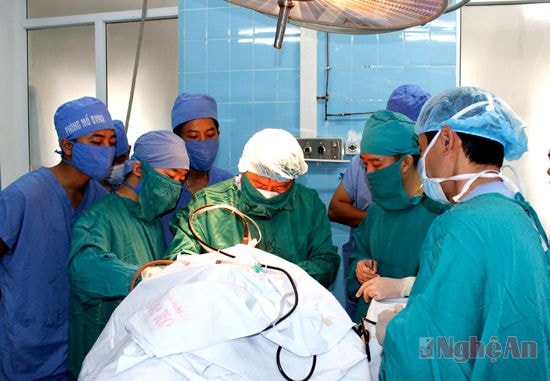 |
| Brain tumor surgery at Nghe An General Hospital. |
Ms. Nguyen Thi Nguyet, 63 years old, a resident of Nam Dan Town, was delighted to receive the news about the opening of the health insurance network for medical examination and treatment. Although the official opening of the network for medical examination and treatment at the district and commune levels will only begin on January 1, 2016, Ms. Nguyet is already very familiar with the new regulations: “With the opening of the network, patients with health insurance cards like me will have the right to receive medical examination and treatment at any health station or hospital at the district, city, or town level in the province as they wish, without being limited to any initial medical facility, and will still have 100% of their medical expenses covered by the Health Insurance Fund… This regulation creates more autonomy for patients in taking care of their health, eliminating limitations on where to seek medical examination and treatment, avoiding hassles with paperwork and procedures, and preventing hospitals from ‘delaying’ them for treatment.”
Dr. Ho Xuan Hung, Head of the Nam Trung Commune Health Station in Nam Dan District, said: “In recent years, the Nam Trung Commune Health Station has become a reliable place for medical examination and treatment for people in the Nam region. People from the communes of Nam Trung, Nam Cuong, Khanh Son, and Nam Phu have flocked to the station for examination and treatment because it has ultrasound machines, complete equipment, and skilled staff who are proficient in using the machinery… Each year, the station assists nearly 300 childbirth cases and examines and treats 10,000 people. Now that the referral system has been opened, the number of people coming for medical examination and treatment will certainly increase even more.” Reputable healthcare facilities find joy in serving and treating a large number of patients. This means hospitals have additional financial resources to invest in upgrading facilities, purchasing equipment, comprehensively developing specialized techniques, and focusing on training young, highly qualified staff. However, this joy also comes with a great concern: many healthcare facilities will have no patients; many others will be overloaded, and their facilities and medical services will not be able to adequately serve such a large number of patients – at which point the rights of those with health insurance cards will not be guaranteed.
Improving the quality of medical examination and treatment.
When the "transfer of healthcare services" is officially implemented, district-level healthcare facilities will face the law of elimination and self-elimination. Only healthcare facilities with quality services, highly qualified doctors and nurses, good service spirit, and modern facilities will be selected and continue to develop. Aware of this, many district-level hospitals in the province have been actively improving themselves in recent times.
With the goal of achieving the standards of a Grade II General Hospital with 250 beds, Vinh City General Hospital has recently made breakthroughs in implementing advanced techniques such as: laparoscopic abdominal surgery (appendicitis, cholecystectomy, ovarian cysts, ectopic pregnancy, endoscopic sinus surgery, extensive CT scans, gastrointestinal endoscopy, etc.); thyroidectomy; colon tumor resection; resection of liver cysts, kidney cysts, and ovarian cysts using a multi-purpose ultrasonic scalpel; retrograde endoscopic lithotripsy with laser; Pharco surgery; tonsillectomy using a plasma scalpel… Along with implementing a comprehensive hospital quality management model, Vinh City General Hospital is striving to provide patients with the best technical services, contributing to minimizing the number of patients who need to be transferred to higher-level hospitals.
Similarly, Thanh Chuong General Hospital is also actively promoting the application of advanced techniques to gradually meet the demand for high-quality medical examination and treatment for the people. Dr. Nguyen Hai Linh, Director of Thanh Chuong General Hospital, said: With many appropriate solutions such as receiving technology transfer from higher-level hospitals, contracting with higher-level hospitals for training and technology transfer packages, and organizing training courses, the hospital's doctors have now truly mastered many techniques such as: various types of endoscopic surgery, phaco cataract surgery, and orthopedic trauma surgery. In addition, the hospital has also invested fully in equipment and machinery to meet the needs of a level 2 medical unit such as endoscopes, high-frequency X-ray machines, color ultrasound machines, hydraulic multi-functional operating tables, and neonatal incubators.
Quynh Luu General Hospital, since 2014, has implemented a smart card system for patients with long-term health insurance (2-3 years). Dr. Nguyen Hoai Nam, the hospital director, stated: "When patients come for examination, they only need to bring this electronic card and not their health insurance card. The card is encoded and synchronized with the computer system, storing all of the patient's medical information. Using the card has helped patients avoid waiting times and increased the time doctors spend with patients during diagnosis. To date, the hospital has issued over 26,000 smart cards to patients… It is known that the hospital only invested about 140 million VND in the management system and convenient software."
By 2021, the "interconnectedness" of health insurance coverage for medical examinations and treatments was not limited to the district level but extended completely to all provincial and central-level medical facilities. Therefore, provincial hospitals are also making rapid progress to meet the healthcare needs of the people. In 2014, the Northwest Regional General Hospital successfully implemented many new techniques such as emergency hemodialysis, neonatal mechanical ventilation, neonatal jaundice blood transfusion, and bacterial culture techniques for antibiotic susceptibility testing, allowing patients to receive high-tech services at the nearest facility. The Traditional Medicine Hospital upgraded and repaired its infrastructure, commenced construction of a new Pharmacy building, and renovated and upgraded Internal Medicine Department A. In addition, the hospital purchased additional equipment to improve the efficiency of examinations and treatments, such as a gastroscopy machine, a CO2 laser machine, and a hyperbaric oxygen system. Similarly, Nghe An Orthopedic and Trauma Hospital is also researching and treating complex diseases such as brain tumors, spinal tumors, and bone tumors, helping patients avoid referrals to higher-level hospitals and reducing costs for patients.
Dr. Dau Huy Hoan, Deputy Director of the Nghe An Department of Health, affirmed: The opening of the health insurance coverage system has been, is, and will strongly promote the development of the Nghe An health sector. To ensure the rights and increasingly high demands of the people, the Nghe An health sector is determined to build a modern medical system, developing both broadly and in-depth; focusing on investing in the development of lower-level healthcare, ensuring that common diseases are detected and treated early, and preventing overload on higher-level facilities… Accordingly, the health sector continues to focus on developing healthcare at the commune level. This includes continuing to update and improve the knowledge of more than 5,000 village health workers; further promoting the construction of communes that meet the national criteria for healthcare, striving to have approximately 80% of all communes, wards, and towns meet the standards by 2020. At the district level, the health sector focuses on emergency treatment of common diseases and further specializing in some areas within its capacity. At the provincial level, hospitals will focus on advanced techniques.
In the near future, when the "inter-provincial" health insurance system is officially implemented, issues requiring adjustments will certainly arise, such as the development of commune-level healthcare and the provision of medical examinations and treatments based on fixed rates. However, it is certain that the "inter-provincial" health insurance system will significantly contribute to improving the quality of medical examinations and treatments in Nghe An in particular and Vietnam in general.
Text and photos:Thanh Son


