
People's Artist Nhu Quynh: Rich in the flavor of aged ginger
(Baonghean)Few actresses of the same generation as People's Artist Nhu Quynh have had such a long and successful career, even though they both had equally glorious and famous pasts. But Nhu Quynh is like a flawless gem, always radiating a pure light and embodying the culture of Hanoi and the elegance of the people of Thang An...
 |
| People's Artist Như Quỳnh. |
With her expressive face, subtle and sensitive acting style, and ease of embodying the character, she successfully portrayed the character of Nết in the film "Until We Meet Again." This was a rather demanding psychological role, especially for a 20-year-old actress playing a girl from a Quan Họ village with a life full of turmoil and a tragic, painful love affair. Recalling that time, her parents were so worried about their daughter that they took Như Quỳnh to meet Professor Hoàng Như Mai, to have him explain the plight of rural girls in the Kinh Bắc region during the 1930s-1940s, and what a "marriage before a funeral" meant. This helped her gain basic knowledge about the character she was playing. And the director's efforts paid off; the film "Until We Meet Again" went down in the history of Vietnamese revolutionary cinema, not only winning the Golden Lotus Award at the Vietnam Film Festival (1975); The main prize at the Karlovary International Film Festival (1976) also brought Nhu Quynh the "Best Actress" award at the festival.
Back then, although she had just entered the film industry, Nhu Quynh already possessed many admirable qualities of a professional actress: besides her innate talent, she had a passion for art and a serious work ethic. She always kept her script close to her to learn her lines, because how could she express the role with subtle emotion without knowing her lines? Nhu Quynh recalled: "First Love" was the first film from the North to be shot in Ho Chi Minh City right after liberation. At that time, everything in the South was incredibly strange to Northern artists, especially the lifestyle of Saigon youth. This was a challenge for Nhu Quynh when playing Diem Huong, a schoolgirl with a deep and extremely romantic love. Because, like many Northern girls at that time, Nhu Quynh had been raised with strict, if not feudal, moral values since childhood, it wasn't easy for her to adapt immediately. She had to watch many films, read romantic novels about old Saigon, and meet with university students to understand their psychology and way of life. "Even so, I still experienced many shocks when I took on the role!" she recalled.
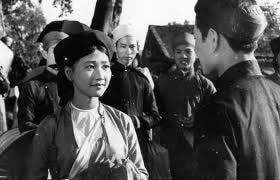 |
| A scene from the movie "Until We Meet Again". |
At the height of her fame, the film studio where she worked faced the risk of closure, leaving her with no more films to act in. Caught in the changing market economy, the lives of artists at that time were precarious and extremely difficult. Therefore, despite being a renowned artist, she spent over 10 years as the owner of a small café called "Quỳnh" on Bát Đàn Street to support her family (her husband is the famous photographer Hữu Bảo; her two daughters, Đan Huyền and Đan Khuê, were still in school). Her patrons were mostly artists and fans, who came to chat or simply admire "Diễm Hương" and "Cô Nết" in real life. Her bright, single-lidded eyes lit up with a kind smile: "Nobody discussed whether the coffee was good or not; they only talked about the films I acted in."
It seems her connection with cinema is inextricably linked to her destiny. Even when she was preoccupied with the worries of making ends meet, directors still sought her out, allowing her to pour her heart and soul into her work, continuing to shine through new characters in films like "The Unmarried Woman's Wharf," "Pao's Story," and "Drifting," even at the age of 50, winning two prestigious awards both domestically and internationally. She was chosen by directors to participate in films with foreign elements: French filmmakers invited her to play the lead role in "Indochine," and the Japanese film "Little Da." Following that came a series of films by Vietnamese expatriate and foreign directors, such as: "Cyclo"; "Vertical Summer"; "Saigon Eclipse"; "Two Girls and the Herb Garden Owner"; "How Long Does the Rain Last?"; "The 'Golden Bride'... Nhu Quynh has become the actress with the most films co-produced with foreign countries. She is a bridge introducing Vietnamese film artists to the world, just as her colleagues say, 'the older the ginger, the spicier it gets!'"
Throughout her artistic career with over 30 roles, Nhu Quynh was honored by the State with the title of Meritorious Artist (1988) and then People's Artist (2007), and the Best Foreign Actress award in South Korea, presented by SBS Television at the end of 2007. It is rare to find a famous actress who leads such a humble, elegant life, imbued with the "Hanoi style" like her. Speaking of Nhu Quynh, one can call her a "Hanoi person" in the truest and most beautiful sense of the word, representing the essence of the people of Thang An (Hanoi).
Le Lan
47, Dang Thuc Hua Street, Vinh City


