
Chung Mountain - a sacred source of water.
Looking across the fields from our paternal hometown of Sen village and maternal hometown of Hoang Tru, Mount Chung emerges amidst the golden hues of the summer sun and the ripening rice paddies. The green of the mountain softens the intense, scorching heat of Nghe An province. On this visit to Kim Lien, we decided to spend time at Mount Chung, where President Ho Chi Minh once played mock battles in his youth and sent his dreams and aspirations flying on kites.
(Baonghean)Looking across the fields from our paternal hometown of Sen village and maternal hometown of Hoang Tru, Mount Chung emerges amidst the golden hues of the summer sun and the ripening rice paddies. The green of the mountain softens the intense, scorching heat of Nghe An province. On this visit to Kim Lien, we decided to spend time at Mount Chung, where President Ho Chi Minh once played mock battles in his youth and sent his dreams and aspirations flying on kites.
The first impression upon reaching Chung Mountain is one of tranquility. This tranquility is both an expression of pristine beauty and embodies the sacredness of a historical site with a rich history. In May, the sun blazed down, yet the air here remained cool and fresh. Stopping at a mountaintop, we felt immersed in a space filled with the sounds of birds. From here, we looked down upon the golden rice fields, where farmers busily harvested their crops.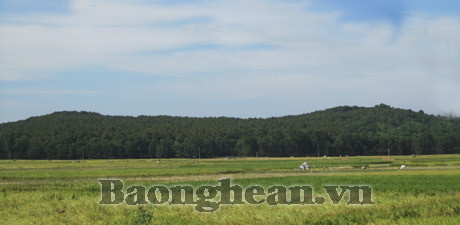
Chung Mountain as seen from President Ho Chi Minh's maternal hometown.
Further in the distance lies the seemingly endless Dai Hue mountain range, the majestic and verdant Thien Nhan mountain range, and the Hung Son (Du Dun) range – a place once considered a "land of mist and clouds," marking the site of the ancient capital of Van An. Following the winding, clear blue Lam River are Lam Thanh mountain – once the administrative center of Hoan Chau – and Dung Quyet mountain – where Quang Trung Nguyen Hue chose to build his citadel...
From Mount Chung, one can gaze in all directions and see the landscape, the rivers, the mountains, and the villages of the region. In this land, every mountain, every stretch of river, and every field is associated with a victory, a glorious chapter in the nation's history. Perhaps, from the time he was a young boy with a topknot, flying kites and playing mock battles with his friends on Mount Chung, President Ho Chi Minh often gazed into the distance to admire the majestic scenery and deepened his love for his homeland. From that, he nurtured the aspiration to travel far, broaden his horizons, and save the people and the country.
Chung Mountain has three peaks. In the past, La Son Phu Tu Nguyen Thiep (1723-1804) left behind a poem: “Chung Mountain has three peaks, shaped like the character ‘Wang’ (王) / Generations of descendants will continue the heroic legacy.” This poem can be seen as a prophecy that this land will continue to produce heroes and valiant figures to save the country and help the people. Legend says that on Chung Mountain lies the tomb of General Le Giac (during the Later Le Dynasty). It was also the training ground of Vuong Thuc Mau, who had passed the imperial examination but instead launched an uprising in support of the Can Vuong movement. Vuong Thuc Mau was the father of Vuong Thuc Quy, a scholar and teacher of President Ho Chi Minh in his youth.
Chung Mountain is also a sacred place. According to some research documents, there used to be Bao Quang Pagoda on Chung Mountain. Initially small, during the reign of King Le Kinh Tong (1600-1619), Duke Dinh Quan Hoang Nghia Phuc, the governor of Nghe An, invested money to upgrade and expand the pagoda, adding a bell tower and planting many precious trees, making the pagoda's landscape more majestic, ancient, and sacred. Chung Mountain is also home to the Thanh Ca Temple, dedicated to General Nguyen Dac Dai of the Tran Dynasty. When the Bon Man rebels harassed the border region, King Tran issued a decree to lead troops to suppress them. He achieved many victories, contributing to the expulsion of foreign invaders and receiving numerous rewards from the king. Later, when the northern rebels harassed the border again, Nguyen Dac Dai was again appointed to lead troops to suppress them. In a fierce battle, the Vietnamese army won, but he was severely wounded. He decided to ride his horse back to his hometown and died upon arrival. When passing through Hoang Tru village, he shed a drop of blood, so the people there decided to build a temple in his honor. Perhaps the sacred energy of Chung Mountain contributed to nurturing outstanding individuals in Nam Dan who will be remembered for generations, including President Ho Chi Minh.
Nearly a year ago, at Chung Mountain, the People's Committee of Nghe An province held a groundbreaking ceremony for the temple dedicated to the parents and siblings of President Ho Chi Minh. Upon completion, the project will become a spiritual site where visitors can express their respect and gratitude for the devotion and sacrifices of President Ho Chi Minh's loved ones. Furthermore, Chung Mountain will gain another sacred source, ensuring lasting peace and prosperity for the homeland.
Tuong Anh


