
Hai Giang fish sauce
(Baonghean) - Visiting Hai Giang 1 fish sauce processing village in Nghi Hai ward (Cua Lo town) during this sunny season, you'll be greeted by the strong, fragrant aroma of ripening fish paste even before reaching the village entrance. Summer is also the ideal time of year for fish sauce makers to dry their fish paste, allowing the sun to ripen it evenly, resulting in delicious, golden-yellow fish sauce. This simple gift from the sea captivates visitors from all over who come to Cua Lo beach.
The salty taste of the salt and the sweetness of the fish further accentuate the distinctive character of Nghi Hai, a coastal village. Originating from the readily available natural resources for fishing and shrimp harvesting from the sea, the people here have known how to process fish sauce since ancient times to meet their daily consumption needs. Over time, as the demand for fish sauce increased, many households in Nghi Hai developed the fish sauce processing industry to supply the market as other essential goods. During the subsidy period, the people of Hai Giang 1 mainly worked as laborers in three seafood processing factories: the Frozen Food Factory, the Cua Hoi Fishing Enterprise, and the Nghe An Fisheries Company. During their years working there, the workers received high-level professional training and accumulated much experience from the production process. When the State abolished the subsidy mechanism and transitioned to a market economy, the factories and enterprises faced difficulties, and the workers returned to their family businesses. The village's fish sauce processing industry also began to develop from here.
Ms. Le Thi Kim and her husband, Mr. Hoang Van Vo, were formerly workers at the Nghe An Fisheries Company and retired under Decree 176. Like many others, they opened a fish sauce processing facility at home using traditional methods. Born and raised in this coastal region, Ms. Kim's love for seafood processing began in her childhood. Combined with her formal training in fish sauce processing at the company, her family started producing fish sauce for the market in 2002. Initially, they operated on a small scale, processing 10 tons of fish per year. Gradually, they expanded production, and today their fermentation tanks have a capacity of 200 tons. They sell 30,000-40,000 liters of various types of fish sauce annually, mainly serving the provincial market and tourists from Hanoi. Now, the Vo Kim fish sauce brand from Hai Giang 1 block is well-known throughout the region.
Rain or shine, customers come to the facility every day to buy fish sauce for personal consumption and to resell in other localities. Customers who have become accustomed to and addicted to Vo Kim fish sauce are numerous. Many people in Vinh City call whenever the stock runs out, and Ms. Kim carefully packages and delivers it directly to them. As for tourists from Hanoi, they call to order dozens of liters of delicious fish sauce at a time, and Ms. Kim sends it via passenger bus. For many years, the Vo Kim fish sauce facility has regularly sold to customers in Hanoi and is continuously expanding its customer base. Hanoians particularly appreciate the traditional fish sauce from Nghe An province, which is both rich in flavor and retains the pure taste of sea fish. Therefore, they often seek out fish sauce from traditional processing facilities that use no additives or preservatives.
Ms. Le Thi Kim shared: "To produce delicious fish sauce, the ingredients must include fresh, unpreserved fish, free from impurities, then mixed with salt to make the fermented fish paste. After adding enough paste to the tank, a thick layer of salt, about 3 cm thick, is applied to prevent insect infestation and spoilage. The process of drying the paste until the fish sauce is ready requires a long time and meticulous processing through each stage, such as pressing, draining the brine, sun-drying, caring for the paste, and extracting the concentrated fish sauce... resulting in fragrant, flavorful drops of fish sauce with the rich taste of the sea."
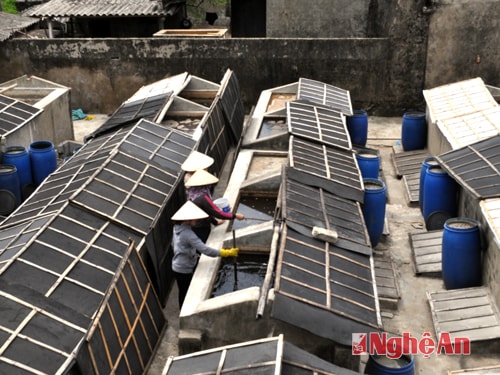 |
| The fermentation tank system of the Vo Kim fish sauce processing facility in Hai Giang 1 block. |
The family of Ms. Nguyen Thi Bien in Hai Giang 1 Hamlet has been making traditional fish sauce for generations. In 1972, when Ms. Bien married into her husband's family, she saw dozens of earthenware jars filled with the fragrant aroma of fermented fish sauce, and she has followed the trade ever since. Now, after more than 40 years of practicing this traditional craft, she has overcome countless difficulties, including initial challenges and the scarcity of raw materials, but she has never lost heart. She remains loyal to the traditional fish sauce making profession, providing her fellow villagers and tourists from all over with the opportunity to enjoy clean, pure fish sauce whenever they visit Cua Hoi and Cua Lo beaches.
Ms. Bien typically produces fish sauce in staggered batches to ensure a year-round supply. Currently, her family has 40 fermentation vats, processing over 15 tons of fish annually to produce 4,500 liters of premium and second-grade fish sauce, primarily serving the needs of the province and tourists from Hanoi. Previously, her family owned a pickup truck used to transport fish sauce, dried fish, and squid to sell in Nam Dan and Thanh Chuong districts. Now, customers often come directly to her house to pick up their orders, eliminating the need for long-distance transportation. Her family's fish sauce is renowned in the region because Ms. Bien strictly adheres to traditional processing methods using fresh sea fish and long-aged, clean salt, without any additives or preservatives.
Ms. Bien confided: "Fish sauce ripens in the sunlight, so we start salting the fish around April and May. During this season, the sun is strong, the fish ripens naturally, producing delicious fish sauce with high protein content and a golden-brown color. The longer it's aged, the sweeter it becomes. My family usually dries it thoroughly for two years before selling the fish sauce; drying it for 1-1.5 years still leaves a fishy smell. Throughout the five months of the dry season, every morning we drain the liquid and dry it in the sun. In the afternoon, we pump the fish sauce back into the fermentation tanks. We patiently dry it in the sunlight to get a delicious, rich fish sauce. The more we stir and dry it thoroughly, the better the fish sauce tastes, leaving a lasting impression on those who try it. When the fish sauce ripens, I usually drain it into earthenware jars and dry it for another two months to eliminate the fishy smell before bottling and selling it."
The Hai Giang 1 fish sauce processing village has 70 households specializing in the production of traditional anchovy fish sauce, averaging about 450,000 liters of various types of fish sauce annually to serve the needs of the province and tourists. The fish sauce here has been recognized by the Intellectual Property Office - Ministry of Science and Technology as the exclusive brand Hai Giang 1 (Cua Lo). Every year, tourists from all over the country buy Hai Giang 1 fish sauce as souvenirs. The reason Nghi Hai fish sauce is favored and trusted by customers is because the product is made from abundant fresh sea fish that arrive at Cua Hoi fishing port daily, resulting in clean fish sauce that meets consumer expectations. In recent years, Cua Lo beach tourism has continuously developed, and a bowl of Hai Giang 1 fish sauce, with its rich flavor of the coastal countryside of Nghe An province, is an indispensable part of the meals served to tourists at restaurants and hotels. Furthermore, during each annual Lunar New Year, Hai Giang 1 fish sauce is a practical and heartfelt gift for relatives. On long journeys back to their hometowns, passengers never forget to bring along liters of this delicious fish sauce, imbued with the love and care of its producers.
For the people of Nghi Hai ward (Cua Lo), practicing this craft not only provides local employment and develops the household economy, but those involved also share a common passion for preserving the traditional craft, ensuring its continued existence over time as a product serving tourism.
Quynh Lan


