
Freshwater fish farming in Thanh Chuong
(Baonghean) - Taking advantage of the abundant water resources from lakes, streams, and low-lying areas, many people in Thanh Chuong district have developed freshwater fish farming models that bring high economic efficiency.
Thanh Chuong district has 7 large reservoirs and over 200 smaller ones. This is an advantage that local people are taking advantage of to develop freshwater fish farming. In Thanh Tung commune, the Cay Vai, Con Song, and Lua Chua reservoirs are known as major fish farming areas. Mr. Nguyen Van Thanh, from Tan Phuong hamlet, who has a 4-hectare fish farm in the Lua Chua reservoir area, said: “Previously, people mainly raised fish for their own family's needs, selling only small quantities because they didn't invest in proper care. However, when they realized the market demand was quite large and the conditions here were favorable for raising many types of fish, people invested in stocking. Besides industrial feed, we also utilize readily available feed sources such as rice bran, cassava pulp, and vegetables, which reduces costs, and the fish grow very quickly. In the next few months, we expect to harvest about 6 to 7 quintals of fish.”
Mastering the characteristics of each fish species, as well as basic techniques in improving farming areas, caring for fish, and treating diseases, are crucial factors in enhancing the economic efficiency of these models. With a farming area of over 3.5 hectares in the Cay Vai dam area, Mr. Nguyen Van Tuong shared: “Grass carp, tilapia, common carp, silver carp… are easy to raise and have few diseases. The food source is made from readily available agricultural by-products at home such as termites, worms, cassava leaves, grass, and rice bran, so the fish grow quickly and have quite delicious meat. It is estimated that each year, the family's farming area yields a profit of nearly 30 million VND.” Assessing the economic effectiveness of fish farming in the reservoirs and lakes in the area, Mr. Nguyen Lam Dung, Secretary of the Party Committee of Thanh Tung commune, added: “Besides the advantage of tea cultivation, the people here also utilize the area of reservoirs, streams, and creeks to develop freshwater fish farming models. Last year, more than 11 hamlets engaged in aquaculture with a total area of 42 hectares. This is one of the directions that helps stabilize the economy for people in the hilly areas.”
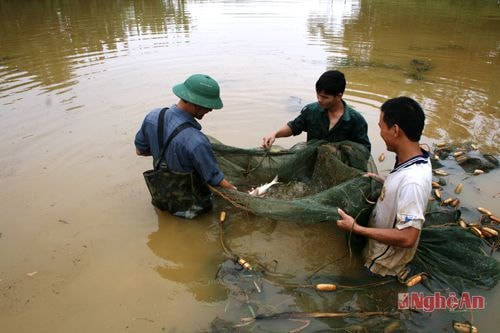 |
| Mr. Nguyen Van Truong harvests fish at the Cay Vai dam in Thanh Tung commune. |
In Thanh Hung commune, farmers have developed rice-fish farming on an area of around 20 hectares. Taking advantage of ponds and low-lying areas, people here often practice intercropping, increasing income on the same plot of land. Mr. Phan Dinh Hy (Hamlet 2) - a rice-fish farmer in Bau Trau - said: “Rice-fish farming has many advantages, because the fish eat insects that harm the rice, stir up the mud, and kill weeds; at the same time, when harvested, the fish eat the scattered rice grains and decaying straw. Fish raised in rice fields, because they use natural food, are delicious and sell at a good price.”
Not content with just a simple fish-rice farming method, Mr. Tran Trong Thang in Hamlet 5, Thanh Hung commune, also combines it with duck farming, earning nearly 100 million VND per year. He said: “Taking advantage of the low-lying rice-growing area in Bau Coi, my family applies the fish-rice-duck model, which has yielded quite stable economic results. The important thing is to master the techniques to have a suitable farming process. After the first month, when the rice begins to flower and the root system is well-developed, we can release the ducks into the rice fields. During the rice flowering period, we only let the ducks graze in the ponds and ditches surrounding the rice fields. Only at harvest time are the ducks released into the rice fields to utilize the spilled rice and other feed. As for the fish, after harvesting the rice, we need to continue raising them for a short period of about 2 to 3 weeks before we start netting them.”
Mr. Nguyen Canh Hanh, Chairman of the People's Committee of Thanh Hung commune, shared: "According to calculations, rice cultivation combined with fish farming brings economic efficiency 2.5 times higher than monoculture rice farming. For households implementing a rice-fish farming method combined with duck raising, the economic efficiency is dozens of times higher, generating hundreds of millions of dong in income each year. Every year, people in the commune mainly focus on raising fish during the winter season to avoid the hot weather and to have a supply for the market before Tet (Lunar New Year)."
Thanh Quynh


