
Mr. Nam "the rickshaw driver"
(Baonghean) - At 85 years old, I suspect Mr. Bui Van Nam is the oldest person still making a living as a cyclo driver, and not just in Vinh. He sits there, leaning back on a plastic chair, his short, white hair and wrinkles on his face creating countless waves. His large, long, rough hands occasionally try to adjust his shirt, which only has a few buttons left. He exudes a weathered, somewhat resigned air. Squinting his cloudy eyes at me, he smiles lightly: "If there are doctors in life, there also needs to be cyclo drivers."
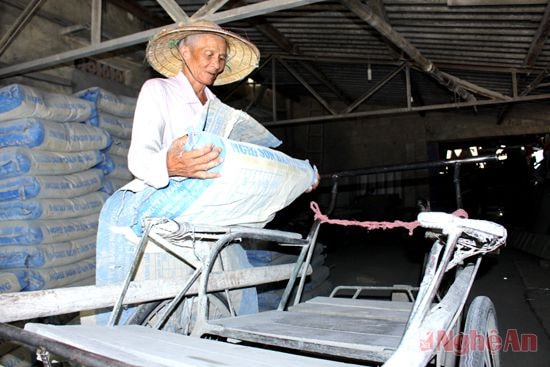 |
| Mr. Nam loads cement onto a rickshaw to deliver to customers. |
That's him talking about himself, about the job he's been doing for almost 35 years: rickshaw driving. That's why in Block 24, Hung Binh Ward, everyone calls him "Mr. Nam the Rickshaw Driver." He says that people aren't being mean to him; it's just a profession tied to his fate. Even he sometimes can't remember the full name his parents chose for him. But what does that matter compared to the worries of making a living in the crowded city, with its countless people rushing in and out? The old man proudly recounted his vibrant youth, his travels from North to South, his experiences in battlefields near and far. And that morning at his building materials shop on Le Hong Phong Street, I was captivated by his nostalgia, the kind of nostalgia a man who has experienced both the sweetness and bitterness of time.
The artillery soldier from the coastal region.
In 1952, Bui Van Nam turned 22. Like hundreds of young men from the coastal village of Dien Loc (Dien Chau), Bui Van Nam eagerly enlisted in the army, answering the sacred call of the Fatherland. At that time, the entire North was seething with anger, and going to war to fight the enemy and save the country became the ideal of life for the younger generation. From his hometown in Nghe An, Bui Van Nam marched with his unit to the battlefield in Northern Laos with the goal of blocking the supply lines of the French colonialists from the Northwest to the Dien Bien Phu front.
The remote, mountainous jungles were incredibly harsh. Lightning-fast battles, nights spent traversing the forest, cutting through enemy lines – the line between life and death was incredibly thin. Many perished in the treacherous jungles before even being hit by bombs. The "green army" perhaps vividly portrays the hardships, difficulties, and tragic heroism of the National Guard soldiers on the battlefields of Northern Laos. After the resounding victory at Dien Bien Phu, Bui Van Nam was transferred to Quang Tri, assigned to the main force of Battalion 15 - Regiment 270, protecting the border area. For Sergeant Bui Van Nam, that could also be considered the best time of his life, participating in the implementation of the Geneva Accords at the 17th Parallel.
The agreement could be broken at any time by ruthless, belligerent forces from the other side of the demarcation line. Simply keeping the national flag flying high along the Ben Hai River was a long and arduous task. During those months, Bui Van Nam was an artillery soldier, serving as a squad deputy. “It was very tense. There were five air raid sirens a day, every single day,” Mr. Nam recalled. After five years at the demarcation line, in March 1959, following a unit reassignment, Bui Van Nam returned to his hometown to work in the construction industry. This was also a requirement of the Party and State for the reconstruction of the homeland and the concentration of labor and production to serve the major southern front. The first project Sergeant Bui Van Nam participated in was the Song Lam Sugar Factory, followed by a series of construction projects, factories, and enterprises in Vinh City. Before retiring in 1981, Mr. Nam was a worker at Construction Company No. 2, and his life took a new turn at this point.
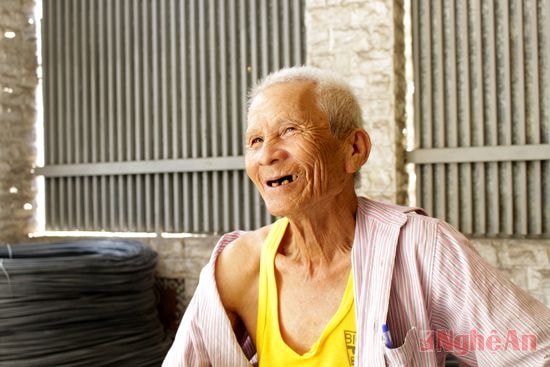 |
| A moment of rest for Mr. Nam "the cyclo driver". |
Mr. Nam, the "rickshaw driver"
With a family of seven to feed, living in the dusty, post-war city streets was difficult on the meager pension of a construction worker. He was still strong, but lacked a practical skill. So, Mr. Nam chose to make a living by operating a three-wheeled vehicle – pulling a three-wheeled cart. “Back then, Vinh didn’t have tractors or cars. The main means of transporting goods was horse-drawn carts, and three-wheeled carts were the most common,” Mr. Nam said with a kind smile. People called him Nam “three-wheeled cart.” “It doesn’t matter, it’s good enough that they remember my ‘nickname.’ At least my wife and children have something to eat.” For this 85-year-old man, the philosophy of life is simple. He is never ashamed or self-conscious about his work and his way of making a living. Indeed, why should one feel inferior or ashamed when earning a living through one’s own abilities and labor?
He pulls a rickshaw, his son pulls a rickshaw too; dozens of people in Hung Binh have become attached to this profession. More importantly, it's the clothing for his wife and the pen for his children. For nearly 10 years, Mr. Nam supported his family by rickshawing through the streets. I suspect that if you added up the distances he'd covered in almost a decade of rickshaw driving, his footsteps could have circled the Earth several times. But why, Mr. Nam, why not choose a lighter job to support your old body? The old man chuckled, revealing his few remaining crooked teeth: "I don't know, that's just how fate is. I like this job. It suits me."
The country is undergoing reforms. Society is developing. Vinh City is also developing. Mr. Nam, the "rickshaw driver," is also "upgrading." The rickshaw seems no longer suitable for the times. In 1990, Mr. Nam switched from rickshaw driving to pedaling a cyclo. It's still a physically demanding job, but transporting goods by cyclo is easier and faster. And he never carries passengers, only goods. Surely, deep down, he doesn't want to be looked down upon any more, or perhaps he doesn't want people to feel uncomfortable riding in front of an old man. And occasionally, Mr. Nam hears people talking about someone with 30 years of experience in the healthcare industry, or someone else with 40 years in the education industry.
He also quipped, "I've been a cyclo driver for 25 years, plus my experience as a tricycle driver, that makes 35 years in total." Mr. Nam has five children, two sons and three daughters. All his children were raised by their father's tireless efforts. He wasn't fortunate enough to have children who grew up to be successful and wealthy like many others. His two sons, who used to be cyclo drivers, have now switched to construction, earning a living as day laborers rather than working for any organization. "They've all moved out, each of them has to take care of their own family. I don't have the means to help them. Why blame them?" he said, his eyes veiled in a silvery mist. Because he doesn't blame or resent anyone, Mr. Nam, the cyclo driver, has quietly continued his cyclo rides for a quarter of a century.
The journeys back and forth between Hung Dong and Hung Loc over the years helped him keep his family stable amidst the turbulent times. Even so, he couldn't keep his life partner by his side any longer. His wife, Pham Thi Hong, passed away on a stormy day more than a year ago. Dying at the age of 77, she surely had no regrets, having devoted her life to the man who had chosen his wife, children, and family as his faith and purpose. During her lifetime, no one ever saw her do any strenuous work; her husband took care of everything. Those unfamiliar with the situation might think he was being tormented by life, but few knew that his wife suffered from heart disease and many other ailments. And Mr. Nam considered caring for his life partner his greatest joy and happiness.
After his wife passed away, the old man became even more withdrawn. Months went by without seeing Mr. Nam, the cyclo driver, waiting for customers at number 80, Le Hong Phong Street – the spot where he had worked for over two decades. Customers called, but he didn't answer. Everyone thought he had given up the profession. But then, at the beginning of this year, he reappeared at the same spot, older and more toothless. "Before, I used to carry 700 or 800 kilograms of cement, now I can only carry a few hundred kilograms," he said. Oh, Mr. Nam! At 85, why is it so hard? "I can still work. I have to support my disabled daughter and my granddaughter who's in 9th grade this year. My son-in-law died in a traffic accident. My pension isn't enough." And so, day after day, people see the old man hunched over, straining to pedal his cyclo through the bustling streets amidst the blaring car horns. He mainly transports construction materials for regular customers. He said that people could have just sped off on their motorbikes, carrying a few bags of cement, but they didn't. They called Mr. Nam "the rickshaw driver" because they respected him and wanted to help him. That's also a kind of humanity.
Opposite where Mr. Nam "the rickshaw driver" waited for customers was a tall, luxurious three-story house. The owner of that house was a close friend of Mr. Nam's. The two were from the same hometown, joined the army on the same day, and fought together in the North Laos battlefield. However, life led them down two different paths. After the war, his friend studied to become a doctor, working at a large provincial hospital, and his children are all successful and prosperous. Meanwhile, the former artillery sergeant is now known as Nam "the rickshaw driver." "It's nothing, I occasionally go to his house for a drink and a chat. If there are doctors in life, there also needs to be rickshaw drivers," he said with a light smile before getting on his three-wheeled bicycle. The southern sun shone brightly, but the wind was biting.
Text and photos:Dao Tuan


