
Falling in love with folk songs
(Baonghean) - Just one folk song can stir the hearts of those far from home in a strange way. A whole childhood memory, a realm of remembrance and affection, comes vividly to life. Nothing is as powerful as music, nothing is as heartfelt and profound as the folk songs and chants of the past...
1.Over 10 years ago, during a trip to Kim Lien to learn about the folk singing style of Nam Dan, I visited the home of teacher Nguyen Huu Cu. Many people found it hard to understand why he suddenly felt the desire to preserve these old melodies, establishing a folk singing club and hoping to revive the traditional atmosphere of folk singing.
I once thought that he – a native of Duc Tho (Ha Tinh province), but whose fate led him to Kim Lien – had an "extreme" love for the folk songs of the weaving guild. He loved them so much that he believed every twist and turn in his life was due to them. He loved them so much that he was willing to spend his own money on anything related to popularizing and preserving them. He loved them so much that, in the scorching midday sun, he forgot his meal and took me to the homes of some elderly artisans in Hoang Tru village, hoping I could "feel" the folk songs of the past… And he was "extreme" when it came to the stage; if the folk songs of the weaving guild weren't performed in brown robes and sung to the rhythm of a spinning top, he considered it a "fake" version, no longer authentic to the weaving guild…
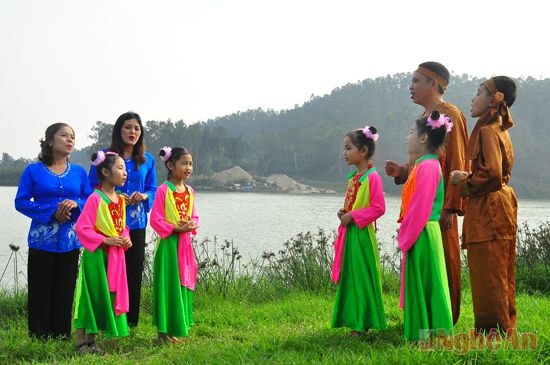 |
| Folk singing by the Lam River by the Nam Dan Folk Song Club. Photo: Tran Hai. |
On that sunny afternoon more than 10 years ago, in a simple house in Hoang Tru village, I heard from the depths of my aging chest the poignant folk song of the silk weavers. The song has endured through the months and years, through the ups and downs of life, of the homeland, and of human destiny, yet it remains here, deep within my heart: “Where is your hometown, sir? How do you know about the mulberry garden with silkworms…?”
From that moment, I knew I had fallen in love with the folk song. A son of the North had fallen in love with the folk song about white sand and the Lao wind…
Now I understand why Mr. Cu, a teacher who had wandered the world his whole life, returned to folk songs in his final days. Those songs of his homeland had become his very blood and flesh. Just like the poet Nguyen Duy, "sitting sadly remembering my mother of old": Milk nourishes the body, songs nourish the soul. What other songs could have nurtured the souls of the people of Nghe An besides folk songs and chants?
Later, many times, as I traveled through the countryside of Nam Dan, I always imagined moonlit nights over mulberry fields and hedges. Somewhere, countless footsteps once flocked to the weaving village of Mrs. An (Mrs. Hoang Thi An, President Ho Chi Minh's maternal aunt), where a grove of trees, a grain of sand, still held the lullabies of Mother Hoang Thi Loan during her nights of weaving. Some corner, in the vastness of present-day space, still lingered the image of a person "going to listen to singing, trousers rolled up at the head of the yard," adding to the poignant sorrow of "a people who have lost their country and are suffering."
The people of Nam Dan also told me many anecdotes about a man named Giai San (i.e., Phan Boi Chau) and a man named Tu San, both of whom were fond of the weaving guild and were "teachers" of many folk singing nights. Those folk singing nights, bathed in moonlight and filled with happiness, became a beautiful, dreamy memory in Phan Boi Chau's soul. Even though the moonlight was hazy and indistinct, even though the distant, dull rumbling of the spinning wheel seemed to lull people into oblivion, even though the folk songs soared high but held a deep sadness, those folk singing nights were real. And the young man Giai San, hesitantly standing by the hibiscus bushes, sang witty songs in response to the girls spinning yarn. He smiled to himself in the moonlight. He had experienced those beautiful, dreamy days in his homeland, which would later lead to a long, arduous, and heroic life.
2.My niece, a young woman in her 20s studying at a university in Hanoi, was surprised to learn how much I love folk singing. And she surprised me too when she revealed that, instead of idolizing young singers or famous foreign artists, she idolizes the folk singers who perform in the fields of her homeland. It was folk singing that brought us closer together—aunt and niece, from two different hometowns, two generations.
My niece confided in me like a friend: "Auntie, we all went to listen to the folk songs and chants when we heard that the Nghe An Folk Song Troupe was performing in Hanoi. When People's Artist Hong Luu sang the line: 'Who knows whether the water of the Lam River is clear or muddy, then they know whether life is shameful or glorious,' my friends and I were all deeply moved. Some even shed tears. In this foreign land, after so long immersed in busy lives, just one simple and gentle melody brought back a flood of memories and longing..."
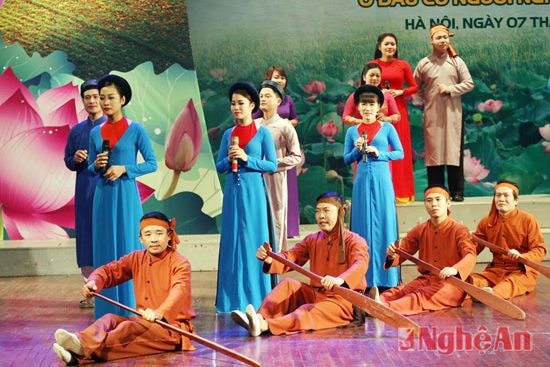 |
| The Center for Preservation and Promotion of Nghe An Folk Song Heritage performs Vi Giam folk songs in the capital. Photo: PV. |
Then, after my grandchild went to see the performance, I saw these lines on Facebook: “I remember the days when I was a child, during the planting season I would follow my grandmother to the fields to sow rice seedlings. In the afternoons, running along the dike, I would hear the giggling of the women and aunts mixed with the sweet melodies carried on the wind: 'If you love, love firmly / If there are problems, solve them completely / Don't be like a rabbit standing at the edge of the field / Playing in the shadows when happy, abandoning its shadow when sad.'" The lyrics, sung amidst hardship, were still incredibly poetic and lovely.
As I grew older, I would often sit in the evenings with a group of adults from the neighborhood, engrossed in listening to the uncles and aunts humming along to their old karaoke system. They sang as if they hadn't had to endure the scorching sun that day. They sang as if they hadn't had to carry sacks of rice heavier than their own bodies that afternoon.
And so, my young, innocent soul fell in love with the folk songs, becoming captivated and enthralled by them, even though I may not have fully understood all the lyrics at the time.
Growing up, my feet have left their mark on every road of our homeland. There were times we spent millions of dong to enjoy a night of music. The artists on stage were magnificent and full of passion, but none could penetrate my heart as deeply as the image of those aunts and grandmothers, their faces weathered by sun and rain, their voices radiant. In that moment, these laborers transformed into artists, not only transmitting songs to me but also instilling optimism amidst hardship and struggle, making me understand and feel proud of my people – those who lived peacefully in the vast fields, who believed in life amidst the bitterness and hardship of our impoverished land. Just one folk song stirred the hearts of those far from home in a strange way. A whole childhood memory, a realm of remembrance and affection, vividly emerged. Nothing is as powerful as music, nothing is as heartfelt and profound as the folk songs and melodies of the region.”
And I would like to say a word to Mr. Cu, who passed away a few years ago due to illness, about his worry that if those folk songs were to disappear one day: Mr. Cu, please rest assured, today and forevermore, wherever there are people from Nghe An, the folk songs will still be sung, still evoke emotion. Because folk songs are the soul of Nghe An in the soul of Vietnam, from ancient times to the present day, and will remain so!
Thuy Vinh
| RELATED NEWS |
|---|


