
Striving to soon become a relatively prosperous district of the province.
(Baonghean) - For the 2015-2020 term, Hung Nguyen aims to focus on attracting investment to develop infrastructure, shift the economic structure, and bring the proportion of industry, handicrafts, and services to over 80%. At the same time, it will prioritize the development of agriculture and rural areas by applying new scientific and technological advancements, striving to soon become a prosperous district of the province.
To achieve the above objectives, the district will focus its leadership and direction on key tasks and solutions in the coming term. This includes a strong emphasis on planning, programs, projects, and policies for development: proactively reviewing and supplementing the overall socio-economic development plan of the district and the plans for various sectors and fields up to 2020. Coordinating with Vinh City to implement the policy of expanding urban space according to Decision 52/QD-TTg. Collaborating with the Becamex - Sembcorp joint venture to implement the VSIP6 project. Developing and implementing programs and projects, focusing on the program for developing commercial agricultural production linked to the construction of new rural areas; developing the economy of the riverside areas along the Lam River, producing clean agricultural products linked to the application of science and technology; attracting investment, developing key infrastructure projects, developing budget revenue; and training human resources to meet development requirements. The administrative reform program is linked to improving the effectiveness and efficiency of state management. It continues to evaluate, supplement, and adjust policies and mechanisms to ensure suitability, prioritizing areas with potential and advantages, or those lagging behind the provincial average.
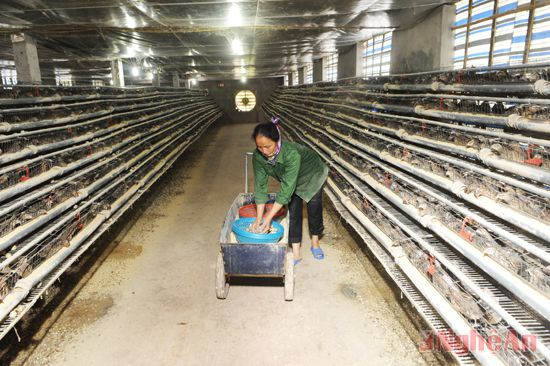 |
| Harvesting quail eggs in Hamlet 2, Hung Dao Commune. Photo: SM |
Simultaneously, accelerate the economic restructuring, striving to bring the proportion of the industrial-construction and service sectors to over 80%; with a strong focus on attracting investment, especially the VSIP6 Nghe An project. This is identified as a large, important, and breakthrough project aimed at shifting the economic structure in the next term. Strengthen foreign relations, promote investment, and effectively implement the Public Investment Law and the Bidding Law to improve the efficiency of investment programs and projects. Accelerate the progress of land clearance, resettlement, and construction of projects, focusing on: the VSIP6 project, the 72m Vinh - Hung Nguyen road, the road connecting historical sites, the road connecting Cau Den bridge to National Highway 1 bypassing Vinh City, Le Xuan Dao road; the Central Park Lake of the district, Hoang Muoi Temple, the Soviet-Nghe Tinh Square, and the district administrative headquarters. Simultaneously, attract investment in eco-tourism and culinary projects in Thach Tien and Lam Thanh, as well as production and business establishments and urban areas in communes and towns. To promote economic restructuring and growth towards industry and services, it is necessary to effectively develop the five recognized craft villages, build brands for craft products such as rượu (rice wine), peanut candy, and bánh đa (rice crackers), and strive to establish several new craft villages such as those specializing in mechanics, welding, and high-end carpentry. The urban spatial development plan for the west of Vinh City should serve as a guideline for service development; simultaneously, service development should be based on completing the network of rural markets, commercial centers in towns and townships, and services along main roads, as well as serving the VSIP6 project. Furthermore, the development of service and tourism activities associated with cultural, historical, spiritual, and scenic sites in the district should be encouraged.
In addition, the district will strengthen the mobilization of resources to effectively implement the national target program for building new rural areas. The district will direct communes to review, supplement, and effectively manage the planning for new rural construction. It will promote the movement of jointly building new rural areas, increase the attraction of resources through social mobilization, and leverage internal resources to mobilize people's strength. It will also strengthen investment promotion and land exploitation, integrate various capital sources, prioritize resources for key communes and disadvantaged communes to accelerate the progress of new rural construction, and focus on implementing production models and investment projects for rural infrastructure development according to the new rural planning. The goal is to have at least 17 out of 22 communes (77%) meet the new rural area standards by 2020, including 2-3 communes achieving model new rural area standards.
To improve product quality and rapidly increase production value, it is necessary to establish large-scale model fields for concentrated commodity production. Land consolidation should be linked with the upgrading of transportation and irrigation systems, while proactively revising maps and issuing land use rights certificates to farmers after the conversion. Continue reviewing and issuing policies and mechanisms to support production development, and strengthen cooperation among the "four stakeholders" (farmers, businesses, scientists, and the government) in applying science and technology, providing inputs, and guaranteeing outputs.
Simultaneously, promote the application of information technology in management and administration at all levels and sectors, from the district to the grassroots, and in production and business activities. Direct and guide farmers to effectively implement the restructuring of crop and livestock production, seasonal schedules, production techniques, and intensive farming. Encourage businesses to invest in the agricultural and rural areas, support people in implementing large-scale model fields and product distribution. Select and attract investment projects that are suitable to the district's potential and advantages, prioritizing the development of clean industries, supporting industries, and the application of new technologies.
To ensure synchronized development and social security, it is necessary to improve the quality of human resources to meet development requirements. Strengthening job creation, expanding the labor export market, especially to stable, high-income markets, and prioritizing vocational training for those whose land is reclaimed by the State for project implementation are crucial. Mechanisms should be established to attract vocational training projects and social security credit funds to meet the capital needs of the poor, policy beneficiaries, and students, enabling them to study and improve their skills. However, to achieve comprehensive results, the most important thing remains reforming organizational and personnel management, effectively implementing planning, recruitment, training, and development of personnel, especially at the grassroots level.
Looking ahead, while many difficulties and challenges remain, with the spirit and revolutionary traditions of the heroic Soviet homeland, the homeland of General Secretary Le Hong Phong, we are confident that with the spirit of "unity, democracy, cooperation, proactiveness, innovation, and creativity," the district will strive to successfully achieve the goals and tasks of the Resolution of the 28th District Party Congress to bring Hung Nguyen to a new level of development.
Ngo Phu Han
(Deputy Secretary of the District Party Committee – Chairman of the District People's Committee)


