
Phan Thai At - A staunch revolutionary fighter
(Baonghean.vn) - At the Yen Xuan Museum (a National Historical and Cultural Relic) in Linh Son commune (Anh Son district), there is an exhibition of photographs of the first generation of revolutionary fighters from Anh Son district. In the front row is a photograph of a young man with a benevolent face, a high forehead, and resolute eyes. This is Phan Thai At (1894-1967) - the first Secretary of the Yen Xuan Party Branch, and later the first Secretary of the Quang Ngai Provincial Party Committee.
(Baonghean.vn) - At the Yen Xuan Museum (a National Historical and Cultural Relic) in Linh Son commune (Anh Son district), there is an exhibition of photographs of the first generation of revolutionary fighters from Anh Son district. In the front row is a photograph of a young man with a benevolent face, a high forehead, and resolute eyes. This is Phan Thai At (1894-1967) - the first Secretary of the Yen Xuan Party Branch, and later the first Secretary of the Quang Ngai Provincial Party Committee.
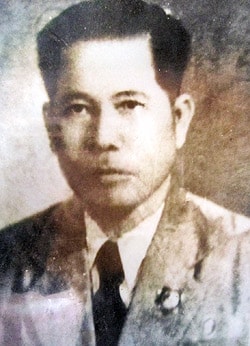
Portrait of revolutionary soldier Phan Thái Ất (archival photo).
Phan Thái Ất was the youngest son in a family with a rich tradition of patriotism and love for the people in Yên Xuân village (now part of Lĩnh Sơn commune, Anh Sơn district). His father and uncle participated in the Văn Thân and Cần Vương movements, but fell into the hands of the French invaders, suffering brutal beatings yet maintaining their integrity. From a young age, Phan Thái Ất witnessed the hardships and suffering of the people under the colonial-feudal regime, along with the greed, cruelty, and inhumanity of the local powerful figures and collaborators of the French colonialists. At the age of eight, he was orphaned, and his mother was tortured by the French collaborators, beaten on the head with a sword, causing serious injuries. His hatred was ignited from that experience. Despite the difficult circumstances, his mother still allowed him to study classical Chinese and the Vietnamese Quốc ngữ script. His teacher was a patriotic man who always cited the examples of heroes from the past and present to instill patriotism in his students.
Entering his youth, Phan Thái Ất and a few close friends frequently met to exchange new information from books and newspapers, as well as information gathered from those involved in revolutionary organizations. In 1922, he initiated the formation of the Tâm Giao group with the aim of exchanging information, disseminating books, newspapers, and poetry to encourage patriotic spirit. This included documents about the revolution and patriotic poems by the patriot Phan Bội Châu. Later, the members of the Tâm Giao group decided to pool their land and capital to open a traditional medicine shop. Two years later, with a considerable amount of capital, the Tâm Giao group expanded their business to include general merchandise and became increasingly successful. They decided to change their name to Hội Ái Hữu (Friendship Association) and bought a two-story wooden house; the ground floor was used for selling goods, and the upper floor for receiving guests and as a meeting place for like-minded individuals. The house was named Hiệu Yên Xuân (Yen Xuan Shop).
Through books and newspapers, people learned about the activities of the Vietnam Revolutionary Youth League and actively responded and supported it. Later, based on the Mutual Aid Association, a branch of the Vietnam Revolutionary Youth League was established with Phan Thai At as its secretary. By September 1929, the Vietnam Revolutionary Youth League branch in Yen Xuan was transformed into a branch of the Indochinese Communist Party. This was the first branch in Anh Son, and also one of the first branches established in the rural areas of Nghe An. At that time, Phan Thai At was appointed secretary of the branch by Comrade Nguyen Phong Sac, a Central Committee member in charge of the Central Committee of the Central Region. Comrade Nguyen Phong Sac asked: “Our Party is just beginning to be established. The enemy is still strong, and operations will be very difficult. Do you think we can do it? Should we do it now or wait for another time?” After some thought, Phan Thai At replied, "I know it's difficult, but if we want future generations to continue, we must start now."
At the end of 1929, at the founding conference of the Nghe An General Farmers' Association, Phan Thai At was again appointed Secretary of the Association. Remembering the advice of Comrade Nguyen Phong Sac, "Once the Party exists, we must make the people aware of the Party," Phan Thai At enthusiastically went to build Party bases in Thanh Chuong, Yen Thanh, and Dien Chau districts. Through a period of revolutionary activity, he drew a valuable lesson: "Every task, no matter how small, that is good and beneficial to the people is meaningful to the Party."
In early December 1929, while engrossed in his work, Phan Thai At received a summons from Comrade Nguyen Phong Sac. He handed over documents to his older brother, who was also involved in revolutionary activities, and went to Vinh to receive a new assignment. After a period of time assisting Comrade Nguyen Phong Sac along with several other comrades (including Nguyen Duc Canh), Phan Thai At was assigned to work and build a base in the South Central provinces, with the following advice: “In those provinces, the mobilization work is just beginning, and the enemy is still very wary. Making revolution is difficult. You will miss your family very much. Soon, you will have to do everything alone, which can easily lead to discouragement. You must be very determined and always think of the Party, relying on the collective and the people to do your job.”
In the provinces of Quang Nam, Quang Ngai, Phu Yen, and Quy Nhon, Phan Thai At worked various jobs such as pulling carts, painting, carrying loads, plowing for hire, and dispensing medicine. These jobs not only helped him make a living but also provided him with opportunities to mobilize and enlighten the masses to follow the Party and build a base. Particularly in Quang Ngai, Phan Thai At established many bases, eventually leading to the formation of a provisional Provincial Party Committee, where he was appointed Secretary.
At this time, the Soviet movement had erupted in Nghe-Tinh, with uprisings against the powerful landlords occurring simultaneously throughout his homeland. He dreamt of a scene of blazing fires illuminating the Lam River, Vinh town, and all the rural areas where he had helped to establish revolutionary bases. In early October 1930, in response to the Nghe-Tinh Soviet movement, Phan Thai At directed demonstrations in Quang Nam and Quang Ngai. The center of the movement was Duc Pho district (Quang Ngai), where the people surrounded the district headquarters, forcing the district chief to flee. Afterward, the movement spread to all the districts in the area. Seeing the movement developing strongly and widely, this communist soldier from Nghe An was filled with joy and silently exclaimed: "Nghe-Tinh! The people of Quang Ngai are rising up together under the banner of the Party!" But soon after, the movement was brutally suppressed and terrorized by the enemy, and many revolutionary fighters fell into their hands, including Comrade Nguyen Nghiem, Deputy Secretary of the Quang Ngai Provincial Party Committee. The revolutionary base was destroyed, and communication lines with higher levels were cut off. Phan Thai At was also exposed and relentlessly hunted by the enemy, but he always received help and protection from the people. Despite these difficult and dangerous circumstances, he remained determined to maintain the movement and find ways to re-establish communication lines.
On July 22, 1931, Phan Thai At was arrested while waiting for a liaison from the Provincial Party Committee to receive documents. Taken to Quang Ngai prison, the enemy questioned him: “We never imagined you, a communist, would build up movements everywhere, causing us so much trouble. What do you think now?” Phan Thai At boldly replied: “What do I think? I live to work for the revolution, and I will die for the Party and the revolution.” The enemy continued: “And as for you, do you also want to live?” Without a moment's hesitation, he answered: “My life belongs to the people and the Party.” At that moment, he planned how he would die to create an impact for the revolution and the Party. Threats and persuasion failed to sway the will and determination of this communist fighter, and finally, the French colonialists sentenced him to death. However, public opinion and the people vehemently protested the sentence, forcing them to reduce it to life imprisonment and exile him to Buon Ma Thuot prison.
Here, he met comrades Phan Đăng Lưu, Tôn Quang Phiệt, and many other steadfast revolutionary fighters. He and his comrades fought relentlessly against the enemy, demanding clean food and drink, medicine and soap, and protesting against beatings and working overtime. Then, they all composed poetry and prose to propagate and encourage each other to maintain revolutionary integrity in the face of the brutal and savage blows of the enemy. And he wrote a few verses brimming with enthusiasm and faith: “Walking too much makes my feet tired, so I have to sit down / Sitting to watch the play on the stage / The enemy, triumphant, puffs up their cheeks and shouts / The dog-like general shows off his power, tearing at his prey / Let my flesh be torn apart, I don't care / My bones are shattered, but I will not retreat / When the curtain falls, we will know who wins / Righteousness will always shine brightly.”
Later, in May 1935, Phan Thai At was exiled to Con Dao Island. In this place, considered a "hell on earth," he met steadfast revolutionary fighters such as Ton Duc Thang, Nguyen Duy Trinh, To Chien, and Vo Thuc Dong... Under strict surveillance and brutal repression, Phan Thai At and the imprisoned revolutionaries continued their struggle in various forms. In particular, they regularly organized reading sessions to keep abreast of domestic and international affairs, held cultural and political classes, and promoted increased production. They even published a newspaper called "General Opinions." In his memoirs, Phan Thai At confided: "In this situation where the enemy was pushing us to the brink of death, the camaraderie and class solidarity shone brightly, becoming extraordinarily profound. We remained optimistic, confident, and determined for the Party because of that."
Following the success of the August Revolution, Phan Thai At and other revolutionary fighters were captured and imprisoned on Con Dao Island. The Government of the Democratic Republic of Vietnam sent ships to pick them up and bring them back to the mainland. His health deteriorated, and although his superiors offered him the opportunity to return home for rest and treatment, he volunteered to stay and work, and was assigned to Cambodia to help build a resistance base. In 1953, Phan Thai At was summoned back to Vietnam by the Central Committee to prepare for the Dien Bien Phu campaign, a journey that took exactly one year. On this occasion, he had the chance to visit his hometown after 23 years of separation. By then, his beloved mother had passed away. His hardworking wife initially couldn't believe he was still alive to return. But he was still happy and excited because his long-held dream had come true: the land had returned to the farmers. After a few days at home, he set off again for Viet Bac.
In 1961, Comrade Phan Thai At retired to his hometown and continued to actively contribute his intellect to the development of his homeland and village. Due to old age and declining health, the wounds inflicted by torture and beatings during his imprisonment recurred, tormenting this steadfast revolutionary fighter until his death in mid-1967. Nearly 50 years have passed since his passing, yet his name lives on in the hearts of the people of Nghe An and Quang Ngai provinces, and in the revolutionary cause of our Party.
Cong Kien


