
Exposing China's non-existent trip to the Paracel Islands.
The 1902 expedition, which never actually happened, was included in history books. This fact was exposed by the French geographer François-Xavier Bonnet.
It is hardly surprising that English-language articles on the dispute, written by Chinese authors and based on Chinese sources, tend to favor China.
Cheng assessed that "it can be said with confidence that China's claims to sovereignty over the islands in the South China Sea are stronger." Chiu and Park concluded, "China's claims to sovereignty over the Paracel and Spratly Islands are stronger than Vietnam's."
Author Shen's viewpoint is clearly expressed from the titles of the articles: "Principles of international law and historical evidence support China's claim of sovereignty over the islands in the South China Sea" and "China's sovereignty over the islands in the South China Sea".
These assertions still have an influence today: for example, they are cited in Li and Tan's 2014 papers. However, a closer examination of the evidence these papers rely on reveals that they are not entirely reliable. The papers from 1933, 1956, and 1974 should not be considered neutral evidence, but rather a biased interpretation of a controversial history.
The scope of this article is insufficient to cover every claim made by the authors regarding events prior to the 19th century. In summary, the writings of Cheng, Chiu, and Park, Samuels and Shen all share the common view that China has always been the dominant power in maritime affairs, trade, and fishing in the South China Sea.
For example, Cheng wrote that, "It [the South China Sea] has been an important part of the sea route from Europe to the East since the 16th century, a haven for fishermen from Hainan Island and a gateway for Chinese merchants from southern China to Southeast Asia since ancient times."
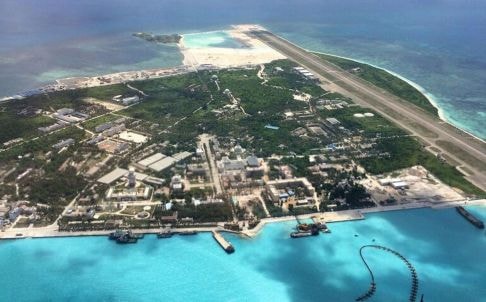 |
| China brazenly released photos of a newly constructed runway on Phu Lam Island, part of Vietnam's Hoang Sa (Paracel) Islands (Source: Internet). |
However, more empirical historical studies of the South China Sea suggest that the actual situation is far more complex. The works of historians Leonard Blussé, Derek Heng, Pierre-Yves Manguin, Roderich Ptak, Angela Schottenhammer, Li Tana, Nicholas Tarling, and Geoff Wade have shown that numerous nations were involved in the use of the sea during the pre-modern period.
Chinese ships and merchants played virtually no role in maritime trade until the 10th century, and even then they never dominated the seas, which were shared by Malays, Indians, Arabs, and Europeans. Research by François-Xavier Bonnet, Ulises Granados, and Stein Tonnesson shows how similar situations persisted in the region into the 20th century.
According to records from the early 20th century, the Chinese state struggled even to control its own coastline and was completely incapable of extending control to islands hundreds of miles offshore.
For example, two articles in The Times of London from January 1908 described the inability of Chinese authorities to control piracy on the West River.
An article published in 1909 in Australia's The Examiner reported that foreigners ("two Germans, one Japanese, and several Malays") had begun mining operations on Hainan Island without the knowledge of Chinese authorities until much later.
What these contemporary records show is that, until the mid-20th century, the South China Sea was essentially ungoverned, except for occasional interventions by foreign powers to combat piracy.
It wasn't until 1909, following the scandal involving the occupation of Dongsha Island by Japanese fertilizer businessman Nishizawa Yoshiji, that Chinese authorities began to pay attention to the offshore islands.
Regarding the 1887 Border Demarcation Treaty
However, author Samuels argues that a tacit claim of Chinese sovereignty over the Spratly Islands may have existed since 1883, when, according to his records, the Ming dynasty officially opposed an expedition to the islands sponsored by the German government. The only basis for this assertion is an article in the May 1974 issue of the Ming Pao Monthly in Hong Kong, without any further corroborating evidence.
Chiu and Park (in footnote 47) also relied on an article published in a 1933 issue of the Diplomatic Monthly, 50 years after the aforementioned questionable events had occurred. Heinzig and Samuels later also cited this issue of the Ming Pao Monthly when stating that the 1883 German expedition was indeed forced to retreat again after Chinese opposition.
The above claim seems highly unlikely, as German explorers mapped the Paracel Islands (not the Spratly Islands) between 1881 and 1883, completed their work, and then published a nautical chart. The French edition was published in 1885.
Samuels wrote that the 1887 Sino-Tonkin border demarcation treaty, negotiated by the French government, nominally representing northern Vietnam, had the value of an international agreement dividing islands for China. Article 3 of the treaty effectively divided islands east of the Paris meridian 105°43' for China.
However, Samuels and other authors failed to note that the Treaty applied only to Tonkin – present-day northern Vietnam – and therefore could only relate to the islands in the Gulf of Tonkin.
The Paracel and Spratly Islands, located much further south, in what was then the territory of Annam (central Vietnam under the rule of the Hue court) and Cochinchina, were not mentioned in the Treaty.
The journey of 1902?
There also appears to be some confusion regarding the exact timing of the first visit by Chinese officials to the Paracel Islands.
Based on an article in the Ming Pao Monthly in 1974, Samuels stated that the time period was 1902, with a return trip in 1908. Austin and Dzurek also adopted Samuels' opinion on this point. Li and Tan (in 2014) also asserted their claim of sovereignty in 1902, along with a separate expedition in 1907.
Cheng again identifies the year as 1907, based on 1933 sources such as those mentioned by Chiu and Park, which are an edition of the National Weekly. However, in contrast to these accounts, which were written 26-72 years after the events they describe, a survey of contemporary press clearly shows that the first expedition by Chinese officials to the Paracel Islands was in 1909.
There is a valid reason for the confusion surrounding the 1902 expedition. In June 1937, Huang Qiang, the leader of China's 9th Administrative Region, was sent on a secret mission to the Paracel Islands, partly to check for Japanese activity on the archipelago.
However, Hoang had another role, which was clarified in a confidential appendix to his report.
An excerpt from this appendix was published in Chinese in 1987 by the Guangdong Provincial Committee for Place Names. His boat carried 30 stone markers, some dated 1902, others 1912, and the rest 1921.
On North Island, he buried two markers dated 1902 and four markers dated 1912; on Linh Chau Island, Hoang's team buried one marker dated 1902, one dated 1912, and one dated 1921. On Phu Lam Island, they buried two markers dated 1921. Finally, on Da Island, they buried one marker dated 1912.
The markers were forgotten until 1974, when, after the Paracel Islands conflict, they were found and this "discovery" was announced in Hong Kong newspapers, such as the Ming Pao Monthly.
This non-existent 1902 expedition was subsequently included in history books. It wasn't until recently that the truth was revealed by the French geographer François-Xavier Bonnet.
(According to VNN)
| RELATED NEWS |
|---|


