
Leveraging the advantages of large-scale timber plantation.
(Baonghean) - Effectively leveraging the advantages of forests and forest land to develop forestry as a sustainable occupation for people in many localities in Nghe An. Besides promoting linkages between raw material areas and processing enterprises, expanding the area of forests for large-scale timber production brings high economic value.
Increase the area of large timber forests.
The Provincial People's Committee has just issued a decision approving the Project for Restructuring the Forestry Sector in Nghe An Province until 2020, which aims to achieve a forest cover rate of 57% and increase the industry's production value by 4-4.5% per year. The project also aims to protect and develop existing forest areas, gradually meeting the demand for timber and forest products for consumption and export; converting 15,000 hectares of existing planted forests into large-timber production forests; planting new large-timber forests on 8,000 hectares of unforested land; and replanting large-timber forests on 30,000 hectares of previously harvested land.
The focus of large timber tree species in the area includes: acacia mangium, eucalyptus, Dalbergia tonkinensis, green lim, black ebony, fir, and pine, with acacia being the main species, covering 90% of the area. The project also considers pine trees as a strength of the province and aims to maintain and develop 21,000 hectares of pine trees planted in protective and production forest areas to combine economic development and environmental protection.
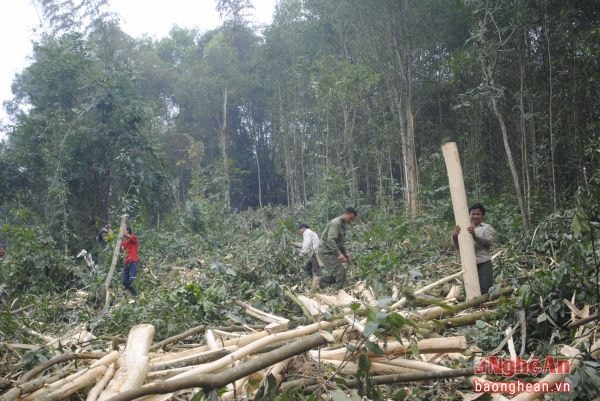 |
| Harvesting acacia trees in Tan Long commune (Tan Ky district). |
Mr. Nguyen Canh Can, Head of the Nghe An Forestry Planning Survey Team, stated: To ensure long-term development of large timber, the provincial forestry planning survey team has just completed the "Planning for Large Timber Production and Business Areas in Nghe An Province until 2025". Accordingly, the plan will be implemented in 18 districts, planting 148,000 hectares of large timber, including 19,000 hectares converted from small timber forests, 72,000 hectares of newly planted forests, and 57,000 hectares of replanted forests. Currently, there is basic consensus among forest owners and the People's Committees of districts and communes. The team has submitted the plan to the Provincial People's Committee for consideration and approval.
Currently, several units in the province are quite effective in planting large timber forests, such as Song Hieu Forestry Company Limited. Mr. Ho Dinh The, the company's director, said: From 2004-2005, the company planned and planted 2,700 hectares of large timber, and to date, 1,000 hectares have been harvested, with the remaining 1,700 hectares still being harvested. Large timber plantations yield 140-160 m3/ha with a cycle of 10-11 years, generating revenue of 180,000-200,000 million VND/ha. In particular, large timber forests are used for multiple purposes, from laminated timber to wood chips, not only bringing high economic benefits but also helping to reduce soil erosion and runoff, contributing to environmental protection and combating climate change.
To ensure the effectiveness of large-scale timber forest planting, the company proactively sources high-quality hybrid acacia seedlings. All seedlings are treated for diseases and pests, and cared for according to proper procedures. In developing large-scale timber forests, it is also necessary to adhere to the correct planting schedule, prioritizing spring and spring-summer planting for faster tree growth. The company has also invested tens of billions of VND in maintaining and constructing over 250 km of access roads to facilitate planting, care, and harvesting. To ensure a stable market for its products, the company has established partnerships with processing businesses, creating stability in the business cycle of its planted forests.
Tuong Duong District is one of the localities that also focuses on planting large timber trees. To date, the entire district has approximately 7,200 hectares of timber forests, of which mixed-growth mahogany and teak trees account for 80%. The effectiveness of planting mahogany has been confirmed, as it is both easy to plant and easy to sell. In addition to state investment policies on forest planting such as Project 147 and Program 30a, Tuong Duong District annually supports local people with 2.5 - 2.7 billion VND for forest planting (providing 100% of the seedlings).
In 2016, Tuong Duong district planted over 1,000 hectares of forest, of which 800 hectares were acacia trees and the rest were mahogany trees. Of this, 450 hectares were planted with large timber trees to supply the wood processing and MDF fiberboard factory in Nghia Dan district. Mr. Lo Kham Kha, Head of the Agriculture and Rural Development Department of Tuong Duong district, said: "If we plant acacia trees for large timber, the income will remain high for 8-10 years, comparable to the price of mahogany. In the future, it will be even more favorable when the factory has a contract to purchase the products from the forest growers…"
In 2017, the Provincial People's Committee assigned the Department of Agriculture and Rural Development to implement the provisional forest planting plan for localities and project units to plant 17,000 hectares of raw material forests (an increase of 1,000 hectares compared to 2016). Notably, this year the province planned to plant approximately over 4,000 hectares of large timber forests, concentrated in Thanh Chuong, Quy Hop, and Nghia Dan districts...
To ensure the effective planting of large timber forests, the province provides a 50% subsidy on the price of seedlings of acacia mangium, acacia auriculiformis, and ebony (grown from seeds or tissue culture) that meet standards for farmers planting forests on allocated or leased forest land within the approved large timber forest production and business planning zone. The province also has a mechanism to subsidize 50% of the price of seedlings of native species (green lim, lat hoa, tram) for households planting forests on allocated or leased forest land within the approved large timber forest production and business planning zone.
Proactively adopt a long-term strategy.
Forest development is a priority for people in many localities. However, most households mainly plant and harvest young acacia trees. If they only plant and harvest within 4-6 years, each hectare of acacia only sells for just over 40 million VND, resulting in no profit. Meanwhile, planting mature timber trees can yield an income of around 200 million VND. The problem is that planting mature timber trees doubles the planting and harvesting cycle, thus creating difficulties for people in achieving long-term sustainability.
Overall, the quality of planted forests is currently not high, and the economic efficiency from harvesting them remains low. Acacia growers are currently operating on short cycles, primarily for paper pulp and wood chips. The harvested products lack competitiveness, have low economic value, and do not reflect their potential. Therefore, developing large-scale timber forests is a sustainable approach. To achieve this, close cooperation and collaboration among businesses are required to support forest growers in "nurturing the forests" and to commit to stable product consumption, thereby increasing the value of the raw materials.
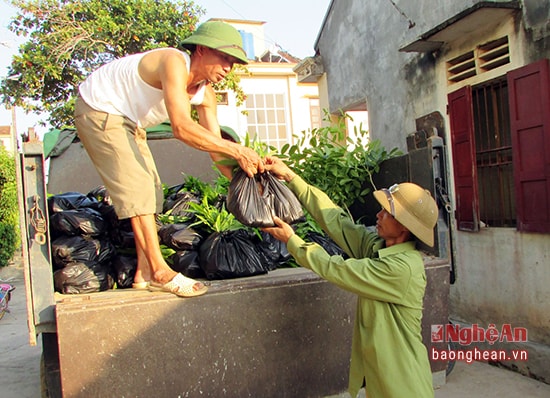 |
| Selling saplings in Yen Thanh. Photo by Thai Duong. |
During the discussion, Mr. Dang Xuan Minh, Deputy Head of the Forest Protection Department, added: To develop large-timber forest business in the province under current conditions, it is necessary to focus on planning and implementing comprehensive solutions regarding land, science and technology, forestry, and production management, as well as issuing policies to support the development of large-timber forest business. However, planting large-timber forests is still difficult. The time required for care and protection is long, at least twice that of planting small-timber forests, leading to a longer harvesting and investment recovery period, while the local people still face significant difficulties.
Van Truong
| RELATED NEWS |
|---|


