
The Deputy Prime Minister "ran out of breath" with his lesson plan.
According to Deputy Prime Minister Vu Duc Dam's statement to hundreds of top education leaders this morning, February 13th, the university entrance exam cannot yet be abolished. At the same time, the Ministry of Education and Training needs to reconsider the proposed changes to the high school graduation exam.
Having taken charge of education since the end of 2013, this is the first time Deputy Prime Minister Vu Duc Dam has attended an education conference with the participation of education leaders from all 63 provinces and cities. This is also happening in a "hot context": the education sector is actively implementing the "educational reform" project, with the first step being the planned changes to this year's high school graduation exam and university/college entrance exam.
Having spent the entire morning listening to 14 opinions, when it was his turn to speak, the Deputy Prime Minister began:
"Today I'm running out of things to say in my lesson plan because I've prepared myself to listen to many comments and planned to only give my opinion in the afternoon. But by the end of the morning, everyone had run out of things to say, so I'd like to share a few thoughts, hoping to offer some sincere feedback."
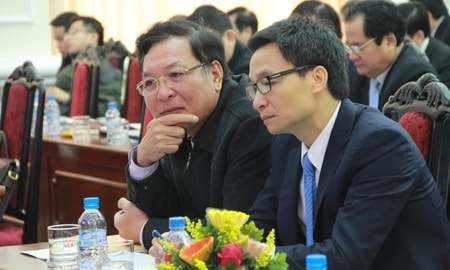 |
| Deputy Prime Minister Vu Duc Dam and Minister Pham Vu Luan are listening to the discussion. Photo: Van Chung |
Don't rush, but don't procrastinate either.
According to Mr. Dam, education has many problems that even the education sector itself is not satisfied with. This dissatisfaction stems from proposals put forward by the sector, and the Central Committee discussed the issue for two sessions before Resolution 29 – fundamental and comprehensive reform of education and training – was finally issued.
But on the other hand, our country's education system has many achievements and advancements to be proud of, and is highly valued by society...
Mr. Dam said, "A country with a good education system will prosper. Therefore, this fundamental and comprehensive reform cannot be done all at once, cannot be rushed, but neither can it be done slowly. We must be very urgent, very determined and resolute, but also very scientific and cautious, step by step."
Reforming everything from singing the national anthem to daily chores.
Sharing his thoughts with officials and teachers in the sector, Mr. Dam stated that, upon closer examination, there are many things that "we talk about changing but haven't actually done."
For example, the goal of "not just teaching knowledge but also teaching how to be a good person" has been set by the education system since the early days of the government, since the first educational reform.
"During my school days and the time of many of my colleagues in the department, there were a few things that should now be reviewed and rectified; from very small things like flag ceremonies and singing the national anthem. Teaching children to love their country and their fellow citizens should be done this way. Now, many schools are not implementing this seriously."
Or consider physical education: In the past, a lot of emphasis was placed on mid-morning exercise sessions. Or, students were assigned daily chores; general cleaning, planting trees, etc., on a weekly basis.
"Nowadays, many places outsource these activities to the point that their children don't know how to work. But the important thing isn't not knowing how to work, but that if you don't do it directly, you don't appreciate labor and you don't appreciate workers."
These examples were cited by the Deputy Prime Minister to illustrate that "there are things that don't need to wait for the Ministry, don't need to wait for hundreds of millions of dollars to create a standard program to modernize textbooks and modernize infrastructure," yet still can be reformed.
Changes should be announced before the start of the school year.
Mr. Dam spent most of his time discussing changes to the examination system in the education sector.
According to him, the Ministry of Education and Training is actively reforming the curriculum, "but we cannot do it sequentially. Reforming exams after teaching is one approach, but we must redesign the Vietnamese education system, then issue a nationwide framework curriculum. Only then can we write textbooks and train teachers. Only then will we complete the reform of the examination system."
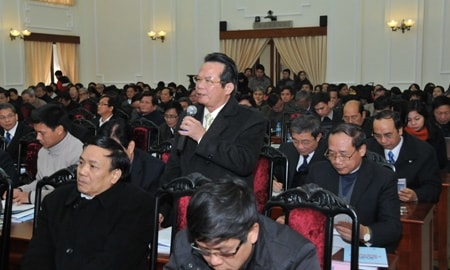 |
| Delegates speaking at the workshop. Photo: Van Chung |
Mr. Dam believes that the Ministry's choice of focusing on examinations as a breakthrough measure signifies taking a proactive step to create strong momentum and spread innovation.
Prior to this conference, the Ministry of Education and Training announced a plan to change the high school graduation exam.
Accordingly, there are plans to reduce the number of compulsory subjects from 6 to 4, allow students to choose elective subjects, exempt 20% of students from the graduation exam (to be applied to this year's exam), etc.
Referring to this plan, the Deputy Prime Minister noted that it needs careful discussion, as the changes will not be implemented within a single year, in the spirit of: not constantly changing but rather piloting on a small scale; avoiding "discrimination against teachers"; "learning from advanced countries" must be appropriate; and any work that is arduous but necessary and effective should not be shied away from.
"The Ministry should discuss this thoroughly and try to announce the plan before the start of the new school year or before the summer break, including the university admissions plan," he suggested.
According to vietnamnet


