
Pest and disease control on summer-autumn crops.
(Baonghean) - This year, all 260 hectares of rice in Tao Son commune (Anh Son district) have been damaged by rice leaf roller. The commune has distributed over 5,000 packets of specific pesticides as recommended by the Plant Protection Station to farmers to control the pest across the entire affected area.
Ms. Pham Thi Hai, Head of the Agriculture Committee of Tao Son commune, said: After spraying, the pest density decreased.
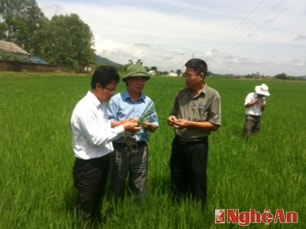 |
| Leaders of the Department of Agriculture and Rural Development inspect the situation of rice pests and diseases in Hamlet 7, Xuan Hoa, Nam Dan. |
This year's summer-autumn crop season saw Tan Ky district planting over 4,300 hectares of rice and 1,400 hectares of corn. The fourth generation of rice leaf rollers has emerged, causing damage across the district's fields with densities reaching 500-600 larvae per square meter in some areas. To organize pest control, the District People's Committee has issued a mechanism to subsidize 50% of the pesticide cost for farmers. Mr. Nguyen Van Trinh, Head of the Tan Ky District Plant Protection Station, said: On July 25th, according to the province's plan, the first round of spraying for the fourth generation of rice leaf rollers was temporarily suspended. However, the entire district has only managed to spray 3,129 hectares out of 4,300 hectares of rice infected with rice leaf rollers that require spraying. Some communes did not meet their targets, such as Ky Tan with only 40 hectares covered out of 130 hectares of rice, Huong Son with 60 hectares covered out of 170 hectares, and Phu Son with 65 hectares covered out of 150 hectares... The farmers were complacent when advised to spray for pest control because they didn't see any pests. They only sprayed when the pests had developed and covered the fields, rendering the spraying ineffective and creating opportunities for the fifth generation of rice leaf rollers to develop.
This year's summer-autumn crop season saw the province planting over 97,000 hectares of rice, over 11,000 hectares of corn, 1,000 hectares of peanuts, more than 5,900 hectares of vegetables, and over 4,000 hectares of beans. Currently, all crops are developing well. However, as of July 26th, 70,654 hectares across the province were affected by the fourth generation of rice leaf roller, with 20,192 hectares moderately infected and 44,538.8 hectares severely infected. Districts with high pest infestation rates include: Dien Chau and Quynh Luu, each with over 6,000 hectares; Yen Thanh with over 3,000 hectares; Nam Dan with 3,100 hectares; and Anh Son with nearly 1,300 hectares. The entire province has implemented pest control measures across 65,516.6 hectares (including 60,842 hectares sprayed for the first time and 4,674.6 hectares sprayed for the second time).
Along with leaf-rolling caterpillars, brown planthoppers, white-backed planthoppers, and bacterial blight, bacterial stripe disease has emerged and caused damage in several districts. Currently, the summer-autumn rice crop is in the heading and flowering stage, while the main rice crop is in the tillering to heading stage. However, according to a report from the Provincial Plant Protection Sub-Department, more than 200 hectares of rice are infested with planthoppers, concentrated in the districts of Do Luong, Con Cuong, and Anh Son. The planthoppers are mainly in the first and second instars, with a common density of 750-1,500 individuals/m2, and exceptionally 3,000-5,000 individuals/m2. Bacterial blight and bacterial stripe disease are also emerging and causing damage to the summer-autumn rice crop in Dien Chau, Yen Thanh, and Quynh Luu districts, affecting a total area of 104 hectares.
Protecting summer-autumn crops amidst the current unpredictable weather conditions is a top priority for the agricultural sector. Mr. Phan Duy Hai, Deputy Head of the Provincial Plant Protection Sub-Department, stated: Currently, the sector is directing farmers to actively monitor their fields. Local authorities need to proactively schedule field inspections to provide support and continue disseminating information to farmers on controlling the fifth generation of rice leaf rollers, particularly in rice paddies, and pests and diseases in general. Currently, brown planthoppers and white-backed planthoppers are showing an increasing trend in both scope and severity of damage, with the potential for widespread and severe damage. This predicts a risk of planthopper outbreaks during the heading and flowering stages of rice. Bacterial blight and bacterial leaf streak also pose a risk of severe damage to rice paddies from the heading stage onwards, especially after heavy rains accompanied by wind and on waterlogged soils with excessive nitrogen fertilization. For other crops, monitoring and care should be carried out by supplementing necessary fertilizers and nitrogen according to technical procedures. For rice fields from the tillering to flowering stage, it is recommended to spray to control brown planthoppers and white-backed planthoppers in areas with densities of 1,000 or more using specific pesticides from the prescribed list, ensuring even wetting of the rice stems and leaves. For areas after flowering to the milky stage, spray to control planthoppers in areas with densities of 2,000 or more using contact or fumigation pesticides. For bacterial blight and bacterial leaf streak diseases, farmers should not use nitrogen, growth stimulants, or foliar fertilizers on infected rice fields. In particular, localities need to strengthen inspections of recommendations, sales, and use of plant protection products in their areas. Promptly detect and prevent the sale of substandard, unregistered, or expired pesticides that affect control results.
Text and photos:Luong Mai


