
Restoring the Nguyen Bieu Temple – Should the people be allowed to do it themselves?
Nguyễn Biểu served as an official during the Later Trần Dynasty. He hailed from Bình Hồ village, La Sơn district, Nghệ An province. He passed the Thái Học Sinh (Imperial Academy) examination at the end of the Trần Dynasty. When Trần Trùng Quang ascended the throne, Nguyễn Biểu was appointed to the position of Điện Tiền Thị Ngự Sử (Imperial Censor). He is remembered in history for his exemplary loyalty and righteousness.
(Baonghean.vn) -Nguyễn Biểu served as an official during the Later Trần Dynasty. He hailed from Bình Hồ village, La Sơn district, Nghệ An province. He passed the Thái Học Sinh (Imperial Academy) examination at the end of the Trần Dynasty. When Trần Trùng Quang ascended the throne, Nguyễn Biểu was appointed to the position of Điện Tiền Thị Ngự Sử (Imperial Censor). He is remembered in history for his exemplary loyalty and righteousness.
When the Ming invaders attacked, he assisted Tran Quy Khoang (Emperor Trung Quang) in organizing the uprising forces of the Later Tran Dynasty. In 1413, when the Ming army threatened Nghe An, the Tran king sent the envoy Nguyen Bieu to request investiture, but he was detained by Truong Phu. To test his loyalty, Truong Phu prepared a feast of human heads. He calmly gouged out his own eyes and ate them, and in response, composed the famous poem "Eating a Feast of Human Heads." Seeing this, Truong Phu let him go, but Phan Lieu intervened and brought him back.
Impressed by his courage, the enemy killed him by tying him to a bridge on the Lam River bank, letting the rising tide drown him. This was on July 1st, 1413 (the year of Quy Ty). After cowardly killing him, the enemy general Truong Phu exclaimed: "Truly a valiant warrior, a hero of Vietnam!" This story took place when Truong Phu of the Ming Dynasty was stationed at Nghia Liet Mountain in Nghe An province; Emperor Trung Quang was building a rampart south of Chi La, opposing the Ming Dynasty's fortifications…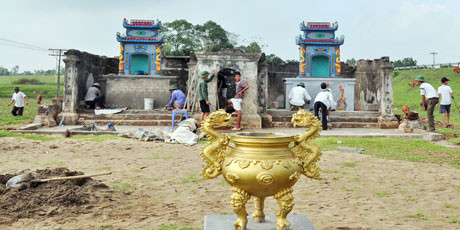
After many days of labor, the people of Hamlet 8, Hung Xuan, now have a place to light incense and commemorate Nguyen Bieu.
After the victory over the Ming invaders, the people of Nghe An and Ha Tinh provinces erected temples and shrines to worship Nguyen Bieu. King Le Thai To posthumously bestowed upon him the title of Nghia Vuong (King of Righteousness). Subsequent dynasties also posthumously honored him as Phuc Than (God of Fortune). In Yen Thai village (now Hamlet 8, Hung Xuan commune, Hung Nguyen district), there is a temple dedicated to Nguyen Bieu located next to the Lam River. Over the years, due to historical upheavals and natural disasters, only a plot of land and a few dilapidated walls remain. Recently, the local people have contributed labor and resources to repair the temple.
Mr. Nguyen Xuan Tu, Chairman of the Veterans Association of Hung Xuan Commune, Hung Nguyen District, said: "In 2007, a seminar on Nguyen Bieu was held in Vinh City. Everyone in my hometown thought that sooner or later, the temple dedicated to Mr. Nguyen Bieu would be restored, but it never happened. With the desire to have a place of worship for him, the people of Hamlet 8, Hung Xuan Commune, contributed their labor and resources to renovate and restore the temple. We know that doing this is not befitting a historical site, but the people voluntarily contributed as much as they could!"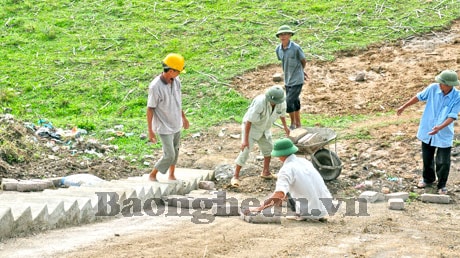
Build a road from the Lam River embankment down to the temple area.
Young people participated in digging the earth and building the foundation.
Mr. Nguyen Van Hung from Hamlet 8, Hung Xuan, added: "To renovate the area around the old temple, the people contributed hundreds of man-days of labor. On some days, more than 50 people participated in digging, leveling, building roads, and cleaning the area around the temple. Some contributed incense burners, others a few hundred kilograms of cement, those who knew how to be construction workers helped repair the shrine, women helped with cleaning, and young men dug and leveled the ground..."
The voluntary restoration of the Nguyen Bieu temple by the residents of Hamlet 8, Hung Xuan commune, is a commendable act. Objectively, in recent years, many localities across the country have done well in social mobilization, effectively encouraging the participation of the people in contributing funds and labor to restore and repair historical relics, significantly contributing to the preservation and promotion of their value and the development of tourism. Restoring, preserving, and promoting the value of historical relics is essential for educating present and future generations about the historical traditions of their homeland and nation. However, restoring a relic like the Nguyen Bieu temple in Hung Xuan commune requires a complex process involving surveys, expert consultations with relevant agencies, and permission from the competent authorities.
Therefore, the people of Hamlet 8, Hung Xuan Commune, need to proceed with the restoration of the temple in a reasonable manner. The authorities at all levels should promptly intervene to help the people fulfill their heartfelt wishes and express their gratitude to the esteemed and loyal official Nguyen Bieu, whose example of sacrifice for the country and its people will forever endure in the glorious history of the nation's resistance against foreign invaders. Furthermore, this will ensure that the Nguyen Bieu temple truly fulfills its role as a historical relic in educating future generations about our traditions.
Thuy Vinh


