
Restoring and propagating disease-free oranges, tangerines, and pomelos.
Based on the reality of genetic degeneration in citrus fruit trees, the North Central Agricultural Science and Technology Institute established a project and program titled "Breeding, Conservation, and Restoration of Disease-Free Citrus Fruit Trees in Their Original Growing Locations." After six years of research (2006-2011), many varieties were recognized and widely cultivated, bringing economic benefits to farmers, such as Xa Doai oranges, PQ1 tangerines, and Quang Tien pink pomelos. These varieties have the advantages of high yield, delicious fruit quality, and high commercial value.
(Baonghean)Based on the reality of genetic degeneration in citrus fruit trees, the North Central Agricultural Science and Technology Institute established a project and program titled "Breeding, Conservation, and Restoration of Disease-Free Citrus Fruit Trees in Their Original Growing Locations." After six years of research (2006-2011), many varieties were recognized and widely cultivated, bringing economic benefits to farmers, such as Xa Doai oranges, PQ1 tangerines, and Quang Tien pink pomelos. These varieties have the advantages of high yield, delicious fruit quality, and high commercial value.
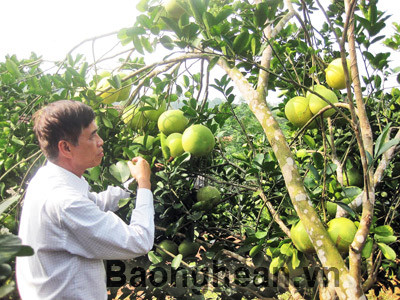
The Quang Tien pink pomelo variety is of comparable quality to other pomelo varieties.
Phuc Trach.
Regarding the Xã Đoài orange variety, Mr. Phạm Văn Chương, Director of the Institute of Agricultural Science and Technology of the North Central region, stated: In the 1980s, the area planted with Xã Đoài oranges in Nghi Lộc reached 400 hectares, but now it has shrunk to less than 10 hectares; many orchards with genetic resources have shown signs of degeneration, resulting in decreased productivity. Furthermore, during cultivation, farmers have not applied the correct technical procedures, neglecting pruning and shaping, thus creating conditions for pests and diseases to develop and cause severe damage, such as gumming disease, root borers, and especially citrus greening. Based on the restoration and propagation process using modern breeding and selection techniques, the Institute has carried out the project: "Research on the restoration and development of Xã Đoài oranges in their original habitat." After three years of research, from the initial 82 selected trees, the Institute has selected five trees that meet the standards of superior parent trees, which have been evaluated and recognized by the Nghệ An Provincial Science Council. The parent trees all grow and produce high-quality fruit, and their grafting scions are used for propagation to meet the production needs of the local area and some other orange-growing regions inside and outside the province. Currently, the Institute has identified and preserved 100 So trees; established a model for producing disease-free Xa Doai orange seedlings on an area of 2 hectares in the original growing region and grafted over 40,000 seedlings to supply approximately 80 hectares of large-scale production.
The Phu Quy Fruit and Industrial Crop Research Center ( thuộc the North Central Agricultural Science and Technology Institute) collected sweet mandarin varieties from Cai Lay, Tien Giang, and successfully conducted trial plantings in the Phu Quy basalt red soil region; naming it PQ1 mandarin... Mr. Nguyen Thanh Van's family, in Minh Hop commune, Quy Hop district, purchased PQ1 mandarin seedlings in 2008 and planted them on 1 hectare of land to stagger the harvest; because this variety ripens late, is easy to sell, and always fetches a higher price than other main-season citrus varieties in the area. After 4 years of planting, Mr. Van has harvested two crops, yielding 25 tons in 2010, generating an income of 150 million VND, and increasing to 32 tons in 2011. With an average selling price of 15,000 VND/kg, he earned a profit of nearly 200 million VND... According to Mr. Van's calculations, PQ1 tangerines are currently yielding the highest economic value compared to other crops in the area...
Regarding the economic efficiency of the PQ1 mandarin variety, Ms. Vo Thi Tuyet, Director of the Phu Quy Fruit and Industrial Crop Research Center, stated: "After 10 years of trial planting and 8 years of monitoring in the production garden at the Center, the PQ1 mandarin variety has many outstanding advantages, growing and developing well in all three criteria: tree height, canopy diameter, and trunk diameter; it is suitable for the soil conditions of the Phu Quy region. Currently, the PQ1 mandarin variety has been recognized by the Ministry of Agriculture and Rural Development for trial production in the North Central region. Within the province alone, the planted area has expanded to over 65 hectares, with many households gradually replacing other less efficient fruit trees."
Regarding the Quang Tien pomelo variety, Ms. Vo Thi Tuyet added: Recently, the research team of the Center reported on the trial of the Quang Tien pomelo variety with two control varieties, Phuc Trach pomelo and Pumelo pomelo. On an area of 1.3 hectares, after 3 years of trial, all three varieties grew well and bore fruit by the 7th year; the Quang Tien pomelo variety yielded 144 fruits/tree, each fruit weighing an average of 1.11 kg; the Pumelo variety yielded 142 fruits/tree, weighing 1.12 kg/fruit; and the Phuc Trach variety yielded 94 fruits/tree, weighing 0.76 kg/fruit. From the 7th year onwards, there was a significant difference in yield: the Quang Tien variety achieved 27.55 tons/ha, Pumelo 27.74 tons/ha, and Phuc Trach 9.94 tons/ha; the quality of the Quang Tien pomelo was crisp, juicy, and had a sweet, refreshing taste without bitterness, comparable to the Phuc Trach variety. Regarding pest and disease resistance, Quang Tien pink pomelo also exhibits better resistance compared to the two control varieties... In the Phu Quy area, the Quang Tien pink pomelo variety has been expanded to approximately 20 hectares, of which 15-16 hectares are already bearing fruit; the yield in the first year reached over 1 ton/ha, and from the fourth year onwards, the average yield is over 50 tons/ha.
The work of restoring, breeding, and selecting high-quality parent plants by the North Central Agricultural Science and Technology Institute in recent years is essential for the province; meeting the demand for fresh fruit consumption in the locality and the domestic market, while also improving understanding of cultivation techniques, creating jobs, and contributing to poverty reduction for farmers.
Ngoc Anh


