
The National Assembly is heated over the Long Thanh International Airport project.
On the morning of October 29th, National Assembly delegates discussed in the Assembly Hall the presentation of the Investment Report on the Long Thanh International Airport construction project and debated the remaining points of disagreement in the draft Law amending and supplementing a number of articles of the Law on Civil Aviation of Vietnam.
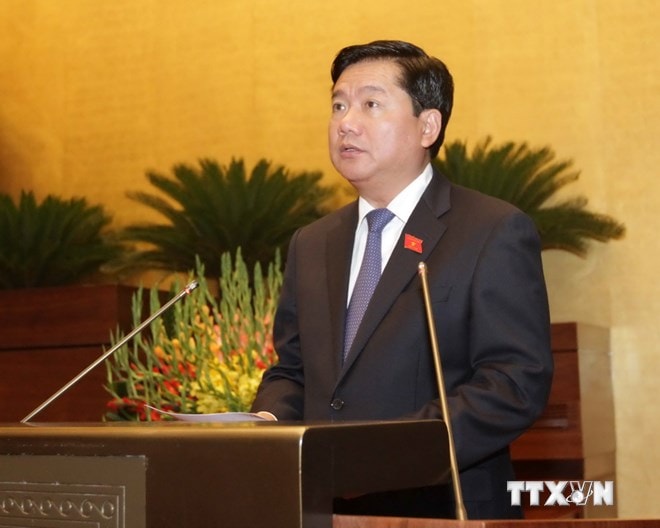 |
| Minister of Transport Dinh La Thang presents the proposal on the investment policy for the construction of Long Thanh International Airport. Photo: VNA |
It is necessary to build Long Thanh Airport to develop it into a regional-scale international transit airport.
The investment report for the Long Thanh International Airport construction project, presented by Minister of Transport Dinh La Thang, clearly states that investing in the construction of Long Thanh International Airport is necessary because it will create and develop a large-scale international transit airport in the region to serve Vietnam's air transport development strategy.
The Minister emphasized that, in line with the development trends of international aviation, and with its advantageous geographical location and potential for air transport development, Vietnam also needs to quickly establish an international airport that will serve as a central transit hub in the region. This is a practical and strategic development need. Furthermore, the construction of Long Thanh International Airport will meet the air transport needs when Tan Son Nhat International Airport reaches its designed capacity and becomes overloaded.
The report states: The selection of the location for the planning and construction of Long Thanh International Airport has been thoroughly studied by specialized agencies of the civil aviation industry since 1993. In addition, socio-economic plans, construction plans, land use plans, and other specialized plans have been approved and are synchronized with the formation of Long Thanh International Airport. Many planned projects have been implemented and invested in, especially transportation routes that facilitate convenient connections between Long Thanh International Airport and Ho Chi Minh City and surrounding areas.
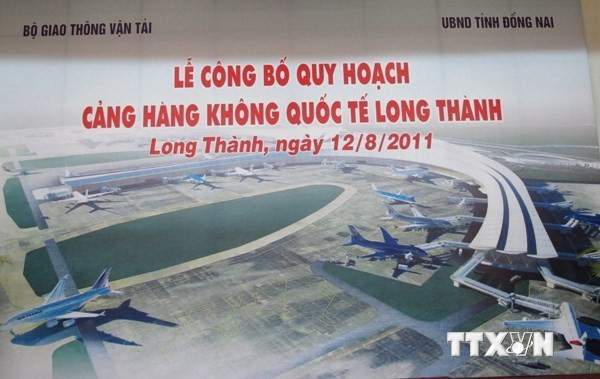 |
| Ceremony announcing the master plan for Long Thanh International Airport. Photo: VNA |
The Minister stated that the investment and construction goals for Long Thanh International Airport aim to gradually achieve Level 4F (according to ICAO classification); playing the role of the country's largest and most important gateway international airport, and is expected to become one of the air transport hubs in Southeast Asia in the future.
The entire project is planned to be divided into 3 phases. Phase 1: investment in a passenger terminal with a capacity of 25 million passengers/year, a cargo terminal with a capacity of 1.2 million tons of cargo/year, and 2 parallel runways with a closed configuration, aiming to alleviate the congestion at Tan Son Nhat International Airport.
Phase 1a involves the construction of the main terminal with one central wing and one runway, capable of handling 17 million passengers per year, scheduled to open in 2023; Phase 1b involves the construction of the remaining two wings of the central main terminal and a second runway, scheduled to open in 2025.
Phase 2: a passenger terminal with a capacity of 50 million passengers/year, a cargo terminal with a capacity of 1.5 million tons of cargo/year, and an additional runway, scheduled to open in 2030.
Final phase: passenger terminal with a capacity of 100 million passengers/year, cargo terminal with a capacity of 5.0 million tons of cargo/year, and 4 runways.
The estimated total investment for Phase 1 of the Project is approximately US$7.837 billion (equivalent to VND 164.589 billion), of which Phase 1a has a total investment of approximately US$5.662 billion (equivalent to VND 118.910 billion).
Capital structure: The projected state capital (budgetary capital, government bonds, ODA, etc.) for phase 1 is VND 84,624 billion. Of this, phase 1a accounts for nearly VND 57,858 billion (approximately 48.65% of the estimated total investment). Capital mobilized from the non-state sector (enterprise capital, shares, joint ventures, public-private partnerships) is VND 79,965 billion. Of this, phase 1a accounts for over VND 61,053 billion (51.35% of the estimated total investment).
In reviewing the Long Thanh International Airport investment report, the National Assembly's Economic Committee assessed that the Long Thanh International Airport project meets the criteria of a nationally important project; it endorsed the policy of the Vietnamese Party and State that a modern international airport is needed to meet air transport needs, contribute to socio-economic development, and be linked to national defense and security tasks.
However, there are also suggestions to clarify the urgency or necessity of investing in Long Thanh International Airport; if it is not urgent, then a more appropriate time for investment should be considered.
The Economic Committee believes that this is only the investment capital for phase 1 of the project; if all three phases are included, the total investment will be very large (approximately 18.7 billion USD). Furthermore, the estimated investment for phase 1 is merely a rough estimate and its accuracy is not high. In addition, infrastructure projects connecting to Long Thanh International Airport need to be calculated and balanced with the total investment capital for the airport itself.
Regarding the capital mobilization plan: investing in the construction of Long Thanh International Airport using state capital and loans, in the context of rapidly increasing public debt and a strained state budget, does not guarantee feasibility.
On the other hand, if borrowing is possible from international financial institutions, it must also be guaranteed by the Government. There is a suggestion that capital mobilization should adhere to Resolution No. 13-NQ/TW dated January 16, 2012, of the Central Committee, which emphasizes mobilizing ODA capital and encouraging public-private partnerships.
Comments on the draft Law amending and supplementing a number of articles of the Law on Civil Aviation of Vietnam.
During the remainder of this morning's session, National Assembly delegates discussed the remaining points of disagreement in the draft Law amending and supplementing a number of articles of the Law on Civil Aviation of Vietnam.
During the discussion, many opinions suggested the need to add regulations on measures to address flight delays and cancellations in civil aviation. According to National Assembly representatives, flight delays and cancellations in civil aviation constitute a breach of the transportation contract and directly affect the rights of passengers.
However, current law lacks provisions that bind transport businesses to ensure compliance with transport conditions, maintain minimum service quality, and specifies minimum standards that businesses must guarantee for passengers.
The draft Law has added provisions on the obligations of air transport businesses, including the obligation to maintain minimum service conditions and quality (Clause 4a, Article 110); added the responsibility of the carrier in case of prolonged flight delays without prior notice (Clause 5, Article 145); and assigned the Minister of Transport to regulate the duration of prolonged flight delays and the minimum service quality for passengers at airports (Clause 5 and Clause 6, Article 145).
At the same time, the state management agency specializing in civil aviation needs to strengthen inspection and supervision of the fulfillment of obligations by businesses in cases of flight disruptions, delays, or cancellations.
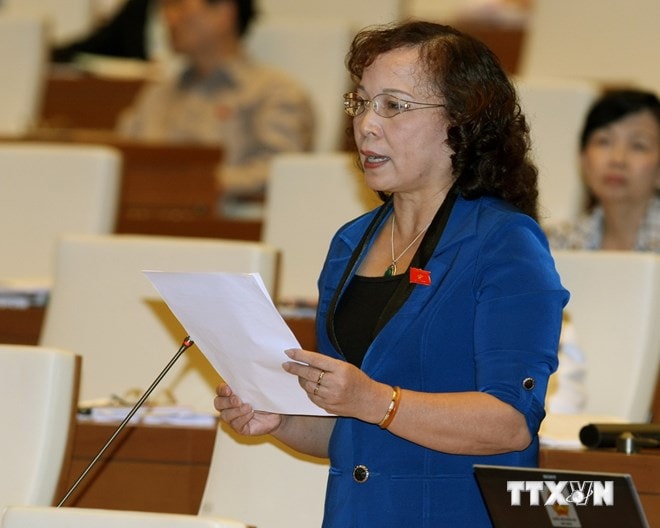 |
| National Assembly representative Nguyen Thanh Thuy from Binh Dinh province delivers a speech. Photo: VNA |
However, delegate Nguyen Thanh Thuy (Binh Dinh) argued that it is necessary to clearly define the responsibility for compensation and the agency responsible for handling customer claims for compensation in cases of flight delays or cancellations. At the same time, the specialized state management agency for civil aviation needs to strengthen inspection and supervision of businesses' fulfillment of their obligations in cases of flight disruptions, delays, or cancellations.
Concerned about the cost of airport services, delegate Nguyen Duc Kien (Soc Trang) suggested that airport services should be tendered to ensure prices reflect market value. He emphasized, "The Minister of Transport's directive to reduce service prices only shows concern, but it raises issues in state management and makes it difficult to effectively protect consumer rights."
According to some delegates, more attention needs to be paid to coordination in airport management, "we cannot allow a situation like the Tan Son Nhat airport operation, which has too many costly lessons due to weak management and unclear decentralization, forcing the National Assembly to consider the policy of investing in the construction of a new Long Thanh airport to rectify the problems."
Representative Tran Du Lich (Ho Chi Minh City) suggested that amendments to this Law should consider two aspects: the development of low-cost airlines and the distribution of short-haul routes.
According to Vietnam+


