
The National Assembly discusses the draft law on the management and use of state capital.
On the afternoon of June 5th, National Assembly delegates convened in the assembly hall to hear the President's presentation, the Government's report, and the National Assembly's Foreign Affairs Committee's verification report on joining the Convention on International Rights in Mobile Equipment and the Protocol on Specific Matters relating to Aircraft Equipment (the Cape Town Convention and Protocol); and discussed in the assembly hall the draft Law on the Management and Use of State Capital Invested in Production and Business.
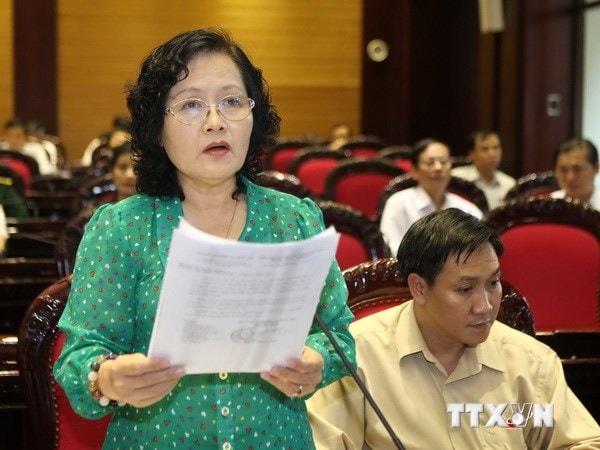 |
| National Assembly representative Tran Thi Quoc Khanh from Hanoi delivers a speech. Photo: VNA |
Enhancing the competitiveness of the Vietnamese air transport market.
The submission on Vietnam's accession to the Convention on International Rights in Mobile Equipment and the Protocol on Specific Matters relating to Aircraft Equipment (the Cape Town Convention and Protocol), presented by President Truong Tan Sang, clearly states: The Convention and Protocol, signed in Cape Town, South Africa on November 16, 2001, were the result of a diplomatic conference in Cape Town (South Africa) co-organized by the International Civil Aviation Organization (ICAO) and the United Institute for the Unification of Private Law (UNIDROIT).
| RELATED NEWS |
|---|
The Cape Town Convention and Protocol were developed to facilitate the efficient financing and leasing of aircraft equipment, bringing economic benefits to member states, especially developing countries; to create a legal framework to protect the rights of creditors in member states, as well as to encourage the granting of credit and facilitate access to preferential loans for airlines.
Joining the Cape Town Convention and Protocol is a condition for Vietnamese airlines to enjoy preferential treatment from aircraft manufacturers and credit institutions, meeting the needs and development plans of the Vietnamese aviation industry and contributing to economic development.
Considering accession to the Cape Town Convention and Protocol to be absolutely necessary, the Government's report and the National Assembly's Foreign Affairs Committee's verification report affirm that: Accession to the Convention and Protocol will facilitate financing and leasing of aircraft equipment, thereby benefiting Vietnamese airlines; increasing the competitiveness and attractiveness of the Vietnamese air transport market; benefiting consumers; reducing business costs; and facilitating the Vietnamese legal system's accession to the international commercial business legal system...
There is still no consensus on the name and scope of the draft law.
The majority of opinions agreed with the Government's proposal on the necessity of enacting a Law on the management and use of State capital invested in production and business, aiming to contribute to the completion and unification of the legal framework regulating investment activities and State capital management; to overcome existing shortcomings and ensure legal consistency with related laws. At the same time, the enactment of the Law will contribute to improving the efficiency of using State capital invested in production and business by enterprises, serving the restructuring process of State-owned enterprises, restructuring the economy, and making a positive contribution to the prevention and fight against corruption and waste in economic management.
According to Resolution No. 23/2012/QH13 of the National Assembly, the draft law's title is "Law on the Management and Use of State Capital Invested in Production and Business," but as proposed in the Government's submission, the draft law's title is "Law on Investment and Management of State Capital in Enterprises."
Regarding this matter, Representative Le Dac Lam (Binh Thuan) agreed with the Government's proposal to rename the draft law as "Law on Investment and Management of State Capital in Enterprises." With the revised name, the scope of the draft law will be broader, without distinguishing between investment objectives; state capital investment in enterprises will not only aim for profit but also for non-profit objectives. The scope of the law will focus on regulating state capital investment in enterprises, managing state capital in enterprises, and supervising investment activities and state capital management in enterprises.
Agreeing with the above opinion, delegate Vu Viet Ngoan (Khanh Hoa) argued that the name "Law on Investment and Management of State Capital in Enterprises" would be appropriate to the scope of the draft law because most of its contents address the responsibilities of the agency that decides on capital investment and the responsibilities of the agency that manages that capital after the investment decision has been made.
However, Representative Tran Thi Quoc Khanh (Hanoi) commented that the name "Law on the Management and Use of State Capital Invested in Production and Business" would avoid overlapping with other laws such as the Investment Law and the Public Investment Law; and would be consistent with the Law on Practicing Thrift and Combating Waste, the Budget Law, etc. The essence of the law is the management of state capital in production and business activities.
It is necessary to tighten the scope and areas of operation of enterprises that receive state investment.
Regarding the scope of state capital investment in enterprises under various investment forms, according to delegate Phung Duc Tien (Ha Nam), one of the reasons for enacting the law is to strengthen management and improve the efficiency of state capital and assets invested in enterprises, limiting losses and waste.
To achieve this, the law needs to tighten the scope and areas of operation of state-owned enterprises with 100% state investment, as well as the types of enterprises in which the State participates in capital investment. Meanwhile, the forms of state capital investment in enterprises stipulated in the draft law are relatively broad, general, and lacking in specificity. The regulations as drafted in the law not only fail to tighten control but also create loopholes, legitimizing a race for investment.
Representative Do Van Ve (Thai Binh) proposed that the draft Law should include provisions on the efficiency of using state capital invested in enterprises, distinguishing between enterprises performing political and public service tasks and those performing business tasks. The representative explained that in investing capital in enterprises, the most important performance indicator is the efficiency of capital utilization, calculated using various indicators, with the most common being the after-tax profit on equity.
However, the draft law does not contain any provisions regulating this issue. The question arises: what percentage of equity capital should the board of members or the chairman of the company be held accountable for in terms of capital utilization efficiency? Without clarification, a business could be considered to have fulfilled its obligations if it only achieved a profit of 1-2% of equity capital; therefore, the State should not invest in such businesses. Furthermore, if a state-owned enterprise under its management has efficient capital utilization, the board of members or the chairman of the company will not be held responsible for this issue, emphasized Representative Do Van Ve.
Also at the session, delegates discussed and gave opinions on restructuring state capital in enterprises; on the rights and responsibilities of state ownership representatives; and on supervising investment activities and managing state capital in enterprises.
According to Vietnam+


