
The Social Insurance Fund is at risk of running out.
The Vietnam Social Insurance Fund could begin experiencing deficits as early as 2021 and be completely depleted by 2034 if timely policy changes are not implemented..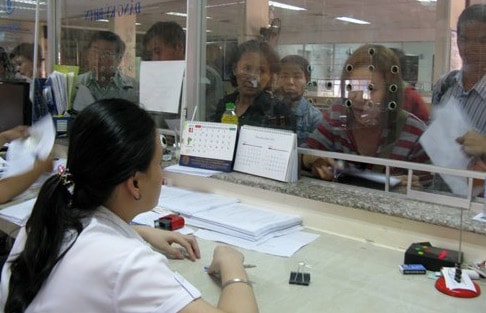
The Vietnam Social Insurance Fund could begin experiencing a deficit from 2021 and completely
Depleted by 2034 (Illustrative image. Source: vnexpress.net)
This recommendation was made during the presentation of the report "Forecasts for the Balance of Social Insurance Funds and Legal Recommendations" organized by the International Labour Organization (ILO) and the Ministry of Labour, Invalids and Social Affairs (MOLISA) on August 22nd.
This report was prepared to meet the Government's request for an assessment of the financial forecast of the pension and death benefit fund managed by the Vietnam Social Insurance. The purpose of the assessment is to examine the long-term solvency of the Social Insurance Fund and to provide recommendations on the direction of social insurance policy reform.
Accordingly, the report forecasts that the Vietnam Social Insurance Fund could begin experiencing deficits from 2021 and be completely depleted by 2034 if there are no timely policy changes.
The ILO Director in Vietnam, Gyorgy Sziracki, stated that "the government, employers, and workers need to act urgently and cooperate to find ways to ensure pension payments for the present and the long term."
To ensure the sustainability of the Social Insurance Fund, the ILO recommends that Vietnam should move towards raising the retirement age for both men and women to 65. However, according to the ILO, this measure alone is not enough to improve the fund's situation. The ILO also recommends the need to revise the pension calculation method to reduce the payout ratio.
The ILO argues that policy changes aimed at extending the sustainable viability of the fund must be implemented simultaneously with ensuring fairness between public sector employees and private sector workers.
In addition, Vietnam also needs to increase the coverage of its pension insurance program and develop voluntary pension insurance programs.
At the workshop, Deputy Minister of Labour, Invalids and Social Affairs Pham Minh Huan assessed that the ILO's forecast will provide a basis for formulating social insurance policies in general and pension policies in particular in Vietnam.
Deputy Minister Pham Minh Huan also stated that the current law stipulates that all Vietnamese citizens who sign labor contracts of 3 months or more are entitled to social insurance, but in reality, the implementation of the law still has many limitations. Currently, only 1/5 of the workforce has social insurance.
Although mandatory social insurance contributions increased from 6.3 trillion VND in 2001 to 89.6 trillion VND in 2012, only 47% of all businesses paid mandatory insurance (in 2010). Meanwhile, in 2012, Vietnam began to enter a period of population aging. With a declining number of young people in the working age group and a "generous" pension system, the pension fund will be depleted if the reform process does not introduce the necessary measures.
According to the Communist Party of Vietnam - LH


