
Democratic regulations – a rare commodity in businesses!
(Baonghean) - Implementing grassroots democracy regulations (QCDCCS) in the workplace within the enterprise sector, as stipulated in Decree 60/2013/ND-CP, aims to contribute to the effective management of production and business operations, ensuring flexibility and efficiency. However, the implementation of QCDCCS in this type of enterprise in our province still faces many difficulties and shortcomings.
Strengthening the bond between businesses and employees.
According to the assessment of the Provincial Steering Committee for the Implementation of Democratic Regulations, the 22/12 Construction Materials and Installation Joint Stock Company in Hung Nguyen district is a company that has implemented this content well. With the view that creating favorable conditions and caring for the legitimate interests of employees will ensure their peace of mind and dedication to serving the company, the company always creates opportunities for workers to participate in monitoring and protecting their legal rights and interests, such as: developing regulations on wages and regulations on emulation and reward.
All policies and regulations related to employee rights are made public, allowing employees to participate, contribute opinions, make decisions, monitor, and inspect through annual employee conferences and direct proposals. Annually, the company holds regular workplace dialogues, focusing primarily on issues of concern to employees such as employment and income, product quality, etc.
 |
| The Nghe An Business Bloc Union organized free medical check-ups and treatment for workers in the Bac Vinh Industrial Park. Photo: Le Thanh |
The company has signed a Collective Labor Agreement between the Director and the Trade Union Executive Committee, and issued regulations on coordination between professional departments and the trade union. Thanks to the effective implementation of the Regulations on Coordination between Professional Departments and the Trade Union, production and business efficiency have increased, contributing to improving the lives of employees, with average monthly wages reaching 5.4 million VND per person in 2016.
Similarly, at the Vietnam Commercial and Industrial Bank - Nghe An branch, the employee conference was organized seriously and systematically. Through this, the Board of Directors publicly and transparently disclosed the results of production and business activities and satisfactorily addressed the requests and concerns of employees. From the beginning of the year, the unit assigned production and business tasks to each team and individual in charge.
Monthly assessments of implementation results identify shortcomings, seek optimal solutions to complete tasks, and promote production and business. The implementation of the Quality Control and Development Policy has created momentum and significantly contributed to the successful achievement of production and business objectives. By the end of 2016, the branch's locally mobilized capital reached VND 3,235 billion, achieving 113% compared to the same period last year; outstanding loans amounted to VND 3,160 billion, reaching 107% of the plan.
“The employee conference at our unit has unleashed the potential and fostered the creativity of the workers. They are informed and given the opportunity to participate in discussions on issues related to their rights, obligations, and responsibilities. This has contributed to maintaining harmonious, stable, and progressive labor relations within the enterprise, creating conditions for the company to produce and conduct business effectively,” said Mr. Van Vu Thong, Deputy Director of the Vietnam Commercial and Industrial Bank - Nghe An Branch.
Implementing the Quality Control and Supervision Regulations in the workplace within enterprises has a positive impact on enhancing the sense of responsibility of both enterprises and employees in the production and business process, contributing to building labor relations, protecting the legitimate rights and interests of employees, and improving production and business efficiency.
Businesses evade inspections.
Despite its benefits and advantages, in reality, many businesses still do not take the implementation of the Regulations on Democracy in Labor and Housing Development seriously, especially private and foreign-invested enterprises. This leads to regrettable strikes or underlying disagreements between workers and employers. For example, on October 3, 2016, more than 3,000 workers of Matrix Co., Ltd., located in Bac Vinh Industrial Park, Vinh City, went on strike to demand their rights.
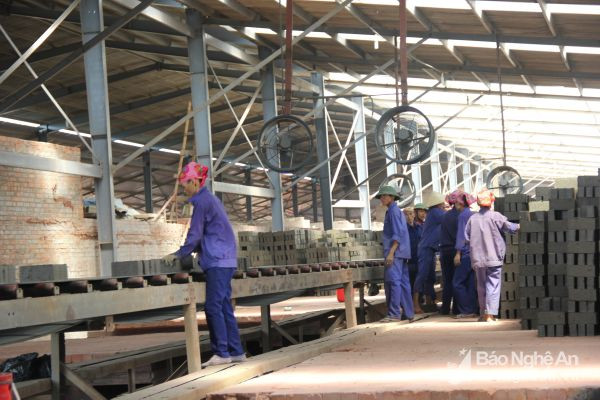 |
| Brick and tile production at the Construction Materials and Installation Joint Stock Company. Photo: Le Thanh |
This situation arose because the workers were extremely frustrated with the pressure of their jobs and the working environment. This was also the third strike at the company since it began operations. Previous strikes took place in 2010 and 2012. At that time, the company's leadership had to hold dialogues with the workers to address their requests and demands regarding employee rights and benefits.
According to the inspection by the Steering Committee for Decree 60/2013/ND-CP, the implementation of the Quality Control and Supervision Regulations has only been carried out in state-owned enterprises, while this sector accounts for a very small percentage, only 0.4% of the total number of enterprises.
In the foreign-invested and private enterprise sectors, many shortcomings remain, such as: Most units have not held conferences to gather feedback from employees on business operations; they have not organized dialogues with employees; some businesses do not comply well with labor laws, failing to create enough jobs and ensure income for employees. The situation of outstanding and delayed insurance payments still persists in some businesses. Many businesses sign labor contracts for less than 3 months and make verbal agreements with employees to circumvent the law and evade social insurance contributions.
Although the province established a Steering Committee for Decree 60/2013/ND-CP tasked with guiding, disseminating, and supervising the implementation of the Regulations on Democracy in the Business Sector, the inspection of these regulations by this subcommittee is very difficult due to the large number of businesses (over 16,000) spread across a wide area, while the compliance awareness of businesses is not high. Even though inspection teams have plans and official documents guiding the inspection content sent to each business, many businesses do not cooperate. Through inspections, violations in the implementation of the Regulations on Democracy in the Business Sector are discovered by units, but there is no authority to impose penalties,” said Mr. Phan Chi Thanh, an official from the Department of Planning and Investment and secretary of the Steering Committee for Decree 60/2013/ND-CP.
Another shortcoming is that, according to Decree 60/2013/NDCP, businesses are required to establish grassroots trade unions to represent employees, but to date, only 400 out of 16,000 businesses in the province have established trade unions. "While the role of the grassroots trade union depends on the company's Board of Directors, they don't dare to fight for and demand rights for the workers."
"If the trade union is not strong, the rights of workers are difficult to guarantee," said Comrade Nguyen Tu Phuong, Chairman of the Provincial Federation of Labor. The reason for this situation is that some employers have an incomplete understanding and do not take the implementation of the Regulations on Democracy in Labor and Social Affairs seriously. What is even more concerning is that many workers are unaware of their rights. Meanwhile, there are no sanctions for violations of these regulations.
To ensure the effective implementation of the Regulations on Democracy in Enterprises, the Director of the Department of Planning and Investment, Nguyen Van Do - Head of the Steering Committee for Decree 60/2013/ND-CP of the province, stated: “Close attention and guidance from Party committees are needed, along with increased propaganda and mobilization activities, and the crucial role of grassroots trade unions. Emphasis should be placed on raising the responsibility of employers to ensure democracy in enterprises, and enterprises that fail to implement these regulations must face strict penalties. Simultaneously, the awareness of workers must be raised, and the inspection and supervision by state management agencies must be strengthened.”
| In 2016, the Steering Committees of districts, cities, and towns conducted inspections of 21 enterprises. 55% of the companies had established operating regulations and formed committees to implement democratic regulations within the company; 46% of the companies had labor contracts between the employer and the company's employees. |
Le Thanh
| RELATED NEWS |
|---|


