
Media planning is necessary and urgent.
Many delegates attending the National Conference on the Development and Management Plan for the Press until 2025 expressed their agreement with the necessity of restructuring the press.
Planning involves rearranging and fundamentally changing the structure according to a specific order. The impact on individual media outlets is undeniable. Each journalist and each media organization will have different concerns and anxieties. However, many agree that it's time to restructure the press. Recent journalistic practices have revealed too many problems that need thorough adjustment at the macro level. Only through restructuring can the press eliminate negative tendencies such as sensationalism, clickbait, commercialization, private ownership, and the erosion of public trust in the media.
"Journalism planning is necessary and urgent."
Speaking at a conference on the press planning, journalist Nguyen Nhu Phong stated: "Implementing a press plan is extremely necessary and urgent. The plan is in line with reality." However, journalist Nhu Phong himself had many concerns and questions about the personnel issue, the problem of handling "sensationalist" publications, and the responsibility of the governing body that "gives birth to newspapers" but fails to sustain them, leaving journalists struggling to make ends meet and leading to many negative consequences.
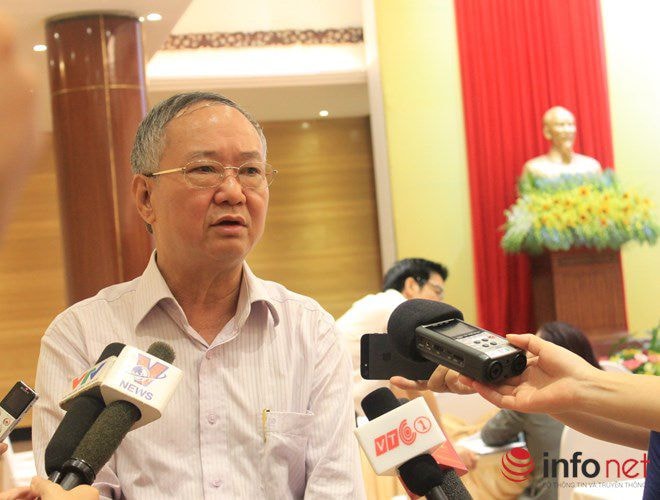 |
| Journalist Nguyen Nhu Phong, Editor-in-Chief of New Energy Newspaper: "Journalism planning is necessary and urgent." |
After listening to Mr. Nguyen The Ky, Deputy Head of the Central Propaganda Department, and Mr. Hoang Huu Luong, Director of the Press Department, explain his concerns, journalist Nguyen Nhu Phong continued to share his thoughts with reporters on the sidelines of the conference. Mr. Phong stated: “Personnel issues are a major concern for us, and journalists are also very worried. If the plan is followed, many newspapers of various associations and organizations will have to be downgraded to magazines, or even dissolved. A large number of journalists will become unemployed. The Politburo has directed that this be avoided as much as possible to protect the livelihoods of journalists. The leadership has just explained this. This must have a roadmap; secondly, we need to reorganize the press agencies to strengthen them. This plan is meticulously organized and calculated, especially considering the position of newspapers – which ones should remain and which ones shouldn't. What is the social impact of these newspapers?”
Despite these concerns, Mr. Nguyen Nhu Phong also expressed confidence: "If the press planning is implemented correctly according to the Politburo's directives and the Prime Minister's views, I think there is nothing to worry about too much."
Furthermore, Mr. Nguyen Nhu Phong also emphasized the role of the governing body. This is also included in the draft amended Press Law and in the press planning orientation, the responsibility and role of the governing body of the press have been clearly defined. According to Mr. Phong: “The governing body that created the newspaper must ensure the minimum funding for its development. If it fails to ensure the conditions for the newspaper to operate and allows the press agency to pursue profit, resorting to writing for hire to make money, then that is the fault of the governing body. At that time, the head of the governing body, who created the newspaper, must bear the responsibility.”
"Press planning reduces overlap and minimizes waste of state investment resources."
Speaking to Infonet reporters on the sidelines of the press planning conference, Mr. Nguyen Hoan, Deputy Director of the Quang Tri Department of Information and Communications, also affirmed: "I find the plan to reduce the number of press agencies unnecessary."
Mr. Hoan shared: “In my opinion, this arrangement is appropriate for the locality. Each locality has one radio channel and one television channel. For print media, there is one newspaper of the Party Committee and one magazine of the local Literature and Arts Association. Provinces in key areas can propose adding a magazine. This is suitable and convenient for management, ensuring that media outlets operate according to their stated purpose and license, avoiding overlapping functions and wasting state investment resources.”
 |
| Mr. Nguyen Hoan, Deputy Director of the Department of Information and Communications of Quang Tri Province: "The press planning reduces overlap and minimizes waste of state investment resources." |
"It's time for this kind of planning."
Sharing his views with Infonet, Mr. Phan Tan Linh, Director of the Department of Information and Communications of Ha Tinh province, also stated that such planning facilitates the management of the press and creates favorable conditions for the press to operate.
Mr. Phan Tan Linh explained: "As we know, the current state of journalism involves numerous media outlets across the country. With a very large number of journalists, both those with and without press cards, managing local media outlets is very difficult."
Mr. Phan Tan Linh expressed his confidence: “This planning creates more favorable conditions for state management of the press at both the local and central levels. We must clearly see that this is absolutely necessary. Previously, we granted too many press operating licenses to too many media outlets, resulting in overlap, inefficiency, and wasted state resources. It is time for this planning.”
 |
| Mr. Phan Tan Linh, Director of the Department of Information and Communications of Ha Tinh Province: "It's time for this planning to be in place." |
In the basic content section of the press planning project, presented by Deputy Minister of Information and Communications Truong Minh Tuan, the role and contributions of the press were highlighted. This also demands an even greater contribution from the press to the country's development in the current situation.
However, the proposal also frankly pointed out some limitations in the current practice of journalism. This is the practical basis and urgent situation that necessitates fundamental adjustments and changes to the current media system. This is because the media system is large in quantity but its quality is not commensurate, and there is overlap in principles, objectives, content, and target audiences.
The trend of "commercialization" in journalism, the indiscriminate exploitation of information, the heavy focus on reflecting the negative aspects of society, and the sensationalism and clickbait content of many news articles have led to a decline in journalistic integrity. Furthermore, the phenomenon of some online newspapers, radio and television channels being controlled by private entities has reduced the political, cultural, scientific, and professional quality of journalism.
On the other hand, the leadership of some media organizations has been lax in managing and providing political and ideological education to its staff, reporters, and editors. The editing and review process has not been given due importance or implemented seriously; in some cases, it has even been done without proper verification, leading to some media organizations and journalists publishing inaccurate and irresponsible information, with many false reports not corrected, violating journalistic ethics, exploiting the profession for personal gain, and in some cases even violating the law.
Furthermore, the role of state management and the role of the press's governing body have not been fully utilized, resulting in limited management effectiveness and failure to keep pace with the development of various forms of media in the new situation; there has been a lack of research, classification, and identification of the nature and tasks of the press to develop appropriate mechanisms and policies; and there is a need to strengthen measures and sanctions to address violations and ensure discipline in press management.
Simultaneously, the lack of timely information provided to the press has hampered the operations of media organizations.
Furthermore, there remains a significant disparity in access to news and information across different regions and areas.
According to Infonet


