
The world's largest iPhone is launched, with a flashlight brighter than car headlights.
A "super-sized" iPhone has just been released, causing a sensation in the tech community not only because of its oversized dimensions, but also because it's equipped with a flashlight that boasts a power output of up to 400 watts, brighter than even car headlights.
Can you imagine owning an iPhone 15 times bigger than the one you currently use? Popular British tech YouTuber Arun Maini, also known as Mrwhosetheboss, has made that a reality by creating the world's largest replica of the iPhone 15 Pro Max, standing over 2 meters tall and weighing more than a refrigerator.
What's impressive is that this giant device isn't just for show; it's fully functional, capable of opening apps, making contactless payments, and even sending messages. Remarkably, it's also equipped with a 400-watt flashlight, bright enough to outshine car headlights.
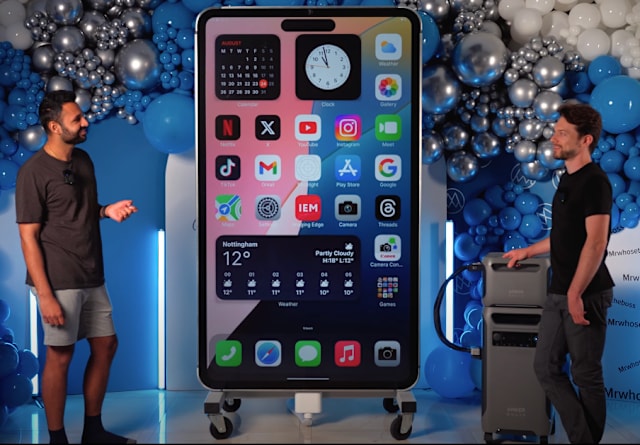
This enormous iPhone was created by Arun to mark a special milestone: surpassing Apple's official YouTube channel in terms of subscribers. To realize this audacious project, he collaborated with Matthew Perks, a renowned creator of the DIYPerks channel, specializing in unique handcrafted tech projects. The result is a "monster" smartphone that requires eight people to lift, and has officially been recognized by Guinness as the world's largest smartphone.
A phone built like a high-end PC.
Despite resembling an oversized iPhone 15 Pro Max, the internals of this giant replica are completely different. The team equipped it with high-performance desktop computer hardware, including an Intel Core i9 processor, 128 GB of RAM, and an AMD Radeon 6950 XT graphics card.
The device runs Android instead of iOS, and also supports Windows, with a total storage capacity of up to 4 TB split equally between the two operating systems.
Surprisingly, this oversized iPhone replica not only performs all the usual tasks like video calls, texting, and browsing social media, but also surpasses the limits of a typical phone.
.jpg)
Thanks to its powerful specifications, it can smoothly run Cyberpunk 2077 at the highest graphics settings, something even the most powerful smartphones today can't do.
The device's screen uses an 88-inch OLED panel manufactured by LG, a type usually only found in ultra-high-end TVs. To turn it into a touchscreen, the research team didn't simply buy a ready-made LED touchscreen. Instead, they decided to use optical adhesive to create their own touchscreen for the OLED panel.
The initial test resulted in a damaged display panel, but the end result was worth the effort: a responsive screen that allowed users to touch, pinch, and swipe just like on a real phone. They even successfully made a video call from a distance of 30 meters, just to prove that this massive device was entirely functional.
High-quality camera and flashlighthuge"Never seen on a phone before"
What truly sets this "giant iPhone" apart isn't just its size, but also its stunning additional features. First and foremost is the 400-watt flashlight, a brightness level typically found only in professional recording studios and almost unheard of on a mobile device.
The intensity was so high that the development team had to design a separate liquid cooling system to ensure the light operated stably without overheating.
The entire device is powered by two massive batteries with a combined capacity of 3,840 Wh, far exceeding the needs of any typical phone. For comparison, the battery in an iPhone 16 Pro Max is only around 18 Wh.
.jpg)
In terms of photography capabilities, this phone has also been upgraded beyond expectations. Instead of using a mobile sensor, it integrates a Canon EOS R5 camera worth approximately $35,000, capable of capturing ultra-high-resolution images. Alongside this is a custom zoom camera based on the Sony RX10, capable of achieving 100x digital zoom, something even modern high-end smartphones can only dream of.
Sound quality has also been given equally high priority. The sound system includes eight speakers, including four subwoofers, each with a power output of 50 watts, many times higher than the 3 watts of a typical iPhone.
Furthermore, to accurately simulate the feel of pressing a button on a real iPhone, each button on the device uses a pneumatic system to recreate a surprisingly realistic physical sensation.


