
Leaving the dense forest, the Dan Lai people have learned to use tractors.
(Baonghean.vn) - Leaving the old forest, the Dan Lai people inThach Ngan commune (Con Cuong district - Nghe An province)Gradually adapting to their new lives... Many households have started using tractors for farming in the resettlement area.
I remember, more than 10 years ago, on the last night in Khe Khang (in Mon Son commune), almost no one slept. We kept going in and out, sleepless amidst the mountain winds and mist. Then, the next morning, we bid farewell to the mountains, forests, villages, and streams that had been so dear to us for generations, to resettle in Thach Ngan commune as part of the Dan Lai ethnic group's conservation and development project.
They carried very little luggage, for traditionally the Dan Lai people lived a precarious life, their food and shelter entirely dependent on the mountains, forests, and rivers. As the boats started their engines and sailed down the Giang River, everyone looked back with a sense of longing...
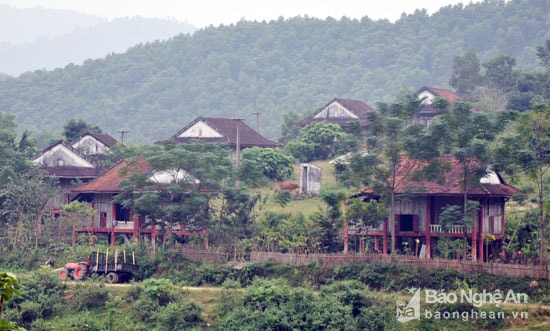 |
| A view of the Thach Son resettlement area, Thach Ngan commune (Con Cuong district). Photo: Cong Khang |
On the way to their new homeland, everyone was anxious, because they had lived their whole lives in the core area of Pu Mat National Park, where ancient primary forests provided food when hungry, and where they could find food at the stream. They cut down trees to build houses, and their lives were almost entirely based on hunting and gathering. Now, moving to a new land, the living conditions were completely different. They would have to work hard just to have enough to eat, not to mention having to produce according to technical procedures.
Meeting an acquaintance again, Village Head La Quang Vinh spoke sincerely: “To be honest, there haven't been any major changes yet, because 10 years isn't a long time. Life is still chaotic and difficult. Currently, 53 out of 54 households in the village are still poor, and the remaining one is near-poor. But now, the villagers think differently. They have started to get used to tending their fields and gardens, planting raw materials, and building barns for raising livestock and poultry.”
Mr. Vinh led the visitors on a tour around the village, past vast hills covered with acacia trees 2-3 years old. In the past, this area was a barren hill, overgrown with reeds and wild plants. The village currently has about 50 hectares of acacia trees, which will be ready for harvest in the next few years. Nearly 40 hectares of remaining forest land are being cleared by the villagers to further expand the acacia plantation, with the area expected to be fully covered by early 2018.
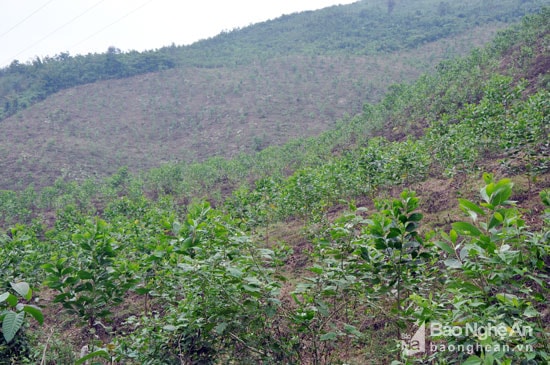 |
| The barren hills in Thach Son village, Thach Ngan commune (Con Cuong district) are gradually being covered with acacia trees for timber production. Photo: Cong Khang |
Not to mention the 4 hectares of rice paddies that yield two harvests a year, meeting part of their food needs. More importantly, the people have become familiar with intensive farming techniques. Thus, from going to the forest to cut wood for building houses and selling it to make a living, clearing land and planting seeds, the Dan Lai people in Thach Son have now developed an awareness of reforestation and intensive rice cultivation, which is truly a step forward in their understanding.
Along with crop cultivation, livestock farming among the Dan Lai people in Thach Son has also made significant progress. We visited the home of Ms. Le Thi Hue and her husband, one of the leading households in developing livestock farming. Her family is currently raising their second litter of four pigs, primarily fed on cornmeal and various plants and vegetables. Ms. Hue started raising pigs a few years ago, after seeing a friend in a neighboring village earning a high income. She and her husband then raised capital to build pigpens, buy piglets, and source initial feed.
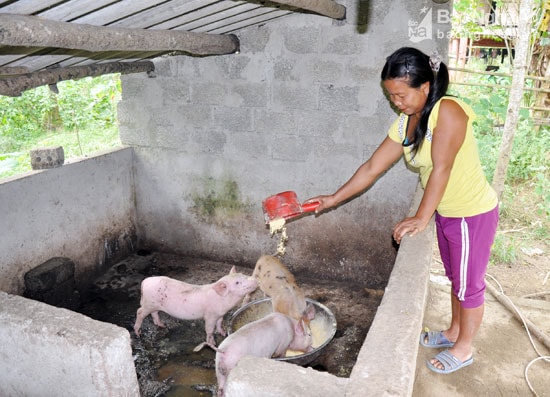 |
| Ms. Le Thi Hue is taking care of her family's second litter of pigs. Photo: Cong Khang |
They raised six pigs in the first batch, and after a few months, they gradually sold them to traders, earning nearly 10 million dong in profit. The couple was overjoyed. Seeing this, many other households in the village followed suit, and now a pig farming movement has begun to take shape.
Mr. La Van Son's family has focused on raising cattle, as he noticed there is still a large area of hilly land available, which he could use to grow fodder crops. He used his savings and borrowed more money to buy two young cows at a low price, planning to sell them for profit when prices rise. Currently, Mr. Son's two cows are thriving and promise to provide a decent income commensurate with his daily care.
In addition, his family also bought a small tractor to help with farming, cultivating the land, and transporting agricultural and forestry products, freeing people from manual labor. When they lived in Khe Khang, owning a tractor was just a dream for the people of Dan Lai, but now, besides La Van Son's family, Thach Son village has several similar tractors.
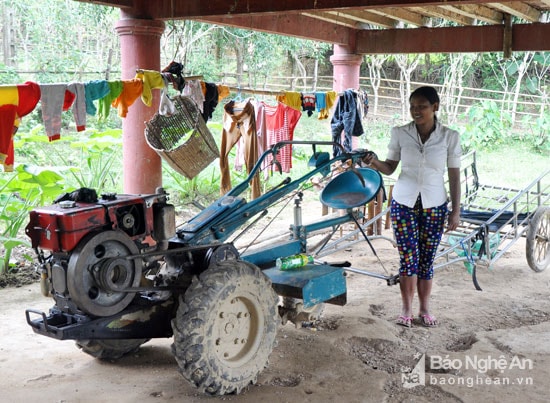 |
| Some households in Thach Son village, Thach Ngan commune (Con Cuong district) have purchased small-sized tractors to serve agricultural production. Photo: Cong Khang |
Mr. La Quang Vinh added that the village currently has over 40 households raising buffalo and cattle, with the most common number being 1-2 animals. The main farming method is semi-intensive, meaning the animals are left to graze in the wild hills, then brought back to the barn and given additional feed. This method utilizes readily available feed sources while allowing for better care and monitoring of the animals' development.
Looking back, ten years is not a long time to bring about major changes in the lives of a resettled Dan Lai ethnic group. However, the transformation in both awareness and business practices has affirmed a suitable and promising direction, which is highly commendable and encouraging.
Cong Khang


