
With tears in my eyes, I return to my homeland.
(Baonghean) - On the morning of July 24th, Vinh City was submerged in heavy rain. Despite the seemingly endless downpour, the organizing committee and 500 delegates participating in the Conference to honor exemplary influential figures from 5 Northwestern provinces: Yen Bai, Phu Tho, Hoa Binh, Thanh Hoa, and Nghe An, were still enthusiastic and cheerful as they set off for Kim Lien (Nam Dan), President Ho Chi Minh's birthplace.
(Baonghean) - On the morning of July 24th, Vinh City was submerged in heavy rain. Despite the seemingly endless downpour, the organizing committee and 500 delegates participating in the Conference to honor exemplary influential figures from 5 Northwestern provinces: Yen Bai, Phu Tho, Hoa Binh, Thanh Hoa, and Nghe An, were still enthusiastic and cheerful as they set off for Kim Lien (Nam Dan), President Ho Chi Minh's birthplace.
>>Promoting the role of influential individuals in ethnic affairs strategies
After a long and tiring journey, on the evening of July 23rd, the delegation from the provinces arrived in Vinh City. Upon setting foot in the birthplace of President Ho Chi Minh, the fatigue from the long journey seemed to vanish amidst the warm and enthusiastic welcome from the leaders and people of Nghe An. That night, everyone rested to regain their strength for the next morning's visit to President Ho Chi Minh's hometown, to see firsthand the scenery that was so closely associated with his childhood. Early in the morning, from the dawn, everyone woke up and dressed in their newest and most beautiful traditional costumes to go to President Ho Chi Minh's hometown to offer flowers and incense. For them, visiting President Ho Chi Minh's hometown was a pilgrimage to their roots, to the cradle of the revolution, to a land long considered a place of spiritual significance and outstanding people.
Within the grounds of the Kim Lien Historical Site (recently recognized as a Special National Historical Site), the distinctive costumes of the Thai, Mong, Khmu, Muong, and Dao ethnic groups were vibrant. The national anthem resounded during the flag-raising ceremony, and the rain outside seemed to pause to witness this sacred moment. After the moment of silence, each delegate offered incense before the altar dedicated to President Ho Chi Minh. In turn, everyone respectfully bowed, standing silently for a moment, their eyes fixed on the statue of President Ho Chi Minh, as if to speak to him about the life of their village and people, while simultaneously expressing their admiration and conveying the unspoken feelings in their hearts.
After the flower and incense offering ceremony, the delegates visited President Ho Chi Minh's ancestral home. Stepping through the bamboo gate, everyone was deeply moved. Blooming hibiscus, lush sweet potato patches, and branches laden with oranges and pomelos – the scenery was truly rustic and incredibly familiar. Many may have seen this scene before in books, newspapers, or on television, but upon arriving here, they were undoubtedly still amazed.
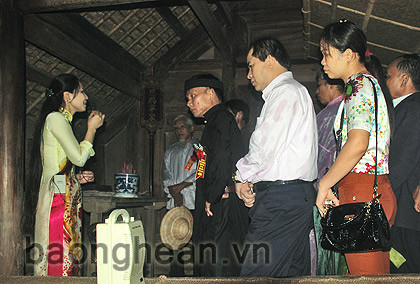
The delegates listened to stories about President Ho Chi Minh's childhood in his ancestral home - Kim Lien.
Photo: Thu Huong
The thatched house was too small to accommodate more than 500 people. Most stood outside in the rain, listening to the loudspeakers emanating from the small house. Inside Uncle Ho's thatched house, we witnessed tears on the faces of almost everyone as they listened, saw, and touched the artifacts that had been closely associated with the lives of each member of the family of Deputy Scholar Nguyen Sinh Sac - the father of President Ho Chi Minh. Standing next to us was Mr. Ly Kim Lich (over 80 years old, of the Dao ethnic group) from Xuan Thang village, Cu Thang commune, Thanh Son district (Phu Tho province), who repeatedly wiped away his tears.
When asked about his experience, Mr. Lich shared: “Since hearing the news that I would be attending the conference in Nghe An, I have been overjoyed. Because I knew that coming here would definitely allow me to visit Uncle Ho's birthplace, which has been a lifelong dream. I remember in 1969, the day Uncle Ho passed away, it was raining heavily like this, and I was part of the organizing committee for the memorial service in the commune. Everyone cried that day. Before coming here, my grandchildren told me to take lots of photos in Uncle Ho's birthplace and to listen carefully to the tour guide's stories so I could tell them to the whole family when I got home…” Standing next to Mr. Ly Kim Lich, Mr. Phung Sinh Toan (of the Dao ethnic group) from Yen Lap district (Phu Tho province) added: “I am over 60 years old this year, but this is the first time I have visited Uncle Ho's birthplace. This morning I woke up very early to prepare, at first I was afraid I wouldn't be able to go because of the heavy rain. But luckily, my dream of visiting Uncle Ho's birthplace finally came true.”
Bidding farewell to their paternal hometown of Lang Sen, the delegation continued on to Hoang Tru to visit their maternal hometown. The emotions were still overwhelming, and tears welled up in the eyes of those who had come from afar. We saw a woman respectfully holding a hammock, then admiring the loom of Mrs. Hoang Thi Loan. Upon inquiring, we learned that her name was Bui Thi Toan (of the Muong ethnic group) from Hang Tram town, Yen Thuy district (Hoa Binh province). Mrs. Toan shared: “This is the third time I have visited Uncle Ho's hometown, the previous times being in 2003 and 2010. Returning this time, I see that Uncle Ho's hometown has changed a lot, the historical site is increasingly solemn. But the emotion remains unchanged.”
In the souvenir display and sales area, Sung A Cau (of the Mong ethnic group) from Mang A village, Thu Cuc commune, Tan Son district (Phu Tho province) was captivated by the display of rubber sandals. He looked at them repeatedly and finally decided to buy a pair. Sung A Cau confided: “Since I was little, I’ve loved wearing rubber sandals, the kind of sandals Uncle Ho wore. I still have several pairs at home, both old and new, and they’re still in great condition. But since I’ve come to visit Uncle Ho’s hometown, I have to buy a pair there as a souvenir, and truly, ‘A pair of rubber sandals, Uncle Ho’s sandals’.”
Visiting President Ho Chi Minh's paternal and maternal hometowns, upon leaving, those who had come from afar still felt regretful that the rain prevented them from climbing Dai Hue Mountain to visit the tomb of his mother, Hoang Thi Loan. And so, the dream and plan to visit his birthplace once more, to respectfully pay their respects to the woman who gave birth to President Ho Chi Minh, remained.
Speaking with us, Comrade Truong Xuan Cu, Deputy Head of the Northwest Steering Committee, affirmed: “Regarding the conference to honor outstanding influential figures from the five provinces of the Northwest region in Nghe An, we are truly reassured about the reception, preparation, and visits to historical sites. This is also a crucial factor determining the success of the conference. Visiting President Ho Chi Minh's birthplace, the people are undoubtedly very happy, moved, and proud, and will continue to contribute their intellect and strength to the development of their homeland and country.”
CONG KIEN


