New Colors of Muong Qua
(Baonghean) - Lush rice paddies, prosperous villages, friendly people, and a rich history and culture. These are the feelings of everyone who sets foot in the Muong Qua region (Mon Son and Luc Da communes, Con Cuong district). Frankly, I like to visit at this time, when the Muong Qua rice fields are in full bloom, when the fragrant scent of rice permeates the air. Hope is evident on the faces of the farmers…
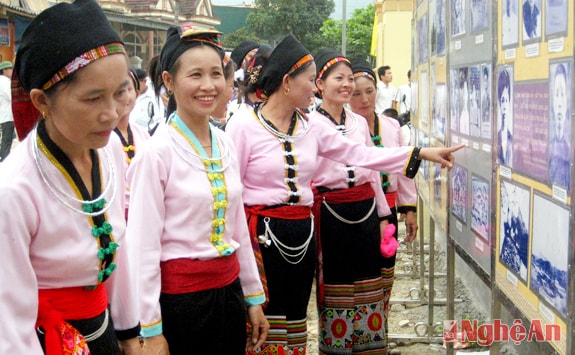 |
| People in Mon Son view an art exhibition themed "The Revolutionary Struggle Movement". |
A GLORIOUS PAST
Artisan Luong Van Nghiep, head of the Cang Village Folk Song and Dance Club (Mon Son), is adjusting traditional musical instruments (bamboo mouth organ, flute, pipe, and stringed instrument) in preparation for a cultural exchange event celebrating Independence Day. Seeing the guests, the host nodded and picked up the bamboo mouth organ, playing a lively melody as a greeting. Mr. Nghiep is quite knowledgeable about Thai culture as well as the historical and cultural roots of his homeland. When we asked about the history of the region, artisan Luong Van Nghiep said: About 200-300 years ago, the Thai people of Northwest Vietnam began migrating to the mountainous areas west of Thanh Hoa and Nghe An provinces. On their journey to find new land, a group of Thai people belonging to the Vi, Luong, and Lo clans stopped in Muong Qua.
Recognizing the ideal terrain of the area, surrounded by mountain ranges, with a relatively flat and fertile valley in the middle, abundant water resources, and a large gathering of wildlife, the people decided to settle here and establish a village. The first task of the Muong Qua inhabitants was to build dams, block streams, and reclaim land for rice cultivation. With perseverance and determination, villages were soon formed, and the Muong Qua rice fields continuously expanded. The rice paddies flourished, the streams teemed with fish and shrimp, and life here was always prosperous. Hearing of Muong Qua as a blessed land, Thai people from all over came to live there. The villages grew increasingly lively, and the region became more and more prosperous.
Later, Hau Bong, a respected chieftain in the region, mobilized the people to continue reclaiming land and expanding rice fields to improve their lives. This chieftain directed the people to dig a canal to bring water from the Moi stream to supplement the water supply for the Muong Qua rice fields. Since the canal was completed, the fields were well-irrigated, and the rice plants flourished, so the people named it Khe Lo (rice stream). Today, Khe Lo still exists and continues to serve its purpose.
During the years 1930-1931, in solidarity with the people of the entire province and the whole country, the people of Muong Qua enthusiastically participated in demonstrations against French colonialism. Based on this, in April 1931, the Mon Son Party Branch was established. This was the first Party branch in the highland districts, affirming the spread of the revolutionary movement under the leadership of the Party. During the historic August Revolution, Muong Qua was one of the regions that seized power relatively early!
FOLLOWING IN THE FOOTSTEPS OF OUR FOREHOOD
We went up to the Pha Lai dam to admire the Giang River and enjoy the local specialties of Muong Qua. Then we went upstream to see Khe Kem waterfall, a majestic natural wonder. Pu Mat National Park has bestowed upon Muong Qua a picturesque landscape of mountains, rivers, streams, and caves, creating a poetic and charming environment. This is a significant advantage and opportunity for the local people to develop their socio-economic life. Currently, the two communes of Mon Son and Luc Da are actively promoting the preservation of cultural identity (restoring traditional crafts, establishing folk song and musical instrument clubs, and reviving some unique customs...) to attract tourists and develop community tourism. To date, several villages in Muong Qua have been designated as community tourism destinations. Many visitors come here not only captivated by the charming scenery and prosperous villages but also charmed by the traditional folk songs, dances, and the resonant sounds of gongs, flutes, and pipes echoing through the majestic mountains at night. Along with that are the traditional dishes of the Thai ethnic group and the products of Muong Qua, a taste that you will surely never forget. Since ancient times, the saying "Rice from Muong Qua, fish from the Giang River" has been passed down and spread...
Promoting the campaign "Studying and following the moral example of Ho Chi Minh," cadres and people, through concrete and practical actions, each mass organization, Party branch, and Party member demonstrates their determination to continue the traditions of their homeland by building a model of "following the example." Arriving at Thai Son 2 village on Monday morning, we witnessed the solemn flag-raising ceremony at the village's cultural center, attended by cadres and Party members. The national anthem resounded throughout the village, and everyone gazed at the national flag fluttering in the wind. Mr. Lo Xuan Dieu, the Party branch secretary, said: "For many months now, every Monday morning, all Party members and village management boards come to the community cultural center to participate in the flag-raising ceremony. Afterwards, they review and assess the village's situation over the past week and plan tasks for the coming week. This practice has become a regular routine and is truly effective, ensuring timely guidance." According to Mr. Lo Xuan Dieu, the weekly flag-raising ceremony is significant in fostering patriotism and raising awareness of responsibility among each official and Party member.
The Tan Son village is currently implementing a savings group model to help each other develop livestock farming, initiated by the Women's Association. Each savings group has 18-20 members, who hold regular monthly meetings and contribute money to a savings fund. This money is used to support members facing difficulties, purchase livestock for farming, and gradually escape poverty. Based on this, some members have strived to improve their lives, actively engaging in production, leading to a significant improvement in their family's economic situation. A prime example is Ms. Ha Thi Chinh. Previously, Ms. Chinh's family was considered disadvantaged in the village. Thanks to a loan from the savings group, she decided to develop pig farming. Starting with just one piglet, she now has dozens in her pen, generating substantial income that has helped her family renovate their house and purchase modern amenities. Ms. Chinh shared: “Before the savings group was established, I really didn't know how to have enough food and money for daily expenses. Since joining the savings group, participating in activities, exchanging ideas, learning business experiences, and being able to borrow capital for production, I have found my own path…”
Upon arriving at Bac Son village, we visited the family of Ms. Vi Thi Anh (born in 1981). Their old house had a corrugated cement roof, bamboo walls, and simple furnishings. Unfortunately, her husband passed away five years ago, leaving behind a poor family and three young children. The Bac Son village Party branch has encouraged each member to save 10,000-20,000 VND per month to support families in difficult circumstances. Based on this, Ms. Anh receives an additional monthly allowance to cover living expenses and her children's education. The Party branch also provides assistance to Ms. Lo Thi Hanh, over 80 years old, who lives alone and has no one to rely on. Ms. Lo Thi Lien, the Party branch secretary, said: “Following the directive of the commune Party committee on the campaign to study and emulate President Ho Chi Minh's example, our Party branch unanimously decided to build a model to help poor and lonely families. This is practical and in line with the compassionate traditions of our nation…”
Speaking with us, Mr. Vi Van Nam, Secretary of the Mon Son Commune Party Committee, affirmed: “Mon Son - Muong Qua is a land rich in revolutionary traditions, and we are always concerned about how to continue the traditions of our ancestors. After discussions and reaching a consensus, at the beginning of this year, the Party Committee decided to launch a campaign for each Party branch and mass organization to build a model of activity based on the specific situation, linked to the campaign “Studying and following the moral example of Ho Chi Minh”. To date, the Party branches have registered and implemented their models, hoping to contribute to changing the face of the villages and making them worthy of being a revolutionary homeland.”
Text and photos:Cong Kien