
Producing biofertilizers from biological preparations: Farmers are not yet enthusiastic.
(Baonghean) - The application of Compost Maker biological products to produce organic microbial fertilizers from agricultural by-products for crop fertilization is a new direction today. While the market is experiencing continuous price increases for fertilizers and agricultural supplies, causing hardship and losses for farmers, this product has been evaluated as a solution to reduce fertilizer investment costs, increase crop yields, and move towards sustainable agriculture. However, in many places, farmers are still not enthusiastic about applying this technology...
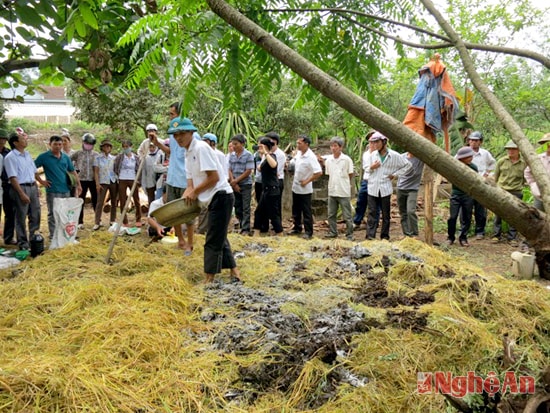 |
| A demonstration model for producing bio-fertilizer in Nghia Hanh (Tan Ky). |
The successful application of Compost Maker to produce microbial organic fertilizer in Nghe An province, implemented by the Center for Application of Advanced Science and Technology, has created organic fertilizer for production, increasing crop yields by 15-20%. To support the purchase of Compost Maker for the production of microbial organic fertilizer from agricultural by-products in Nghe An province during the 2012-2014 period, the Provincial People's Committee issued Decision No. 16/2012/QD-UBND. Accordingly, over the three years (2012-2014), farmers purchasing Compost Maker for the production of microbial organic fertilizer received financial support. For the high mountainous districts of Que Phong, Quy Chau, Ky Son, Tuong Duong, and Con Cuong, the support was 70%; and 60% for the low mountainous districts of Nghia Dan, Tan Ky, Thai Hoa town, Quy Hop, Anh Son, and Thanh Chuong. 50% will be allocated to the remaining districts, cities, and towns at a stable price of 24,000 VND/kg.
After two years of implementation, the Center for Application of Advanced Science and Technology has conducted production, training, and technical instruction on the production of microbial organic fertilizers for farmers in the province. However, currently, only two districts, Anh Son and Tan Ky, annually register and purchase the product to supply to their people, with financial support for these two districts totaling over 271 million VND (2012-2013). To date, the center has supplied 26,340 kg of the product to people in Anh Son and Tan Ky. Through the Tan Ky District Horticultural Association, the method of producing microbial organic fertilizers using Compost Maker, as well as the application process for some of the district's main crops, has been transferred directly to farmers through hands-on training, with farmers practicing immediately after learning. In addition, in the first two years, Tan Ky district also issued a policy to support farmers with 40% of the cost of purchasing Compost Maker. Thus, in 2012-2013, farmers in Tan Ky were able to use Compost Maker to produce microbial organic fertilizer completely free of charge.
The family of Ms. Trinh Thi Yen in Hamlet 7, Nghia Hanh Commune, is one of nearly 2,000 households in Tan Ky District that have participated in producing microbial organic fertilizer using Compost Maker for the past three years. Since starting to produce microbial organic fertilizer, Ms. Yen's family has been able to clean up household waste and agricultural by-products. The next benefit is a reduction in fertilizer costs for crops. Previously, with 8 sao (approximately 0.8 hectares) of rice paddies plus over 2 acres of land dedicated to fruit trees including lemons, dragon fruit, and various vegetables, Ms. Yen's family had to spend at least 20 million VND annually on fertilizer, mainly chemical fertilizers. Now, using microbial organic fertilizer has helped her family not only reduce fertilizer costs by about two-thirds, but also earn extra money thanks to a 10-15% increase in crop yield.
If we compare prices on the market, 1 ton of organic bio-fertilizer produced by businesses costs no less than 2.5 million VND, while 1 ton of fertilizer produced by farmers using Compost Maker biological products and utilizing agricultural by-products only costs between 400,000 and 500,000 VND, with comparable, if not superior, quality. Mr. Tran Tu Ba, Vice Chairman of the Tan Ky District Gardening Association, said: “Most of the district's cultivated land is hilly, and solving the problem of barren land is extremely difficult. Using Compost Maker to produce bio-fertilizer helps improve soil structure, making it more porous and preventing degradation that occurs with long-term use of chemical fertilizers; it also reduces pests and diseases, and increases crop yields, especially for the district's main crops like sugarcane and corn, from 50 tons to 80 tons per year. However, for this policy to be truly effective and widespread, relevant agencies need to provide more thorough support mechanisms, clear and easy-to-follow guidelines, and this support policy should be extended in the future.”
In Anh Son district, in 2013, the Standing Committee of the Farmers' Association launched a campaign to promote the production of bio-fertilizers and directed farmers to produce over 6,000 tons. A prime example is Hung Son, which currently has 500 hectares of industrial tea plantations. The Hung Son Tea Enterprise provided 40% of the cost, with the remaining funds used to purchase the fertilizers for farmers. Over three years, Hung Son was a leading unit, producing over 800 tons. Other households, such as those in Tho Son, Binh Son, and Thanh Son communes, produced an average of 4-5 tons annually for fertilizing their crops. In the first six months of 2014, farmers were encouraged to produce nearly 2,000 tons. “In previous years, during droughts like the present, the tea hills here would often dry up, leaving no harvest. The excessive use of inorganic fertilizers over a long period had made the soil barren. Since applying microbial organic fertilizer, the soil here has retained moisture, and the tea plants no longer wither and die during dry seasons. Understanding the effectiveness of Compost Maker in the production of microbial organic fertilizer, since 2009, Hung Son Tea Enterprise has collaborated with the Department of Science and Technology to transfer the production process to farmers, bringing efficiency to cultivation, reducing wilting and pesticide residue in the soil,” shared Mr. Nguyen Huu Quy, Deputy Director of Hung Son Tea Enterprise, Anh Son district.
Despite the significant benefits, the relatively simple production process, and the availability of support policies, farmers have not been truly enthusiastic about producing organic microbial fertilizers from Compost Maker biological preparations over the past three years. The main reasons are farmers' continued reliance on government support and their reluctance to learn and implement the process. Hopefully, in the future, recognizing the real benefits of this product and with continued timely implementation by relevant authorities, farmers will embrace and proactively adopt this effective production method.
Thanh Hoa


