
Tighten inspection procedures for transport vehicles.
(Baonghean)- The phenomenon of transport vehicles modifying or expanding their cargo compartments to increase load capacity is very noticeable on current transportation routes… To solve this problem, focusing solely on inspection by the Transport Department and enforcement by the Police is insufficient; active participation from local authorities, auto repair shops, and especially vehicle owners is needed.
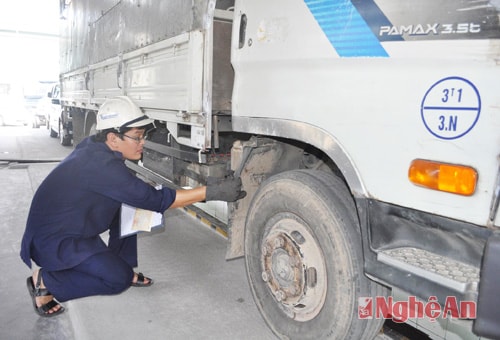 |
| Vehicle inspection at the Nghe An Road Motor Vehicle Inspection Center. |
Meeting with us, Nguyen Xuan Truong, the owner of truck 37C-041145 in Lang Son, Anh Son, said: “The truck's cargo bed was reinforced to carry a larger volume of goods, so the vehicle's curb weight doesn't match the specifications in the documents. During the inspection, I had to make a second modification to meet the inspection agency's standards.” Recently, many motor vehicles have been rejected by inspection agencies for failing to meet quality standards. At the Nghe An Road Motor Vehicle Inspection Center (under the Department of Transport), about 100 motor vehicles arrive for inspection each day, many of which are trucks that have to return to the auto repair shop to have their original condition modified.
In April 2014 alone, 3,086 vehicles underwent inspection, but only 2,190 met the requirements, while 895 failed, primarily cargo vehicles. Mr. Phan Van Minh, Deputy Director of the Nghe An Road Motor Vehicle Inspection Center, stated: “In implementing Directive No. 08/CT-TTg dated April 12, 2014, of the Prime Minister on urgent solutions to improve quality and combat corruption in vehicle inspection work, and the official letter from the Nghe An Department of Transport, the Road Motor Vehicle Inspection Center has organized briefings and signed commitments with inspectors to prevent corruption and harassment during vehicle inspections. We are determined not to issue inspection certificates to vehicles that do not fully meet safety regulations, especially those with modified cargo compartments.”
With such decisive action, in the first 16 days of May, out of a total of 1,573 vehicles inspected at the Nghe An Road Motor Vehicle Inspection Center, 550 vehicles failed to meet standards. The failure rate on the first inspection, categorized by system, was 44.47%, with 227 vehicles failing due to issues with the frame, seats, and bodywork. For example, truck 37 H-9706 of Company 471 – Vinh City, due to modifications to the leaf springs, extended cargo bed, and faulty braking system, required repairs and only passed the inspection on the third attempt.
At the 3703D Motor Vehicle Inspection Center located in Nghi Thach commune, Nghi Loc district, a large number of motor vehicles arrive for inspection daily. However, many vehicles have to go to the inspection center for further repairs such as replacing lights, repairing brakes, and servicing the steering system. Many vehicles require the removal of illegally modified or extended parts, restoring them to their original condition. Mr. Hoang Trung Liem, Deputy Director of the 3703D Motor Vehicle Inspection Center, stated: “In the first 16 days of May, the 3703D Motor Vehicle Inspection Center inspected 752 vehicles, of which 193 failed to meet standards. Vehicles failing the first inspection, specifically the frame, seats, and bodywork, accounted for nearly 27%, while the braking system accounted for nearly 50%...”
Despite this, many types of cargo vehicles are still circulating on the roads, carrying overloaded and bulky goods due to modified cargo beds and vehicle extensions, yet they still receive inspection certificates. Leaders of vehicle inspection centers affirm that all road motor vehicles meet the required standards after inspection. However, after inspection, vehicle owners often return to auto repair shops to expand their cargo beds. Therefore, in addition to penalizing overloaded vehicles, authorities need to take strict measures against auto repair shops that modify vehicles in a way that doesn't conform to their original condition. One of the necessary steps in limiting overloaded vehicles is to strengthen inspection and strictly penalize violations, while also promoting awareness among vehicle owners about the harmful effects of modifying their cargo beds.
Hoang Vinh


