
Promptly adjust the land conversion process in Thanh Mai commune.
(Baonghean)The Nghe An Newspaper received a complaint from Mr. Bui Van Hao, Secretary of the Party Branch of Bac Son hamlet, Thanh Mai commune, requesting clarification regarding violations of his family's property rights by the commune government and the hamlet's land conversion team. Verification revealed that the land conversion in Thanh Mai commune had some unreasonable aspects...
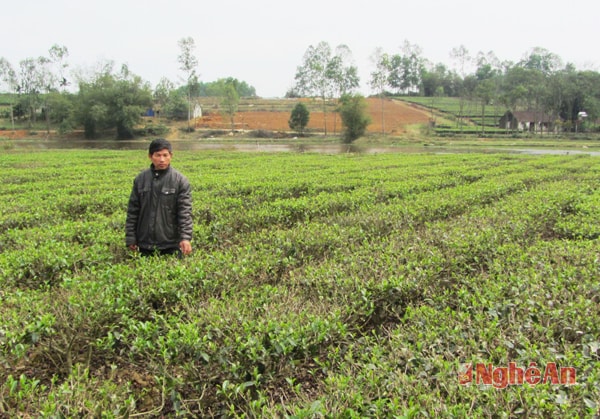 |
| Mr. Hao's family tea garden was given to someone else by the village after the land redistribution. |
According to Mr. Bui Van Hao's petition, in 1999, his family was granted a land use right certificate for 14,548 square meters by the People's Committee of Thanh Chuong District.2, of which 9,644m2The land consists of permanent garden land, with the rest being rice and other crops. In 2013, during the land conversion process, Mr. Hao's family had 1,780 square meters of land confiscated.2Agricultural land out of the total area of rice and other crops, including over 400m².2The tea plantation land has already yielded a harvest. Mr. Hao petitioned the commune authorities but received no resolution; he then petitioned the district People's Committee, which replied that the matter should be handled by the commune, but he received no further response...
It was found that Mr. Bui Van Hao's land use right certificate, registered under the name of Bui Van An (Mr. Hao's father), was issued on February 2, 1999. In addition to the permanent garden land, it includes 10 plots of rice and other crops with a total area of 4,904 square meters.2The land use rights are valid for 20 years. According to Mr. Hao, out of the 10 plots of rice and other crops, 6 were allocated by the commune government, and the remaining 4 were reclaimed and improved by his family in areas with barren, rocky soil, near roads, or areas frequently damaged by buffaloes and cows, managed by the Truong Son Cooperative. Regarding the land conversion, Mr. Hao believes it is a correct policy aimed at facilitating production for the people. As the Party branch secretary, he was assigned the task of leading the land conversion team in the hamlet. However, during implementation, he found that the commune and hamlet's approach was not in line with the province's policy and guidelines, so he suggested to the commune that they review the method.
Because the method of implementation remained unchanged, he requested to withdraw from the land conversion team. The conversion work continued in the hamlet, under the direction of the commune. The Bac Son hamlet conversion team reclaimed all of Mr. Hao's agricultural land, as well as that of 47 other households in the hamlet, and then divided it equally among the hamlet's population as of October 15, 1993 (the date of implementation of Decree 64-CP). After the redistribution, Mr. Hao lost 6 plots of land allocated by the commune, corresponding to an area of 1,780 square meters.2Mr. Hao expressed his frustration: "The province's policy is land conversion, not land reclamation. The conversion guidelines from above are about multiplying by a coefficient K, not redistributing the land. Why is the commune giving the hamlet the right to reclaim and redistribute the land? We put in the effort to improve the land, acquired assets on the land, and moreover, the land has already been granted certificates by the competent authorities. They say it's conversion, but my family hasn't received any conversion at all. Out of 10 plots, we've lost 6, leaving us with only 4..."
According to Mr. Hao, on the plots of land that the village has reclaimed and given to others, in addition to over 400 square meters of tea plantations ready for harvest, there are more than 500 square meters of other land.2The land he used to grow rice was over 600 square meters.2The cassava he planted has sprouted. Currently, it covers 600 square meters.2The cassava land was cleared by the person who was allocated the land to plant corn; more than 500m2Regarding the rice paddy land, the households that were allocated the land are requesting permission from the commune and village authorities to clear it and replant; over 400 square meters.2The land used for tea cultivation is constantly being reclaimed by those who were allocated it... Feeling heartbroken and resentful, Mr. Hao said: "I told these people that I still own the land because the land title is still valid, and it is wrong for them to arbitrarily destroy my property. If the Party Committee and the Commune People's Committee allow it, then it's up to them... With these events, although I am very upset, I try to restrain myself to avoid conflict..."
In a discussion with the head of Bac Son hamlet, Mr. Bui Van Hong, he stated that the reason for the land redistribution was that in 1993, Bac Son hamlet failed to implement Decree 64-CP on allocating agricultural land to households and individuals. This resulted in 30 residents at that time not receiving land. When the land conversion policy was introduced, most residents in the hamlet requested a redistribution to ensure fairness. The Party Committee and the commune government also agreed with this approach. The commune has decided to temporarily reclaim all agricultural land in the hamlet for redistribution...
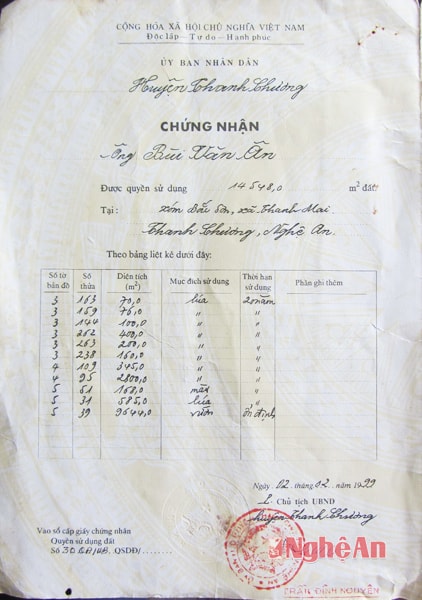 |
| Land title belonging to Mr. Bui Van Hao. |
We contacted Mr. Phan Dinh Ha - Vice Chairman of the District People's Committee (who directly supervised the land conversion work in Thanh Mai) and Mr. Phan Thanh Ngan - Head of the Department of Natural Resources and Environment of Thanh Chuong District to clarify this issue. Mr. Phan Dinh Ha and Mr. Phan Thanh Ngan affirmed that Thanh Chuong District did not instruct the communes in the area to "reclaim agricultural land" to "redistribute land". "As far as I know, Thanh Mai commune completed the land conversion in 2013. If this information is accurate, then Thanh Mai's method of implementation is too rigid. The authority to reclaim land belongs to the district, not the commune or village. When reclaiming land, the full process must be followed, and compensation must be provided... The district also does not force communes to convert land used for perennial crops like tea. I will report to the district leadership for further action..." - Mr. Ngan said.
Land ownership is closely tied to the interests of each household and individual, making land conversion very complex, especially in hilly areas like Thanh Mai commune. However, regardless of the reason, the way land conversion was carried out in Bac Son hamlet was contrary to the guidelines of the Department of Natural Resources and Environment. To ensure fairness for the 30 people who had not received land under Decree 64-CP, the Thanh Mai commune authorities and the Bac Son hamlet land conversion team should have clearly reported the situation to the Thanh Chuong District People's Committee, requesting the district to reclaim the agricultural land and redistribute it according to the correct procedures and authority. When reclaiming land, careful consideration should be given to which land area should be reclaimed appropriately, and the contributions of those who have worked to improve and restore the land should also be taken into account. According to our investigation, in Bac Son hamlet, besides Mr. Bui Van Hao, several other families are dissatisfied with the hamlet's approach. Mr. Bui Van Nham (whose household was allocated a rice paddy plot from Mr. Bui Van Hao) confided: "I also disagree with the method of reclaiming all agricultural land to redistribute it, but because I saw many people agreeing, and thought that protesting wouldn't change anything, I had to accept it. Previously, my land, which was both allocated by the commune and reclaimed, consisted of more than a dozen plots, covering an area of over one hectare. After the land conversion, I lost about 4 sao (approximately 0.4 hectares)..."
In my opinion, the People's Committee of Thanh Chuong district should promptly review and rectify the land conversion process in Thanh Mai commune to ensure it aligns with the province's policies and guidelines, and does not affect the legitimate rights and interests of the individuals involved.
Nhat Lan


