
Develop a flood release plan for Vuc Mau Reservoir (Hoang Mai Town) as soon as possible.
(Baonghean) - Vuc Mau Lake is a large reservoir in Nghe An province. Besides supplying water to 3,600 hectares of agricultural land and providing drinking water for 100,000 people in 12 communes and towns in Hoang Mai district, it also serves as a flood control measure. Unfortunately, the 2013 flood release from Vuc Mau Lake resulted in regrettable consequences. This year, affected residents hope that relevant authorities will soon develop and publicly disclose a flood release plan, but this has yet to be done, and the evacuation plan remains very general.
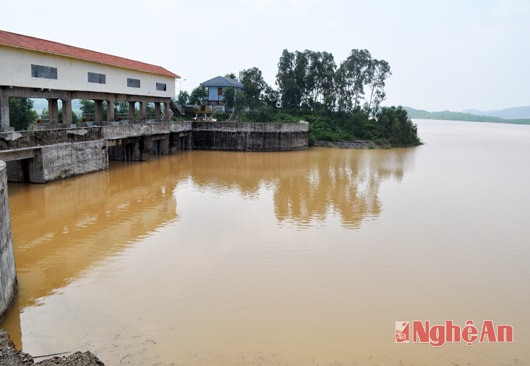 |
| The flood discharge system of Vuc Mau Lake. Photo: V.D. |
| RELATED NEWS |
|---|
Clearly, the 2013 flood release demonstrated a lack of preparedness and a reactive approach, leading to a reactive response in downstream areas and causing extremely heavy damage. Therefore, after this incident, those responsible must review every aspect, from legal documents to flood control plans, from operational procedures to flood release scenarios, to the responsibilities of individuals and groups involved, and their sense of responsibility and professional ethics.
It is known that the Hoang Mai Irrigation Enterprise has developed and implemented flood control plans. The 2014 flood control plan was also sent to Hoang Mai Town early, and Hoang Mai Town has also developed a flood control plan for the area, adding the Chairman of the People's Committee of Hoang Mai Town to the Vuc Mau Reservoir command subcommittee. However, the provincial document on the operation procedure of Vuc Mau Reservoir has not yet been revised, or rather, it is still under review and has not been signed. Nguyen Huy Phuc, Deputy Director of the Hoang Mai Irrigation Enterprise, said: “The flood release scenario is not yet available. Basically, it requires funding; we cannot afford to build a plan for the flooded area. The operation procedure for Vuc Mau Reservoir is still being revised and submitted; it is not yet ready.”
Returning to Vuc Mau Lake one day in mid-July, looking out into the distance, the lake's surface was a clear, rippling blue. Surrounded by lush greenery and hills, the erosion caused by last year's floodwaters was only a trace. The Chairman of the People's Committee of Quynh Di Commune, Mr. Nguyen Quang Dai, told us: “Last year's flood in Quynh Di, located downstream, caused immense damage. This year, we see that the Hoang Mai Irrigation Enterprise has improved in notifying people about flood releases. They call us 2-5 hours in advance, notifying us about the number of gates to open. However, we hope that the Northern Irrigation Company will soon develop a flood release plan, communicate it to the people, and publicly display it along National Highway 1A. They should indicate how much water will flood when two gates are open, and what to do when five gates are open. We don't want people to live in anxiety and uncertainty. The Hoang Mai Irrigation Enterprise needs to proactively manage flood releases so that the lake remains safe during the rainy season, and the lives and property of the people are protected.” Mr. Dai also added that his house is right next to the Hoang Mai River, so for decades he has been familiar with the high tides. The tide rises once a day, following the moon; when the moon rises, the water rises. At the peak of the high tide, the Hoang Mai River water rises by 2-3 meters. If floodwaters are released along with the rising tide, it will immediately inundate people's homes. Those who release floodwaters need to understand this and should not release them during high tide.
Residents of Quynh Trang living along the riverbank believe they need flood warning signs, and these signs should be publicly displayed along the river and National Highway 1A. They also believe that when multiple floodgates are opened, a siren should be sounded, as simply calling the commune leaders is insufficient. "We demand that these things be done soon, before the rainy season, and not delayed for another year," said Mr. Cong from Hamlet 5.
This year, regarding the organizational plan: Hoang Mai Irrigation Enterprise will mobilize 200 militia members from Quynh Trang commune as the core force, along with the reservoir management cluster, to handle technical incidents at the reservoir. Mr. Nguyen Huy Phuc, Deputy Director of Hoang Mai Irrigation Enterprise, will be in charge of technical command. The rescue force will consist of the People's Committees of Quynh Trang, Quynh Thang, Tan Thang, Quynh Tan, Mai Hung, and Quynh Di communes in Hoang Mai town, with each commune required to contribute 200 militia members to the rescue effort in case of an incident at Vuc Mau reservoir. Regarding the evacuation plan: “When the reservoir water level reaches its peak at +21 and is rising, the Vuc Mau reservoir will release floodwaters according to the operating procedure. When the reservoir water level reaches the emergency warning level (+21.92), it is necessary to evacuate people and property in the downstream area of the Vuc Mau reservoir. When the reservoir water level is at +22.72 and rising, according to the procedure, the Vuc Mau reservoir will operate at maximum flood discharge. If combined with high tides and additional rainfall in the downstream area, this will cause severe flooding. To ensure the safety of people and property, it is necessary to evacuate people to safe areas.” That's the regulation, but neither Hoang Mai nor the Northern Irrigation Company have a specific plan for how many hamlets and communes need to be evacuated because there is no flood discharge scenario. Therefore, the evacuation plan is very general. For example: “In Quynh Loc commune, the area to be evacuated is Quynh Loc, the evacuation locations are school buildings, sturdy high-rise buildings, and hills; in Quynh Di commune, the area to be evacuated is Quynh Di, the evacuation locations are ward People's Committee headquarters, high-rise schools, and high-altitude areas…”.
In a conversation with Mr. De, Deputy Director of the Department of Agriculture and Rural Development, it was learned that the Department is currently revising some aspects of the flood discharge operation procedure for Vuc Mau Reservoir (this procedure was issued in 1999). The reason for the delay in submission is the need for meetings and consultations, but only some legal issues have been presented so far; the technical aspects have not yet been addressed. The technical factors need to be studied to calculate the conditions of natural disasters, weather, water storage levels, and water inflow into the reservoir, as a long time has passed since the issuance of this operation procedure, and many conditions have changed. According to Mr. De, the current conflict is the need to resolve the relationship between the upstream and downstream areas. Upstream, many households have encroached on flood-prone areas to build houses, so when the water level rises, approximately 200 households (in Tan Thang area) will be flooded. If the reservoir does not release floodwaters, these households will be flooded, but if all the water is released downstream, the downstream area will be flooded. Therefore, Quynh Luu district needs to relocate households in the flood-prone area of Vuc Mau lake.
Regarding the necessary conditions for developing a flood release plan, funding and human resources are also crucial. Assessing how many gates to open and how much flooding is possible is currently impossible; scientists need to be involved. Even at Vuc Mau reservoir, while a monitoring system exists, it only monitors upstream, not downstream.
Thus, the hopes of the people in the downstream area of Vuc Mau reservoir for this year's rainy season and floods have not been met. They still live in fear, and if flood prevention and control efforts remain flawed and complacent, the consequences could still occur.
Chau Lan


