
The Legend of Cua Luy Temple
On this trip to Anh Son, we sought out Mr. Nguyen Sy Ta (80 years old) in Hoa Son commune to learn about the history of the Cua Luy temple.
According to Mr. Ta, his ancestors recounted that during the Lam Son Uprising, when Le Loi's army advanced into Nghe An province via the mountain route, they quickly captured Tra Lan citadel (now Bong Khe commune, Con Cuong district) and then sent a general (whose name is not clearly remembered) to lead an army across the Ca River to encamp in the Kim Nhan mountain region (now Anh Son district). This was a strategically important area surrounded by mountains and hills, with many ravines and streams, and only a few entrances, among which Cua Luy was the most crucial.
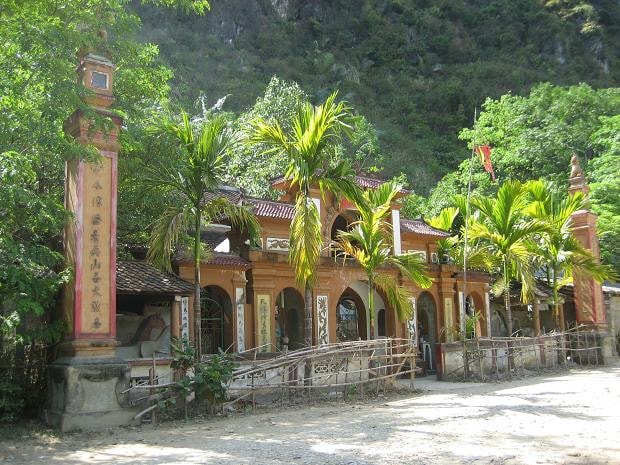 |
The facade of the Cửa Luỹ temple. |
At that time, due to the arduous march, the harsh living conditions, the constant fighting with the enemy, and the unsuitable climate and terrain, many soldiers fell ill, and epidemics frequently broke out in the camps.
Under the general's command was a female physician who wholeheartedly cared for the soldiers, diligently attending to their needs and advising them on maintaining their health. To ensure a sufficient supply of medicine for everyone, she often braved the elements, rain or shine, to trek alone through the forest in search of precious medicinal herbs. This work earned her the respect and admiration of everyone, who affectionately and intimately called her "Miss."
One day, the camp was ravaged by a malaria epidemic, and medicine was severely lacking. The girl ventured alone into the forest to find herbs. Exhausted, she leaned against an ancient tree by the roadside to rest, never to rise again. When she didn't return, the soldiers fanned out in all directions to search for her. She was brought back to the camp, lying motionless in her hammock, her hand still clutching a handful of medicinal leaves.
Deeply saddened by the loss of the devoted female physician, the general ordered her burial in a field in the area. From then on, the soldiers commonly referred to it as the Princess Physician's Tomb, and the field became known as "Co Field" (later mispronounced as "Crane Field").
One day, the general and his soldiers were visiting a grave when, along the way, they encountered a white rabbit that emerged from an ancient tree. It circled the group several times before advancing forward, raising its hind legs as if to block their path, and then disappeared. Sensing this might be an ominous sign, the general ordered his soldiers to turn back and planned a vigilant patrol and guard duty.
The next morning, they captured a group of Ming scouts who confessed to being ordered to assassinate the general guarding the area. The general believed the white rabbit was the White-Clothed Princess who had appeared to save his life, so he ordered his troops to build a temple at the foot of the ancient tree where the white rabbit had appeared. He named the temple Luỹ Sơn (commonly known as Cửa Luỹ Temple), and from then on, the soldiers and people referred to her as the White-Clothed Princess. When the general died, the soldiers and people erected a temple on a mound not far from Cửa Luỹ Temple and called it Đức Ông Temple.
Later, because the Duc Ong Temple was surrounded by swamps, making it inconvenient for people to visit and offer incense, the people moved the deity's tablet to be worshipped together at the Cua Luy Temple. Legend says the Cua Luy Temple is very sacred. According to ancient accounts, the female physician was later bestowed the title of Holy Mother of Luy Son by Emperor Minh Mang, and later by Emperor Khai Dinh, the title of Duc Bao Trung Hung Thuong Dang Than. Unfortunately, due to war and the destruction of the temple by bombs, these imperial decrees no longer exist.
In 1968, the Cua Luy Temple was severely damaged by American bombs, leaving only an incense burner on a rocky outcrop. Mrs. Tran Thi Chau, originally from Vinh, evacuated here with her husband who worked as a power plant worker. Hearing about the temple's sacredness, she bought bamboo and hired people to rebuild it. In 1988, Mrs. Chau decided to submit the necessary paperwork to relevant authorities to request the restoration of the Cua Luy Temple. The funding for the restoration mainly came from her family's charitable donations. Today, the Cua Luy Temple, though not yet grand in scale, boasts beautiful and peaceful scenery, welcoming people daily who come to pray for peace and prosperity.
Cong Kien


