
Tan Ky: Effectiveness of innovation in Party building and organization work.
(Baonghean) - In 2014, under the focused and decisive leadership of the Standing Committee of the District Party Committee, the work of Party building and organization was comprehensively, proactively, accurately, and promptly implemented by the Tan Ky District Party Committee, creating positive changes that were rated as outstanding by the Provincial Party Committee's Organization Department. Outstanding among these were the solutions to continuously improve the practical work quality of the cadre team…
Strengthening the fighting capacity of grassroots Party organizations.
It must be said that, within the Tân Kỳ cadre system, there were times when internal unity was lacking, and the province often had to deploy cadres to reinforce the system. This created "ideological problems" among cadres and Party members, affecting the development and growth of grassroots cadres as well as the unity and cohesion in leadership and guidance. Fortunately, with the renewal in thinking, in the work of cadre organization and Party building, the Tân Kỳ apparatus at all levels has strived to improve the quality of its operations, promptly addressing shortcomings and drawing on lessons learned to gradually improve.
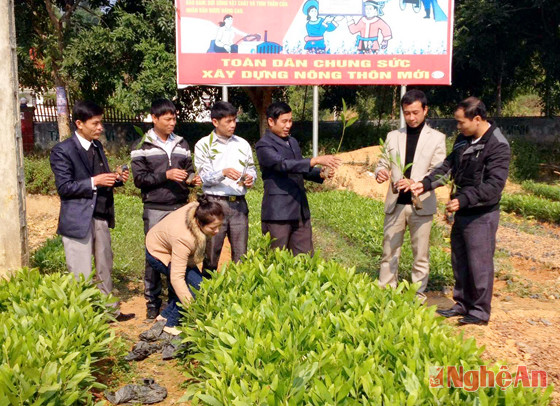 |
| Officials from the Tan Ky District Party Committee discussed with officials from the Tan Huong Commune Youth Union about the work of cultivating acacia seedlings to serve the raw material reforestation program. |
Regarding its organizational structure, the Tan Ky District Party Committee has 62 grassroots party organizations with 6,386 party members, including: 21 commune party committees, 1 town party committee, 6 party organizations under administrative agencies, 20 public service units, 12 enterprises, and 2 armed forces units; there are 430 branches directly under the grassroots party committees, of which: 341 branches directly under commune party committees, 13 branches directly under town party committees; 20 branches directly under the party committees of state-owned enterprises, 6 branches under the party committees of joint-stock companies, 27 branches under the party committees of administrative agencies, 11 branches under the party committees of public service units, and 12 branches under the party committees of armed forces units. Adding to this, the fact that ethnic minorities account for over 21%... This "richness" further demands that the Party Committee of the district devise solutions to effectively carry out the work of Party building and organization to consolidate and enhance the fighting capacity of the leading and guiding role in socio-economic development.
Embarking on a new phase of Party building and organization, the Tan Ky Party Committee continues to effectively implement Resolution No. 4 of the Central Committee (11th term) on "Some urgent issues concerning Party building today." Key highlights include: focusing on directing, inspecting, and supervising from the district level to the grassroots level the implementation of tasks that need to be done immediately after self-criticism; implementing solutions to overcome and correct shortcomings identified through self-criticism; focusing on the grassroots level to promptly address pressing and prominent issues; and reorganizing the staff of some departments and grassroots units that have limited effectiveness. The Standing Committee of the District Party Committee issued Directive No. 463/2014 on "Supervising tasks that need to be done immediately according to Resolution No. 4 of the Central Committee." With serious and decisive leadership, the Standing Committee of the District Party Committee has completed all 9 tasks that needed to be done immediately after self-criticism. For Party organizations, there were a total of 341 tasks, of which 298 have been completed; 38 are currently underway; and 5 new tasks have arisen. For departments, offices, and equivalent agencies under the district level, there were a total of 121 tasks; 112 have been completed; and 9 are currently underway.
The district also successfully organized a Central Committee workshop in Tan Ky, summarizing 30 years of reform on "Building the ruling Party, reforming the content and methods of Party leadership," which was highly appreciated by the Central Committee and the Provincial Party Committee. The Standing Committee of the District Party Committee has decisively led the "Plan to build a strong and comprehensive political system in all communes," achieving many results to date. It continues to implement two projects of the Party Committee on "Improving the quality of cadres in the political system of rural and town areas to serve the cause of industrialization and modernization in the period 2011-2015 and beyond" and the project "Improving the effectiveness of the rotation and transfer of leading and managerial cadres in the period 2011-2015 and beyond." Supervising the implementation of regulations assigning tasks to Standing Committee members and Executive Committee members to attend Party branch meetings under the Party committees of communes and towns... Through this, the quality, effectiveness, and leadership role of grassroots Party organizations have been enhanced. In implementing Plan No. 114-KH/TU dated February 8, 2014, of the Provincial Party Standing Committee on "Surveying the grassroots political system in religious areas," the District Party Standing Committee issued a district-level survey plan, directed grassroots units to conduct surveys according to the plan, and simultaneously implemented solutions to improve the political system in these areas.
Bringing about a transformation in personnel management.
First and foremost, we must trust and promote the capabilities of young cadres. Comrade Vi Hong Son, born in 1979, a member of the Thai ethnic group, was appointed Deputy Head of the District Agriculture Department and later transferred to become Chairman of the People's Committee of Tien Ky Commune, a locality facing many difficulties. However, Comrade Son has successfully carried out his duties in building new rural areas and developing the local economy and culture. Meanwhile, Comrade Chu Van Loi, born in 1981, was appointed Deputy Head of the Internal Affairs Department and has demonstrated strong advisory capabilities, earning high praise from the district leadership.
Comrade Loi shared: “Cadres, civil servants, and public employees must give their all, uphold their responsibilities, and do what is right and beneficial to the collective and the people.” Several other young comrades, currently holding leadership positions in communes and departments, promise a plentiful source of cadres for Tan Ky in the future. During the 2015-2020 term, for the first time, the District Party Committee's Standing Committee introduced and approved the rotation of many young cadres from district-level departments and agencies to key positions at the grassroots level. As a result, Tan Ky now has a team of young cadres serving as heads and deputy heads of departments and some key leaders in communes, constantly demonstrating dynamism and effective work closely aligned with reality.
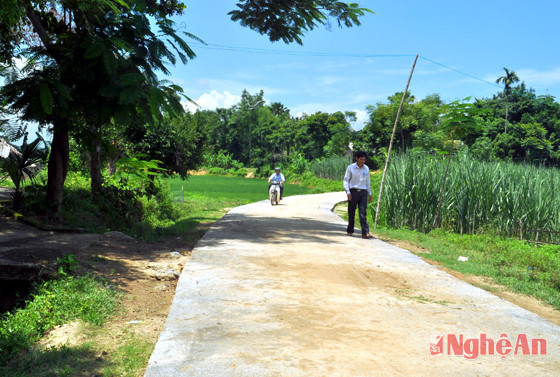 |
| A newly completed, standard concrete road has been built in Ke Gieng hamlet, Tien Ky commune, Tan Ky district. |
Regarding the evaluation of cadres, recognizing this as the weakest link in personnel management, the Tan Ky District Party Committee has recently developed and supplemented regulations on cadre evaluation, outlining specific policies, plans, and measures such as: distributing confidence-gathering questionnaires to district and grassroots cadres, suggesting focused year-end reviews; guiding grassroots units to fully implement all steps and procedures of evaluation… The subjects for evaluation include positions under the management of the District Party Committee Standing Committee, cadres who are members of the grassroots Party Committee Executive Board, members of the People's Committee and heads of mass organizations at the commune level; heads and deputy heads of departments, agencies, the Fatherland Front, and mass organizations at the district level. After the evaluation, the Party Committee directed grassroots units to replace cadres with excessively low confidence ratings, correct, remind, or review those with shortcomings or low confidence ratings. This approach requires cadres to constantly cultivate their ethics, hone their political acumen, and strive to continuously improve their professional skills and work performance. On the other hand, this is an important basis for Party committees at all levels to arrange and assign cadres.
To ensure that all officials are evaluated, the Standing Committee of the District Party Committee issued Project No. 06 on "Improving the quality of commune and town officials to serve the cause of industrialization and modernization in the period 2011-2015 and subsequent years" with 10 groups of solutions, in which the evaluation of officials is considered a fundamental measure. The evaluation content includes 10 aspects such as: sense of responsibility towards tasks; work efficiency; ethics, lifestyle, attitude towards serving the people; fulfillment of civic duties in the place of residence; sense of solidarity, self-awareness in learning and training...
Over the past two years, the evaluation of cadres, especially at the grassroots level, has become a well-established practice, having a significant impact on educating, deterring, and preventing cadres from violating regulations. Simultaneously, it has enhanced the sense of responsibility and public service ethics of grassroots cadres, leading to a noticeable improvement in their work efficiency. Following lessons learned from the grassroots level, the Standing Committee of the District Party Committee conducted an evaluation of district-level cadres and civil servants, allowing grassroots leaders to provide assessments. Through this evaluation, the Standing Committee and the Executive Committee of the District Party Committee directly reminded cadres exhibiting ethical and lifestyle violations, and promptly transferred or dismissed some cadres. This demonstrated the Party's strictness and helped cadres recognize their shortcomings and correct them.
Over the years, the review, development, and supplementation of personnel planning in the district have received due attention from Party committees at all levels, from the district to the grassroots. In addition, the District Party Committee Standing Committee has publicly and transparently implemented the planning, receiving strong support from grassroots Party organizations. Personnel planning has been carried out seriously, ensuring the structure and adherence to the Party's principles and viewpoints, with dynamic and open planning. Cadres included in the plan are gradually trained and improved in all aspects. The capabilities and strengths of cadres are utilized, ensuring continuity and development, and meeting the requirements for proactive placement and utilization both in the short and long term.
Training and professional development of cadres has been emphasized. To date, key cadres at the district level all possess a university degree or higher in their respective fields, as well as advanced or bachelor's degrees in political science. 97% of the district Party Committee members have a university degree in their respective fields; 100% have political science qualifications at the intermediate level or higher, with 83% holding advanced or bachelor's degrees. The majority of district-level cadres and civil servants have received basic training, with 100% possessing at least an intermediate level in their respective fields, including 131 out of 142 individuals holding a university degree or higher.
Regarding the rotation of cadres, the District Party Committee issued Project No. 07-DA/HU on "Improving the quality of cadre rotation," and simultaneously developed a specific rotation plan for implementation. This plan clearly defined the target groups, standards, rotation periods, and return dates. Importantly, those who performed their duties well or better were assigned to higher positions. As a result, after more than a year of implementation, the rotation and reassignment work has become well-established, and the rotated cadres are confident and enthusiastic in successfully completing their assigned tasks.
Mr. Phan Van Giap, Head of the Organization Department of the Tan Ky District Party Committee, stated: The process of electing, appointing, transferring, rotating, receiving, and promoting cadres, and designating additional Party committee members from the district to the grassroots level, ensures adherence to the principles and procedures stipulated by the Party and the State. The implementation process was flawless and achieved high consensus among cadres, Party members, and the people. In 2014, 18 comrades were transferred, reassigned, and reorganized (including one comrade transferred from the District Party Committee to become the Chairman of the Commune People's Committee); 21 comrades were elected and appointed to Party committees; 27 comrades were promoted and appointed; and in coordination with provincial-level agencies, 20 comrades were promoted, appointed, transferred, and had their policies implemented. The staff effectively reviewed and supplemented the planning of leadership and management personnel for the 2015-2020 term (A2, A3) from the district to the grassroots level, ensuring the process was correct, rigorous, and met standards, structure, objectivity, and strategic thinking. Regarding party membership, in 2014, 189 new members were admitted out of the planned 179 (including 2 Catholic members, accounting for 1.1%), achieving 106% of the plan.
The achievements in Party building and organization in 2014 serve as an important impetus for Tan Ky district to continue implementing the plan to build a strong and comprehensive political system at the grassroots level, thereby enhancing the leadership capacity and fighting strength of grassroots Party organizations; and as a prerequisite for the Party Committee and people of Tan Ky to successfully hold congresses at all levels for the 2015-2020 term, leading up to the 12th National Party Congress.
Pearl


