
TAN KY: Connecting with citrus trees
(Baonghean) - At this time, many families in Tan Long, Tan An, and Tan Phu communes (Tan Ky district) are tending to nearly 160 hectares of citrus trees that are in the basic development stage and 20 hectares that are bearing fruit. After many years of absence, citrus fruit trees, especially oranges, are gradually asserting their position and promising to bring economic benefits to the Tan Ky area.
Recognizing that Tan An is a suitable area for citrus fruit cultivation, and with a booming market for this fruit, Mr. Dau Tien Sy in Quynh Luu hamlet, Tan An commune (Tan Ky district) invested in planting 250 PQ1 mandarin trees in his hillside garden. Thanks to the favorable soil and good care, this mandarin variety is quite sweet and fragrant, with an average yield of 120 kg of fruit per tree. During each harvest season, traders often come directly to the garden to place large orders, almost always selling out, resulting in profits of 100 to 120 million VND annually.
Building on his initial success, Mr. Sy continued to invest in experimental cultivation of V2 and Van Du orange varieties – high-yielding orange varieties that are quite popular in Con Cuong, Quy Hop, and Nghia Dan districts. In 2008, when the trees bore their first fruits with a yield of 15 tons/ha, his family earned nearly 200 million VND. In subsequent years, especially from the fourth year onwards, the yield increased to an average of 30 tons/ha. Mr. Sy shared: “Growing citrus trees is not difficult; growers only need to diligently care for them using basic techniques to ensure a good yield. The market for the product is quite favorable because the Vinh orange brand already has a strong foothold.”
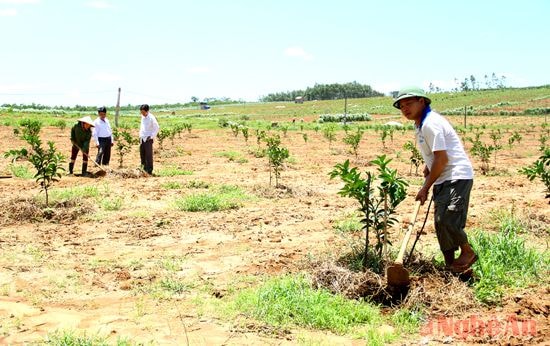 |
| Mr. Thai Doan Tai (Tan Xuan - Tan Ky) is tending to 1.6 hectares of newly planted orange trees. |
Over the years, An Ngai Agricultural Company Limited, located in Tan An commune, has made significant progress in citrus fruit cultivation. Currently, the company has over 65 hectares planted with various types of oranges, tangerines, pomelos, and lemons. Of these, 20 hectares are currently producing fruit, while the rest are in the initial stages of development. In the past two years, farmers have planted 15 hectares of new orange trees with the main varieties being Xa Doai, V2, and Van Du oranges. According to Mr. Chu Hoai Thanh, Deputy Secretary of the Party Committee of Tan An commune: “Currently, the yield from the areas already producing fruit is quite high. Farmers have a basic understanding of cultivation techniques, as An Ngai Farm was previously one of the key orange-growing areas in Tan Ky district, so they have considerable experience in this field.”
According to information gathered at Song Con Agricultural Company Limited, located in Tan Phu commune, the farm currently has nearly 100 hectares of citrus trees, primarily oranges, with 20 hectares of newly planted orange trees. Mr. Phan Thanh Hung, Deputy Director of the company, stated: “Through surveys, we found that the soil and natural conditions here are very suitable for orange trees, and the market for this fruit is quite open. Therefore, the farm has converted the rubber plantations damaged by this year's storm to orange cultivation. In the future, the farm will also convert the old rubber plantations, which are no longer productive, to citrus trees.”
In the first six months of 2015, Tan Ky district planted nearly 25 hectares of new orange and tangerine trees, mainly concentrated in the communes of Tan Long, Tan An, Tan Phu, and Dong Van. As one of the households with a relatively large area of orange orchards, Mr. Thai Doan Tai in Tan Xuan hamlet shared: “Currently, my family has nearly 1.6 hectares of orange trees, planted 7 months ago. We spray pesticides to prevent basic diseases and apply fertilizer according to the procedures guided by technical staff. Due to suitable soil and careful care, the trees are developing quite well, even during the recent prolonged hot weather. My family has cultivated this type of tree for a long time, so we now have quite a lot of experience in caring for them. Orange trees thrive with organic fertilizer, so we need to apply it according to the tree's growth cycle. We also need to dig trenches 20-30cm deep and 30-40cm wide around the tree canopy, put the fertilizer and lime in, and cover with straw after backfilling. This will ensure the trees grow well and bear abundant fruit.”
Regarding the recent trend of expanding orange cultivation areas, Mr. Nguyen Ba Thuc, Head of the District's Agriculture Department, stated: “In previous years, our province identified oranges, as well as other citrus fruits, as high-economic-value crops that need to be encouraged for development. The areas designated for concentrated orange cultivation are mainly in the districts of Con Cuong, Nghia Dan, Quy Hop, and Tan Ky, due to their suitable natural conditions and climate. To encourage the expansion of orange cultivation areas, the district recently organized visits for many farm owners and households to learn from the experiences of several districts with large orange cultivation areas and high yields, especially to study commercial orange farming models in the Phu Quy area. Based on the valuable experiences and lessons learned from practice, the district will have timely and appropriate support policies for orange growers, gradually forming a commercial orange production area that brings stable income to the people.”
The shift to growing oranges or other citrus fruits is a direction supported by many households here. However, this is a "high-value" crop, requiring significant investment, from land preparation and infrastructure development to seedlings, care time, and technical procedures. The process from land preparation to harvest takes nearly 5 years, and on average, one hectare of oranges requires an investment of about 250 million VND. Furthermore, ensuring proper techniques during cultivation places many stringent demands on growers. The current market is wide open, but will mass planting lead to price drops and difficulties in sales?
Mr. Nguyen Van Hoa, Vice Chairman of the Tan Ky District People's Committee, said: “In the 1960s, Song Con and An Ngai farms in Tan Ky district established many specialized orange cultivation areas with an area of over 400 hectares. However, after a while, this area deteriorated due to people using old varieties. On the other hand, citrus greening disease was rampant, forcing growers to cut down their trees without being able to replant or improve the soil. However, in recent years, the V2 orange and PQ1 tangerine varieties have been planted on more than 50 hectares in our province, showing disease resistance and stable yields. Some households in the district have also started planting them and have achieved quite high results. Currently, the district has more than 1,000 hectares of alluvial and hilly land suitable for developing citrus trees, including commercial oranges. Based on the favorable land conditions and the benefits that oranges and tangerines have brought to the people in recent years, the District People's Committee has decided to develop a plan to develop the area.” "We are focusing on commercial orange production and restoring the 'brand' of Tan Ky oranges. The district's plan is to expand the area of orange and tangerine cultivation to 200 hectares in the next five years."
Thanh Quynh


