
Tan Ky is experiencing water shortages for crop production.
By the end of May, Tan Ky district had finished harvesting the spring rice crop, and farmers were sowing seedlings and plowing the land in preparation for the summer crop. However, currently, up to 20% of the reservoirs and dams in the district have run out of water, and it is predicted that about 30% of the district's early summer rice crop land will lack water for production.
(Baonghean)By the end of May, Tan Ky district had finished harvesting the spring rice crop, and farmers were sowing seedlings and plowing the land in preparation for the summer crop. However, currently, up to 20% of the reservoirs and dams in the district have run out of water, and it is predicted that about 30% of the district's early summer rice crop land will lack water for production.
In Ky Tan commune, two dams are currently unable to provide irrigation water in the near future: the Nhom dam and the Cay Khe dam. The Nhom dam provides irrigation water for nearly 50 hectares, while the Cay Khe dam irrigates over 20 hectares of agricultural land. Visiting the Cay Khe dam during these extremely hot days, we observed that the water level had dropped below the dead water point, rendering it incapable of providing irrigation water. Locals reported that about half a month ago, the dam was almost completely dry, but a few days ago there was some rain, causing the water level to rise slightly, becoming muddy but only suitable for buffaloes to wallow in. Therefore, local people have dug many ditches at the bottom of the dam and are using pumps to draw water through the sluice gates for rice seedling cultivation. However, the sluice gates leading through the dam and the upstream irrigation system of the Cay Khe dam are damaged in many places, resulting in very weak water flow. This situation has been going on for quite some time, but the relevant authorities and departments have yet to find a solution.
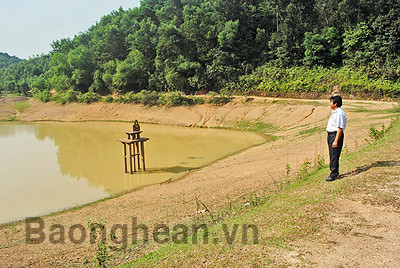
The Cay Khe dam in Ky Tan commune is running dry, and the sluice gate is damaged.
According to statistics from the District Department of Agriculture, 20% of irrigation works in Tan Ky district are currently experiencing water shortages. These include structures where water levels have reached a point where irrigation is no longer possible, such as the Dong Dang dam (Nghia Hanh district), the Hoa Binh dam (Nghia Phuc district), and the two dams in Ky Tan mentioned above. The reasons include prolonged hot weather, high rates of surface water evaporation, and water leakage and seepage through the dam structures.
Due to a lack of proactive irrigation water sources, many agricultural areas have opted to delay planting, as they need to wait for heavy rains before they can plant. Tan Ky district plans to plant 3,300 hectares this season, with 60% hybrid rice and the remainder being purebred varieties. Currently, seed and agricultural supply units in the district have prepared sufficient quantities to supply farmers promptly. However, according to the district's forecast, about 30% of the area will lack water for post-planting. Therefore, farmers are proactively switching to planting the Bao Thai rice variety. Although the district did not designate this variety for planting, because Bao Thai rice is drought-tolerant, farmers are planting it.
Given the current prolonged hot weather, the Tan Ky District People's Committee has directed local authorities to prepare plans to maximize water utilization in reservoirs and dams, such as using pumps to transfer water from the reservoirs to the sluice gates. The district is also using funds from irrigation fees and other sources to repair canals and drainage ditches to ensure efficient and economical water use.
Text and photos: Xuan Hoang


