
Creating new benefits for spring crops.
(Baonghean) - To date, Do Luong district has completed land consolidation and exchange in all communes, creating favorable conditions for farmers in the area to invest in intensive farming, increasing productivity and efficiency of crops in the fields.
| RELATED NEWS |
|---|
At this time, Mr. Nguyen Tho Chien, residing in Hamlet 4, Xuan Son Commune (Do Luong District), is completing land preparation on his rice fields with his family to plant spring crops. Speaking with us, Mr. Chien said that the yield of these crops on rice land is 3 to 4 times higher than that of rice, and the products are guaranteed to be purchased by Prex Vinh Garment Company and the Do Luong Market Trade Center. Thanks to this, in the spring of 2015, after completing land consolidation, he converted 1.5 hectares of rice land to specialized crop cultivation, investing hundreds of millions of dong in building barbed wire embankments, drilling irrigation wells, and developing a comprehensive economic model to enhance the value of his crops.
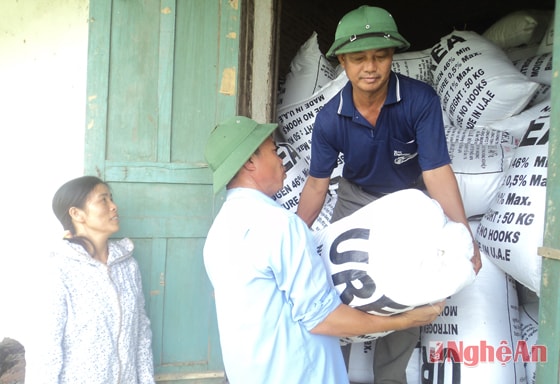 |
| Van Son Agricultural Service Cooperative (Do Luong) supplies materials to its members in preparation for the spring planting season. |
Xuan Son commune currently has over 310 hectares of double-cropping rice land. After land consolidation and exchange, the average agricultural land per household decreased from 5 plots to 1.75 plots. The entire commune has constructed 8.5 km of concrete irrigation canals, bringing water directly to the fields and plots. Vehicles carrying materials and mechanized machinery can easily access the rice paddies. Mr. Nguyen Viet The, Chairman of the Xuan Son Commune People's Committee, stated: The commune's goal for the 2015 spring crop is comprehensive intensive farming by converting some effective double-cropping rice land models. The commune is directing farmers to "share land" to form inter-household production groups, averaging 10 groups per hamlet and 1.5 hectares per field for high-quality rice production, thereby moving towards building large-scale model fields. The commune is converting some rice production models to specialized crop cultivation in cash crops, developing family farms on double-cropping rice land towards commercial production.
Each year, Van Son commune produces nearly 100 tons of rice seeds for sale on the market. Entering the spring planting season of 2015, with upgraded internal roads and irrigation systems, Van Son commune converted 210 hectares out of 340 hectares of hybrid rice to high-quality AC5 rice, an increase of 40 hectares compared to the previous year. Mr. Nguyen Dang Ha, Chairman of the Van Son Cooperative, said: "In practice, AC5 rice yields 7 tons/ha and sells for 10,000 VND/kg, higher than previous pure rice varieties (6,000 VND/kg). Therefore, if farmers produce rice seeds, they can earn 70 million VND/ha, almost double the income from pure rice production (42 million VND/ha)." Currently, the cooperative is contracting with Nghe An Agricultural Materials Joint Stock Company to guarantee the purchase of rice seeds from its members.
Entering the 2015 spring crop season, Do Luong district completed land consolidation and exchange, with an average land use of 1.7-2 plots per household, facilitating the introduction of mechanization into the fields, intensive cultivation of crops, and increased income. As of November 25th, the entire district had mobilized over 540,000 man-days of labor, excavated and filled 3.5 million cubic meters of earth for internal field roads, and repaired 22,000 meters of concrete irrigation canals, contributing to the effective exploitation and utilization of poor-quality land that previously lacked reliable irrigation water. The Khe Chuoi dam in Dai Son commune was upgraded, ensuring irrigation for nearly 100 hectares of rice fields. However, this year's spring crop season also coincided with the transition of production land after land consolidation and exchange, so farmers invested considerable effort in leveling the land, constructing internal field roads, and building field and plot boundaries. Furthermore, according to a report from the Do Luong District Irrigation Enterprise, currently two-thirds of the reservoirs throughout the district have water levels below 50% of their designed capacity. Rainfall is expected to decrease compared to the average of previous years, leading to a risk of drought…
Based on the above advantages and disadvantages, for the spring crop of 2015, Do Luong district set specific goals. These included: arranging a rational crop structure and planting schedule based on the production conditions of each region, ensuring crop safety; directing farmers to focus on comprehensive intensive farming from seedling sowing and land preparation to transplanting according to the set schedule; transforming the crop structure, especially in difficult areas, to improve production efficiency; and expanding the area of large-scale model fields to affirm the competitive advantage of agricultural products in the market.
Mr. Le Anh Son, Deputy Head of the Agriculture Department of Do Luong District, said: "The spring crop is the main production season, determining over 60% of the agricultural output and income for the year. For the 2015 spring crop production plan, the district scheduled rice planting from January 15th to February 15th, 5-7 days later than in previous years to avoid the risk of late-season cold weather affecting yield. The district's policy is to only include recognized high-yielding, good-quality rice varieties such as AC5, Nhi Uu 986, and Nhi Uu 986, minimizing the use of low-quality varieties. For corn, priority is given to promising varieties such as NK66, B.06, NK6654, and glutinous corn varieties; each commune will allocate no more than 3 hybrid corn varieties and 2 glutinous corn varieties." The Nghe An lotus peanut variety, L14, is also being prioritized for inclusion in the main crop structure... For flood-prone areas such as Hien Son, Quang Son, and Thai Son, production is being implemented 7 days earlier than the district's general schedule. The district encourages expanding the area for rice seed production in Van Son, Yen Son, and Thinh Son communes, with a scale of 120-150 hectares per crop. Currently, the district has contacted and invited units such as Bac Ninh and Bac Giang Seed Joint Stock Companies, Central Seed Company No. 1, and Thai Binh Seed Corporation to supply seeds and support the purchase of products from farmers at a price 1.4 times higher than the market price.
This spring, Do Luong district has allocated over 7,700 hectares for rice, 831 hectares for corn, over 1,100 hectares for peanuts, and hundreds of hectares for various vegetables and legumes. Compared to previous years, the rice area has decreased by nearly 300 hectares (due to land being mobilized for embankment construction and internal field roads), while the peanut and corn areas have increased significantly on converted rice land and less productive arable land. Currently, 80% of the winter vegetable crop on rice land is being harvested by farmers for sale. Despite being implemented under conditions where land consolidation and exchange have just been completed, most localities have ensured production progress. According to the directive, farmers will complete the winter crop harvest on rice land by December 20th. Many localities, after harvesting the winter vegetable crop on rice land, have proactively mobilized machinery and equipment to plow the land, preparing for planting the new crop. Many communes are investing in building integrated family farm models on rice land, typical examples being Hien Son, Xuan Son, Minh Son, and Giang Son Dong. The entire district is striving to launch a large-scale land preparation campaign by the end of December, and officially begin sowing and transplanting rice seedlings for the spring crop around the beginning of January 2015.
Luong Mai


