
Hawthorn berries can treat bloating.
According to traditional Chinese medicine, hawthorn fruit has a sour, astringent, slightly sweet taste and a slightly warm nature, which helps with digestion, treats stomach pain, bloating, heartburn, and stops diarrhea.
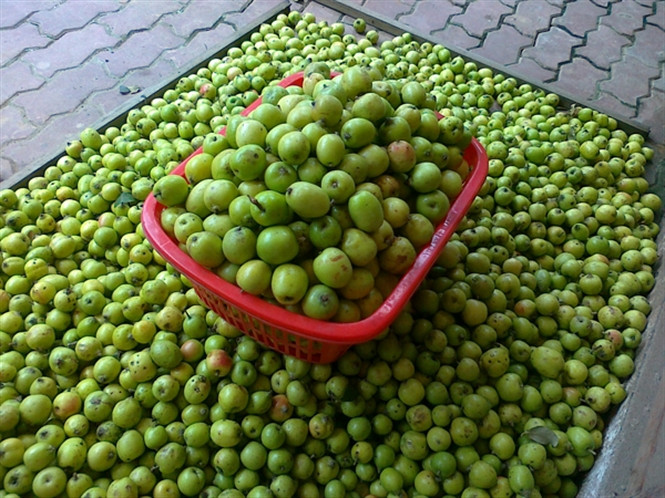
The wild apple tree, scientifically known as Docynia indica (Wall Dec), belongs to the Rosaceae family and is a familiar tree to the highlanders of Northwest Vietnam. It blooms with white flowers in late spring, and its fruit is harvested in autumn. The fruit is egg-shaped, with a sour and astringent taste, and is commonly found in provinces such as Lao Cai, Yen Bai, and Son La. The particularly delicious wild apples are those from Tram Tau or Mu Cang Chai.
 |
Traditional Chinese medicine holds that hawthorn fruit has a sour, astringent, slightly sweet taste and a slightly warm nature, with effects that aid digestion, treat abdominal pain, bloating, heartburn, and stop diarrhea. Modern medicine has analyzed many components such as tartaric acid, cretaegic acid, citric acid, saponins, sugars, vitamins, etc., and more notably, hawthorn fruit contains two alkaloids, crataegin and oxyacantin, which have cardiotonic, sedative, tonic, and analgesic effects.
Hawthorn berries can also boost immunity, lower blood lipids, and treat bloody stools... But for digestion, hawthorn berries are even more effective. The average dosage for decoctions, liquid extracts, powders, and pills is 10-20g. However, the liquid extract form is most commonly used.
For your reference and effective application of the medicinal effects of hawthorn fruit, here are some typical remedies using hawthorn fruit.
- Digestive aid: 25g hawthorn berries, 25g lemongrass, 25g Sophora japonica peel, 25g Syzygium aromaticum bark, 25g tangerine peel, 40g Dioscorea opposita root, 20g fresh ginger, 10g calcined alum. All ingredients are dried, roasted until crispy, and ground into a fine powder. Adults take 2 teaspoons daily with warm water. Children take 1 to 2 teaspoons depending on age.
Alternatively, take 12g of roasted hawthorn berries, 12g of lemongrass, and 16g of tangerine peel, decoct with 500ml of water until only 200ml remains, divide into 2 doses per day for adults, and 3-4 doses per day for children depending on age.
- To stimulate digestion: Wash 200g of hawthorn berries, remove the seeds, and soak them in 300ml of rice wine. After 7-10 days, drink 20ml twice a day before meals. Once the wine is finished, mix the remaining pulp with sugar and eat gradually.
- Method of preparing liquid extract: Take ripe hawthorn berries, cut them horizontally into slices about 0.4 cm thick, then dry them in the sun or in a dryer. For every 1 kg of dried herbs (without seeds), add 5 liters of water and decoct until only 1 liter remains. Strain the liquid, then add another 3 liters of water and decoct until only half a liter remains. Strain the liquid again. Mix these two decoctions together and concentrate until only 1 liter remains.
Add 800g of malt candy or sugar to the water, stir until dissolved, then simmer until only 1 liter of liquid remains. Let cool, then add 40ml of 50% alcohol infused with dried tangerine peel or star anise. Drink twice a day, one tablespoon (about 30ml) each time. Use for indigestion, bloating, flatulence, to stimulate digestion, and to lower blood cholesterol...
- To treat bloating: Take 30g of dried hawthorn berries, boil them in water and drink the decoction as a substitute for tea throughout the day. Continue this for 2-3 days.
- Treatment for dyslipidemia: 50g of hawthorn berries, 50g of rice, and a sufficient amount of rock sugar. Slice the hawthorn berries and cook them with the rice to make porridge. Then add rock sugar to taste, and eat it in several portions throughout the day.
Take 15g of hawthorn berries and 15g of lotus leaves, boil them to make a decoction, and drink it throughout the day instead of tea. A course of treatment lasts 15 days. Take a break for a few days and then continue.
To treat high blood pressure and prevent complications: Use one of the following two methods.
- This remedy has the effect of dispelling wind, dispersing heat, calming the liver, lowering blood pressure, and lubricating the intestines, making it suitable for people with hypertension accompanied by chronic constipation: It consists of 12g of roasted hawthorn berries, 12g of Cassia seed, and 9g of white chrysanthemum flowers. These three ingredients are dried, finely ground, and steeped in boiling water in a sealed container. After 20 minutes, it is ready to use. Drink it throughout the day instead of tea.
- This method is effective in tonifying Qi and activating blood circulation, benefiting the heart and strengthening the brain, and is suitable for people with hypertension accompanied by cerebral circulatory disorders (manifested by fatigue, shortness of breath, reluctance to exercise, poor appetite, and excessive sweating...). It consists of 12g of hawthorn, 45g of Astragalus membranaceus, 20g of Pueraria lobata, 20g of Loranthus parasiticus, and 30g of Salvia miltiorrhiza. Boil these ingredients in water twice, mix the resulting decoction, and concentrate it to about 300ml. Divide this into several doses and drink throughout the day. Each course lasts 15 days, followed by a 20-day break before resuming treatment.
- This method is effective in nourishing yin and cooling blood, suitable for people with yin deficiency of blood pressure, manifested by thinness, hot palms and soles, mild fever in the afternoon, dry mouth and throat...
Ingredients: 200g Rehmannia glutinosa, 500g hawthorn berries, 100g white sugar. Wash the Rehmannia glutinosa and slice it. Remove the seeds from the hawthorn berries and slice them. Boil these two ingredients until very soft, then add the sugar and mix until a smooth paste is formed. Take 2 tablespoons three times a day for 20 consecutive days.
According to Alobacsi.vn


