
The probe has discovered a mysterious rock on Mars.
According to an announcement on January 23rd by the US National Aeronautics and Space Administration (NASA), the small, round rock was discovered from photographs taken on January 8th by the Opportunity rover.
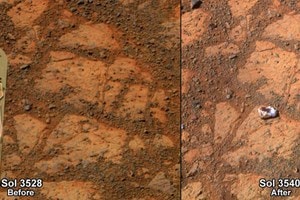 |
| (Source: nytimes.com) |
The stone has a transparent red core and a white exterior.
NASA experts believe the rock's red color is an unusually deep red, different from the red of rocks and soil found on the surface of Mars.
Explaining the unusual color of the rock, Steve Squyres, an expert on the Mars exploration program, suggested that the red soil is part of an underground layer that has not been exposed to the Martian atmosphere for billions of years. According to scientists, this piece of rock was lifted from the ground by the impact of the Opportunity rover's movement.
Microscopic observation revealed that the object was a type of rock not found on Earth. Scientists named it "Pinnacle Island." Analysis from the spectrometer on board the Opportunity rover showed that the rock's texture was unprecedented, containing high levels of sulfur and a high concentration of manganese and magnesium.
Squyres said this will be a long-term project and scientists are conducting detailed measurements of the chemical composition. The expedition team plans to search for the origin of the rock.
In addition to discovering the strange object, NASA's announcement on the same day also stated that the Opportunity rover had found further evidence suggesting that the Red Planet once had freshwater, reinforcing the earlier discovery by its sibling, Curiosity.
Exploration and analysis of water-bearing rocks in the Endeavour crater area have uncovered white clay formed from water with a neutral pH, possessing properties similar to drinking water.
The new discovery has further strengthened the scientific hypothesis about the history of the Red Planet, according to which most of the activity related to life on Mars was concentrated in the first billion years.
During this period, temperatures on the Red Planet were warmer and there was fresh water on the surface. Gradually, this water source dried up and acidified, and starting about 3 billion years ago, Mars became arid.
The Opportunity rover has been operating on Mars for 10 years, even though it was designed for a mission lasting only 90 days on the Red Planet. Its mission has been extended several times as it continues to discover new things on Mars. Opportunity is scheduled to continue its southward journey to find more evidence for analysis.
According to VNA


