Vietnam's upgraded anti-tank missiles are now capable of penetrating 750-800mm of steel armor after defeating explosive reactive armor (ERA).
 |
| Anti-tank missiles are currently one of the most effective tank-destroying weapons on the battlefield. In the Vietnam People's Army, anti-tank missiles (the B72 missile – the Vietnamese designation for the Soviet 9M14 Malyutka projectile) entered service in 1968 and proved their superior power by destroying countless M41 and M48 tanks of the US and South Vietnamese armies. (Image source: QPVN Channel) |
 |
| However, the rapid development of modern main battle tanks, equipped with various advanced armor types, necessitates an upgrade of anti-tank missiles. Currently, anti-tank missiles have reached the 4th generation worldwide and are continuously being improved and upgraded, considered the 5th generation. In Vietnam, however, domestically produced anti-tank missiles are still only at the 1st generation (B72) and 2nd generation (9K111 Fagot). Image source: QPVN Channel |
 |
| Faced with the urgent need to modernize anti-tank missiles, Colonel Nguyen Thanh Binh, Head of the Missile and Special Equipment Engineering Department (Department of Military Engineering, General Department of Engineering), shared some good news in an interview with the People's Army Newspaper Online: “Anti-tank missile systems, including ammunition and equipment (launchers, control stations), which are planned for use until 2020 and beyond, are currently undergoing technical and tactical improvements and upgrades by the Vietnamese Army.” (Image source: QPVN Channel) |
 |
| Improvements focused on anti-tank missiles with dual warhead (Tandem) and thermobaric warheads. (Image source: Wikipedia) |
 |
| Specifically, the improved anti-tank missile features a dual-warhead design, replacing the old warhead with a Tandem warhead (two explosive charges) and new propellant, while retaining the missile body and other components. After the upgrade, the missile is capable of penetrating 750-800mm of homogeneous steel after breaking through the explosive reactive armor. The improved missile has a speed of up to 135m/s and can destroy new-generation main battle tanks at ranges from 500m to 3,000m. (Image source: Wikipedia) |
 |
| The missile was improved to carry a thermobaric warhead, including: replacing the warhead and propellant with new ones, while retaining the missile body and other components (control unit, gyroscope, steering mechanism, electric ignition...). Upon detonation, the missile creates a pressure zone of 0.3 Bar, 7m from the center of the explosion, and produces a stronger effect when destroying fortified targets such as bunkers, enclosed fortifications, pillboxes, and buildings. The average flight speed of the improved missile is 120 m/s and it is capable of destroying targets at a range of up to 3,000 m. Image source: Wikipedia |
 |
| All anti-tank missiles share a common improvement: replacing the propellant in the cruise engine to increase range and flight speed. The average speed of the improved missile is increased by 12.5%, and the flight time is shortened to approximately 3 seconds at maximum range. The warhead replacement ensures higher combat effectiveness. (QPVN Channel) |
 |
| The missile's control system and launch platform have also been improved, ensuring operation in both manual and semi-automatic guidance modes. (Image source: QPVN Channel) |
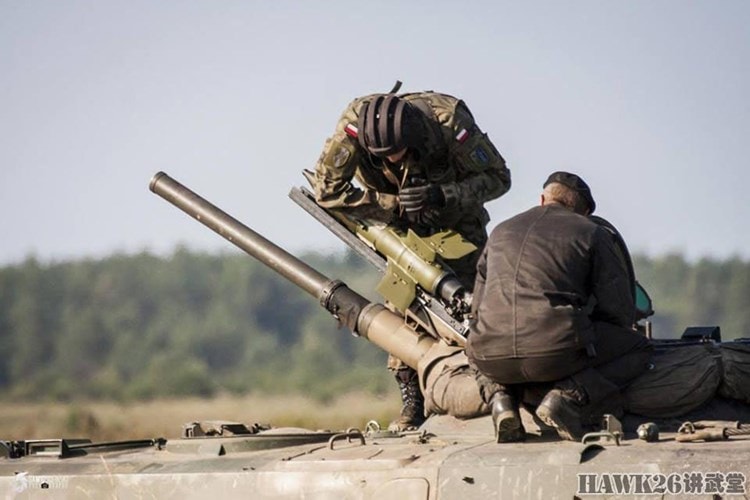 |
| According to Colonel Nguyen Thanh Binh, the Vietnamese Army has now completed phase 1 of the anti-tank missile upgrade project. The upgraded missiles have been successfully test-fired. The General Department of Engineering is currently preparing to conduct a demonstration firing of the upgraded anti-tank missiles to report to the Party, State, and Ministry of National Defense. (Image source: Hawk26) |
 |
| According to the People's Army Newspaper, the Missile and Special Equipment Engineering Department directed and coordinated with the technical forces of various units to provide technical support for live firing of improved anti-tank missiles on BMP armored vehicles of the Armored Corps. In the photo: A foreign army's BMP-1 launching a B72 anti-tank missile. Image source: Hawk26 |
According to Kienthuc



