
Tet "gathering medicinal herbs" in Con Cuong
(Baonghean) - In the Thai, Tay, and Muong communities in Con Cuong (Nghe An), besides the Lunar New Year and Independence Day on September 2nd, the Dragon Boat Festival (the 5th day of the 5th lunar month) is also a major joyous occasion of the year, to remember the gratitude owed to ancestors and for family reunions. On this day, people also go into the forest to gather medicinal herbs...
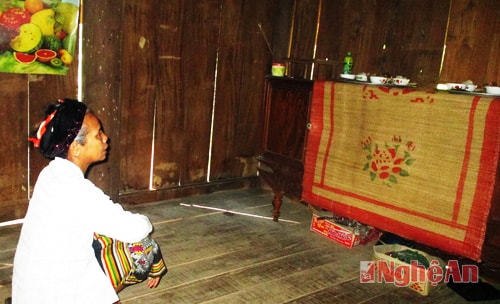 |
| Offering prayers before the ancestral altar. |
In villages where the Dragon Boat Festival is still celebrated, few remember when this holiday originated. Even the oldest residents, like Mr. Luong Phuc in To village (Yen Khe - Con Cuong), only remember that he was born on the 5th day of the 5th lunar month. Later, when he learned to read and listen to the radio, he learned that people in the lowlands also have a similar festival. They call it the Dragon Boat Festival. Some call it the "Insect Extermination Festival." Everyone has their own name, but the festival itself is the same: the 5th day of the 5th lunar month. The Thai people in Con Cuong simply call it the "5th Day of the 5th Lunar Month Festival."
In the past, in self-sufficient communities, people would prepare chickens for this day as early as the first lunar month. With the warmer weather in the first lunar month, young chickens in the coop were selected for the offering on the fifth day of the Lunar New Year. Chickens offered on the fifth day of the Lunar New Year were usually well-cared for and therefore fatter and healthier than regular chickens. Some families offered a rooster, but the Luong family of Mr. Phuc didn't necessarily need a rooster or a hen; as long as it was a healthy, fat chicken. Sugarcane molasses, used to cook mung bean porridge and black bean porridge, was also an important item on the offering tray for the fifth day of the Lunar New Year.
On the fifth day of the Lunar New Year, everyone in the house wakes up early. Although they don't slaughter pigs like during the Lunar New Year, they still slaughter chickens to offer to their ancestors. People only celebrate the fifth day of the Lunar New Year for one day, but the festive atmosphere is very strong. In the villages of Nua, To, Na Pha (Yen Khe commune), and some villages in Chi Khe commune, the people collectively celebrate this day as a real festival. Only a few clans in these communities do not celebrate this holiday.
A crucial part of the fifth day of the Lunar New Year for the Tay Muong ethnic group in Con Cuong is the offering trays. In To village (Yen Khe commune), besides wine (usually two cups), two plates (bowls) of sticky rice, one chicken, and two cups of green tea, the offering tray must include two bowls of mung bean porridge cooked with molasses. Nowadays, people can also use sugar to cook the porridge, as long as it tastes sweet. This offering tray is placed on the ancestral altar, and the homeowner will offer prayers inviting their ancestors to celebrate the New Year.
Besides the offerings to the "household spirits," on the 5th day of the Lunar New Year, each family must also prepare a feast to offer at the ancestral temple of their entire lineage. Like people in the lowlands, the Tay Muong Thai group in Con Cuong also has a family temple. This is also an occasion for everyone in the lineage to gather and eat. The gathering place is usually at the head of the lineage's house. If the lineage has a grand and spacious temple, like the Vi family temple in Lien Dinh village (Chi Khe commune), then the temple can also be the place for all families in the lineage to gather and eat. In addition to the offerings to ancestors and the family, on the 5th day of the Lunar New Year, the Tay Muong Thai group in Con Cuong also prepares a feast to offer to the parents-in-law of the host's wife, as well as the parents-in-law of the children in the family. In the past, in multi-generational families, the matter of preparing feasts to offer to related family members was very complicated. A household often had 3 or 4 generations, so it was normal for several married couples to live together in one house. Once married, Thai people have an obligation to visit their wife's parents and the matchmaker's grandparents during Tet (Lunar New Year). Therefore, on a small holiday like the fifth day of Tet, some families would prepare up to ten trays of food to offer as gifts. However, nowadays, these cumbersome customs are gradually being abolished, and the trend of two-generation families is becoming increasingly common in the Thai community in Con Cuong. As a result, the preparation of food trays and offerings during Tet has become simpler.
There's a rather unique custom on the 5th day of the 5th lunar month in Con Cuong: it's the only day of the year for gathering medicinal herbs. People believe that on this day, many plants in the forest and gardens become precious medicinal herbs. Those already considered valuable herbs are believed to be most effective when gathered on this day. The herb gatherers are usually women from the household, possessing basic knowledge of medicinal plants. The gathering time is usually chosen at noon. Before setting off into the forest, they light incense and pray before the ancestral altar, asking for guidance to find the precious herbs. Once in the forest, before picking the first herb, they pray to the local deity (chàm đìn, chàu nhà) for permission to take home and use. The herbs gathered on this day are believed to bring health and spiritual nourishment to those who use them. The herbs are then boiled and consumed daily. Therefore, the 5th day of the 5th lunar month is also known as the "herb gathering" festival.
Huu Vi