
I won't be coming home for Tet this year.
Nghe An is one of the provinces with the largest number of migrant workers nationwide, mainly concentrated in markets such as Taiwan, Malaysia, Japan, South Korea, and the Middle East. Visiting families with relatives working abroad during the Lunar New Year season, one can truly understand their feelings…
(Baonghean)Nghe An is one of the provinces with the largest number of migrant workers nationwide, mainly concentrated in markets such as Taiwan, Malaysia, Japan, South Korea, and the Middle East. Visiting families with relatives working abroad during the Lunar New Year season, one can truly understand their feelings…
Tet, the Lunar New Year, is a time for family reunions. No matter where they are, people try to save money and arrange time to return home to celebrate Tet with their families. This is the heartfelt wish of everyone, both those living far away and those at home. However, not everyone can fully enjoy this happiness, especially migrant workers. In many countries, the Vietnamese Lunar New Year doesn't even coincide with the local holidays, so it's common for Vietnamese workers to still have to work overtime.
Many families with relatives working far away feel a pang of sadness when Tet (Lunar New Year) arrives and the reunion is incomplete. Nghi Hai Ward (Cua Lo Town) is one of the localities with a relatively large number of people working abroad. In the days leading up to Tet, visiting this rural area reveals a somewhat quieter atmosphere. Mr. Vo Tai Dong's family in Hai Binh ward shared: "We have four children, three daughters and one son. The two older sisters are married, the eldest is all the way in Dong Nai, and our youngest son, born in 1989, went to work in South Korea after finishing school, and has been there for over four years. This year, our third daughter also went to South Korea seven months ago. So, two of our four children are celebrating Tet (Lunar New Year) in South Korea, and our eldest daughter is in Dong Nai. In the last days of the year, our children are even busier with work. When they call to ask how the family is preparing for Tet, we feel so sorry for them, but we have no choice. What's even sadder is that for the past four years, our only son has only come home once, and he's been absent every Tet." Mr. Dong's wife confided: "Every mother loves her child, especially her youngest son. During Tet (Lunar New Year), if we have acquaintances over there, we can send some gifts from home and Tet supplies for him. Otherwise, we just have to accept it. We love him, but all we can do is encourage him to try his best to complete his work."
Nguyen Thi Hoa's family situation is different. In 2007, her husband packed his bags and left for Spain to work abroad, leaving her alone to care for their two children (the older one in 5th grade, the younger one only 5 years old). Since then, for the past five years, the four of them have celebrated Tet (Lunar New Year) without a husband and without a father. She confided, "Because of the need to make a living, I have to accept the lack of affection. Since my husband went to work abroad, the family's finances have improved, but the atmosphere in the house is always devoid of a man's presence." All the preparations for Tet fall on the woman's shoulders, from visiting both sides of the family, shopping, and tidying up to prepare for the Spring Festival—she handles it all herself. Her two children, one in 10th grade and the other in 4th grade, occasionally ask why their father is taking so long to come home? Will he come home for Tet? At those times, she can only comfort them, "Dad is working to support you, be good and study hard and wait for him to come home." Every Lunar New Year, seeing other families gathered together, she feels sorry for her husband abroad who is trying to earn money to build a family life, and this makes her even more determined to complete her work at home perfectly.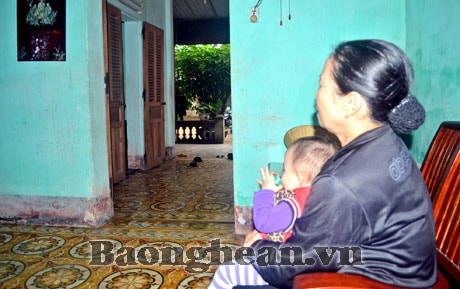
Ms. Nguyen Thi Ly (Cua Lo) has a son who has been working abroad in South Korea for 5 years and hasn't returned for Tet (Lunar New Year).
That's the situation for families whose relatives have been working abroad for a long time. But for those families whose Tet (Lunar New Year) in 2013 is their first Tet away from their husbands and children, they have their own unique feelings. For Ms. Phan Thi Nam in Hamlet 3 (Quynh Doi - Quynh Luu), this is the first Tet she and her husband are apart. In 2012, Mr. Ho Sy Toan went to work in Malaysia, so this year, the young wife and her two small children—the oldest only 6 years old and the youngest still in kindergarten—have to celebrate Tet without the warmth of a husband and father. In previous years, with her husband at home, preparing for Tet was easier, but this year, even on the 20th of the lunar month, she hasn't prepared anything yet. This is partly due to her work, farming, and the burden of caring for two young children alone. She confided sadly, "Since my husband went to work abroad, I moved in with my sister-in-law (Nam's younger brother also went to Malaysia), so the two of us live together to keep each other company and avoid feeling lonely at home. Other women have husbands at home, so the Lunar New Year is much warmer and more joyful. But for the sake of our children's future and our livelihoods, we have no choice but to accept it."
The Lunar New Year is a time for family members to gather together, sharing stories about the past and the coming year. However, not everyone gets to experience those sacred and warm moments with their family. Mr. Nguyen Phuc Son (from Vinh Tan ward, Vinh City), who recently returned from working in South Korea, said: “Four years ago, I applied to work in South Korea. For three years, I couldn't visit home even once, especially during Tet (Vietnamese New Year). Being abroad and unable to return for Tet made my family back home sad. But actually, if my family back home is sad, those of us far from home are ten times sadder. Celebrating Tet in a foreign land is very lonely. Although the company still gives us a few days off during Tet, I miss home, my friends, and the Tet atmosphere in Vietnam so much! Although there are many other Vietnamese people there, almost everyone shares the same feeling, so we Vietnamese organize our own Tet celebrations to ease the sadness. Now that my contract has ended, I'm able to return home to reunite with my family. Tet is coming soon, and I'm trying my best to prepare a proper Tet celebration with my family after months of separation.”
All the families we met shared the same feeling: longing, affection, and the inevitable absence, but they all tried to encourage each other to overcome it for the sake of work and life, waiting for tomorrow, the day of reunion…
Hong Quang


